
In This Article
Need fishing reel or tackle parts? Upload drawings for a quote
Direct Answer
When a baitcasting reel casts, the spool spins at high speed on its own inertia while the lure slows down under air resistance. If the spool turns faster than line leaves it, the extra line loosens and tangles: a backlash. A casting brake applies the right amount of resistance to the spool during the cast.
- Centrifugal brake: brake blocks on the spool are thrown outward by centrifugal force and rub against a brake ring. Braking rises steeply with speed, so it is strong early and weak later, letting line flow freely late in the cast; as a friction brake, it is affected by wear, oil, temperature and humidity.
- Magnetic brake: uses eddy-current resistance created when magnets sit close to a conductive spool. Braking is roughly proportional to speed and acts throughout the cast, with no contact wear, easy adjustment and good consistency.
The right choice depends on target lure weight, application and price point. Either way, braking performance depends heavily on manufacturing quality: spool weight and runout, the gap between magnets and spool, brake ring roundness and surface, brake block dimensions and spool bearings all directly affect casting stability and batch consistency.
01|Why Baitcasting Reels Need a Casting Brake
During a cast, the spool rotates as line pays out. The problem is that the spool and the lure slow down in different ways:
| Phase | Spool | Lure | Risk |
|---|---|---|---|
| Start of cast | Accelerates from rest to very high speed | Moving fastest | Spool overruns; the most common backlash point |
| Mid-flight | Keeps spinning on inertia | Gradually slowed by air resistance | Spool outruns the line, which starts to loosen |
| Late flight | Speed drops | Keeps slowing | Too much brake costs casting distance |
| Splashdown | Still spinning | Stops suddenly | The angler must thumb the spool |
A casting brake therefore has to balance preventing backlash against preserving casting distance. Spool weight and inertia matter as well: the lighter the spool, the faster it starts and stops, the less it tends to backlash, and the better it suits light lures.
Most baitcasting reels also have a mechanical cast control knob that presses on the end of the spool shaft. It removes axial play from the spool and adds basic resistance. It is a separate mechanism from the centrifugal and magnetic brakes discussed below.
02|Centrifugal Brakes: The Faster the Spool, the Harder They Brake
A typical centrifugal brake has several radial pins on the side of the spool, each carrying a sliding brake block, and a brake ring inside the side plate. As the spool spins, the blocks are thrown outward by centrifugal force and rub against the ring, creating braking force.
- Braking behavior: centrifugal force is proportional to the square of rotational speed, so braking is strong early in the cast and fades quickly as the spool slows. There is almost no braking late in the cast, so line flows freely, which helps distance.
- Adjustment: usually by changing how many brake blocks are engaged; some reels also have an external dial on the side plate.
- Watch points: as a contact friction brake, the blocks and ring wear. Oil on the brake ring, or changes in temperature and humidity, change the friction coefficient and therefore the braking force.
03|Magnetic Brakes: Acting Throughout the Cast, With No Contact Wear
A typical magnetic brake has a ring of magnets inside the side plate, close to a conductive part of the spool (usually the aluminum spool itself or a conductor ring inside it). As the spool spins, the magnetic field induces eddy currents in the conductor, and the eddy currents create a force that resists rotation.
- Braking behavior: braking force is roughly proportional to speed and acts throughout the cast, giving an even, predictable feel.
- Adjustment: usually a dial changes the distance or overlap between magnets and spool, which is convenient for anglers who change lure weights often.
- Watch points: there is no contact wear, so behavior changes little over time; but because it also brakes late in the cast, it can give up a little distance when maximum casts are the goal. Braking force is very sensitive to the gap between magnets and spool.
04|The Two Brakes Compared
| Item | Centrifugal brake | Magnetic brake |
|---|---|---|
| Principle | Friction between brake blocks and brake ring | Eddy-current resistance from magnets in a conductive spool |
| Braking vs. speed | Roughly proportional to speed squared | Roughly proportional to speed |
| Main braking phase | Strong early, fades quickly | Throughout the cast |
| Wear | Blocks and ring wear | No contact wear |
| Environmental sensitivity | Oil, temperature and humidity affect friction | Low |
| Adjustment | Number of engaged blocks, or an external dial | External dial changing magnet distance or position |
| Best suited to | Distance casting, experienced anglers | Light lures, beginners, frequent lure changes |
| Key to production consistency | Brake ring roundness and surface; block dimensions and material | Magnet-to-spool gap, magnet strength, spool conductor |
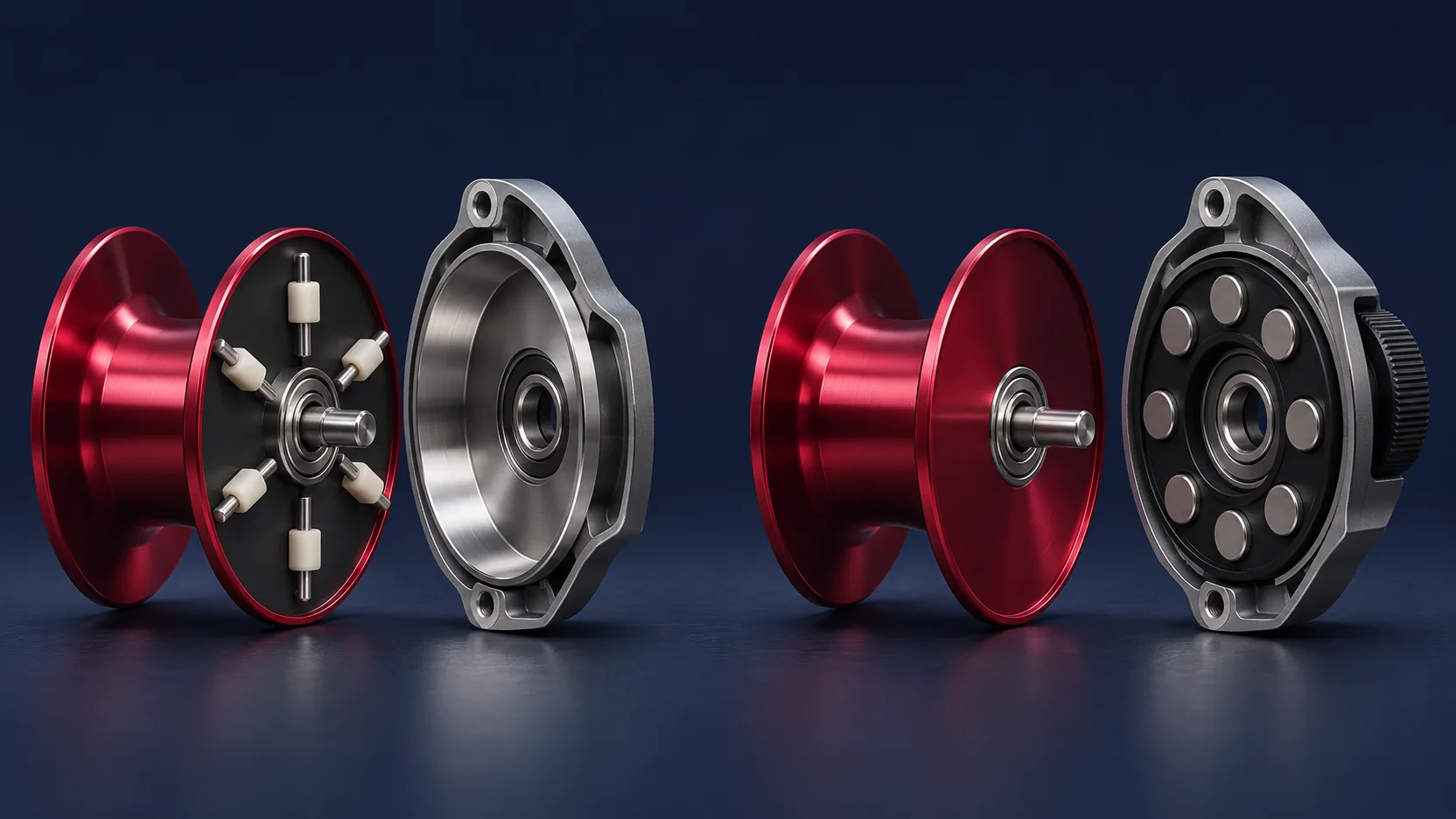
Figure: Schematic illustration. Left, a centrifugal brake: blocks on the spool are thrown outward and rub against the brake ring inside the side plate. Right, a magnetic brake: magnets inside the side plate sit close to the spool, and an external dial adjusts the braking force.
05|Other Brake Types
- Centrifugal plus magnetic: using both brakes to combine strong control early in the cast with stable braking throughout.
- Variable magnetic: centrifugal force moves the magnets, so the magnetic brake’s characteristic changes with speed and behaves more like a centrifugal brake.
- Electronically controlled brakes: a circuit controls braking force based on spool speed; cost and development effort are higher.
For a new brand, we usually recommend starting with a proven centrifugal or magnetic design and focusing on manufacturing consistency, rather than chasing a complex mechanism from day one.
06|Manufacturing Factors That Affect Brake Consistency
When some reels of the same model cast well and others backlash easily, the cause is usually manufacturing variation rather than design.
| Part or factor | Effect on braking | How to control it |
|---|---|---|
| Spool weight and inertia | Different weights give different startup and braking feel | Control wall thickness and material; sample-check weight in production |
| Spool runout and balance | Runout causes vibration and noise and changes the magnet gap or brake contact | Manage as CTQs; re-check in the final condition |
| Magnet-to-spool gap | A small change in gap noticeably changes magnetic braking force | Control the magnet holder position, spool axial position and shims |
| Magnet strength | Inconsistent magnets give different braking at the same setting | Sample-check incoming magnets; fix supplier and specification |
| Spool conductor material and thickness | Aluminum alloys differ in conductivity, so a material change alters magnetic braking | Fix the alloy grade; re-validate after any change |
| Brake ring | Roundness, concentricity and roughness affect centrifugal brake contact and friction | Control machining and surface condition; keep clean |
| Centrifugal blocks and pins | Dimensions, material and how freely the blocks slide affect braking | Control dimensions and material; check sliding |
| Spool bearings and shaft | Different rotational resistance changes both distance and brake feel | Specify bearings and lubrication; control fits |
For spool runout and balance, see How Fishing Reel Spools Are Machined; for side plate distortion and location, see Why Fishing Reel Frames and Side Plates Deform.
07|How to Validate a Casting Brake
| Method | Purpose |
|---|---|
| Spool free-spin comparison | Spin the spool the same way each time and compare spin duration and smoothness |
| Real casting tests | Cast with different lure weights and brake settings; record distance and backlashes |
| Brake setting comparison | Confirm that each setting changes braking evenly and predictably |
| Batch consistency comparison | Sample several reels from one batch and compare under the same conditions |
| Benchmark comparison | Compare casting feel against benchmark reels under the same conditions |
| Endurance validation | For centrifugal brakes, confirm behavior after block and ring wear |
Real casting tests are strongly affected by the caster and the environment. Fix the tester, rod, line, lure and location, and combine casting tests with methods such as free-spin comparison.
08|Information to Include in Your RFQ
| Information | Why it matters |
|---|---|
| Target lure weight range | Determines spool weight and brake characteristics |
| Main application | Finesse, general purpose, distance casting, saltwater and so on |
| Brake type | Centrifugal, magnetic or combined, and whether it is specified |
| Adjustment | Number of settings and external dial requirements |
| Spool material and weight target | Affects inertia and magnetic braking force |
| Benchmark reels | Used to compare casting feel and brake behavior |
| Expected volume | Determines how spools and side plates are made, and tooling investment |
09|How Zhongde Can Help
- Brake-related parts: spools, side plates, brake rings and magnet holders can be machined to drawing, with spool runout, weight and magnet holder position managed as critical characteristics.
- Assembly validation: spool free spin and brake adjustment can be checked in the assembled reel.
- Baitcasting reel OEM: MOQ of 200 units for baitcasting reels; other reel types can be considered with sufficient volume.
- NDA first: check “An NDA is required first” in the RFQ form, and we will complete the NDA before reviewing your drawings.
Zhongde has worked with Japanese customers for more than 18 years, producing reel parts with demanding cosmetic and quality requirements.
Frequently Asked Questions
Which is better, a magnetic or a centrifugal brake?
Neither is better in every case. A centrifugal brake brakes hard early in the cast and fades quickly, so line flows freely later on; it suits experienced anglers who want distance, but it is affected by wear and oil. A magnetic brake acts throughout the cast with no contact wear, is easy to adjust and consistent, suits light lures and beginners, and is easier to keep stable in mass production. Decide based on target lure weight, main application, target users and price point.
Why do baitcasting reels backlash?
During a cast the spool spins at high speed on its own inertia while the lure slows under air resistance. If the spool turns faster than line leaves it, the extra line loosens and tangles. Backlash is most likely right at the start of the cast, when the spool accelerates fastest, and when the lure hits the water and line suddenly stops. The casting brake, spool weight and casting technique all affect how severe it is.
Why do some reels of the same model cast well while others backlash easily?
The usual cause is manufacturing variation. Differences in spool weight and runout, the gap between magnets and spool, magnet strength, brake ring roundness or surface condition, centrifugal brake block dimensions and spool bearing friction all make the actual braking force differ at the same brake setting. These items should be managed as critical characteristics and compared within each batch by casting or spin tests.
Which brake suits light-lure finesse casting?
Light lures usually need a low-inertia spool and fine, predictable braking. Magnetic brakes are common here, and some centrifugal brakes are designed specifically for light lures. Spool weight and spool bearing resistance often matter more than the brake type. The right setup should be confirmed by real casting tests against the target lure weight range and benchmark reels.
Does switching to a lighter spool or a different spool material affect the brake?
Yes. A lighter spool has less inertia, starts and stops faster and tends to backlash less, so the original brake setting may become too strong. For magnetic brakes, the material and thickness of the spool conductor also directly change braking force, because different aluminum alloys have different electrical conductivity. After changing spool material or design, the brake must be re-tuned and re-validated.