
In This Article
Need fishing reel or tackle parts? Upload drawings for a quote
Direct Answer
In a fishing reel, more bearings are not automatically better, and neither is a higher precision grade. What matters is putting the right bearing in the right place:
- Both ends of the spool shaft: determine rotational resistance during the cast.
- Handle shaft and drive train: determine retrieve feel.
- One-way bearing: determines whether the anti-reverse holds reliably.
Selection should weigh material and corrosion resistance, shields or seals, lubrication and precision grade. Precision grades such as ABEC only specify dimensional and running accuracy; they say nothing about noise, lubrication or corrosion resistance. Once installed, bearing seat dimensions and concentricity, shaft fits, axial play and anodizing thickness often matter more than the bearing’s own grade.
01|Where the Bearings Are in a Baitcasting Reel
| Position | Function | Selection priorities |
|---|---|---|
| Both ends of the spool shaft | Support the spool at high speed | Low rotational resistance and corrosion resistance; key to casting |
| Handle shaft (main shaft) | Supports the main gear and handle | Carries retrieve load; feel and durability |
| Pinion support | Supports the pinion (depending on the design) | Concentricity; affects gear mesh |
| Handle knobs | Let the knobs turn smoothly | Feel; resistance to water and sweat |
| Level wind | Some designs use bearings or bushings on the worm shaft | Corrosion and wear resistance |
| One-way bearing | Prevents the handle from turning backward (anti-reverse) | Reliable locking; sensitive to lubrication and water |
02|Bearing Count: More Is Not Always Better
Reel specifications often use a “number + 1” notation, for example several ball bearings plus one more. The extra one is usually the one-way bearing.
A bearing count only tells you how many bearings are used, not where they are or how good they are. Keep in mind:
- Key positions matter more: suitable bearings at both ends of the spool shaft, on the handle shaft and in the drive train are worth more than a higher count.
- Bushings are an option: some low-speed, low-load positions work perfectly well with bushings at lower cost.
- More bearings add cost and tolerance stack-up: each extra bearing means another bearing seat to machine and inspect.
03|Material and Corrosion Resistance
| Type | Characteristics | Watch points |
|---|---|---|
| Standard bearing steel (high-carbon chromium) | Hard and low cost | Rusts easily; unsuitable for most reel positions |
| Stainless bearings (martensitic stainless) | Good corrosion resistance; the most common in reels | Can still rust after long saltwater use without care |
| Bearings with special anti-corrosion treatment | Further improved corrosion resistance | Higher cost; confirm the treatment and validation data |
| Hybrid ceramic (ceramic balls, steel rings) | Ceramic balls are lighter and harder; low resistance; balls do not rust | Rings are still steel and can rust; higher cost |
| Full ceramic | Does not rust | Very expensive and relatively brittle; rarely used in reels |
Hybrid ceramic bearings are often used as spool bearings where casting performance matters. But spool smoothness also depends on the bearing seats, lubrication and the spool itself, so changing bearings alone may not make a clear difference.
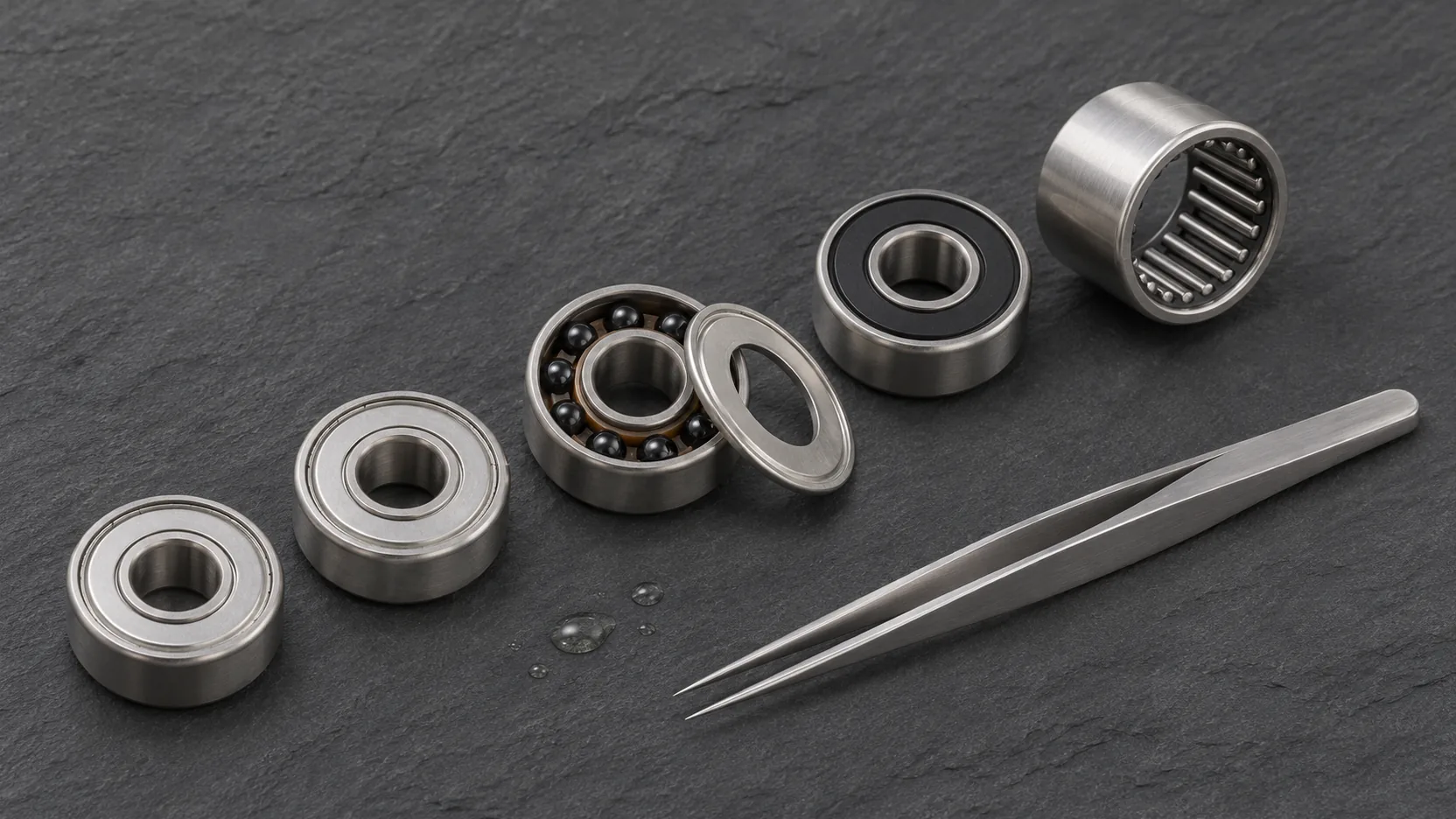
Figure: Schematic illustration. From left to right: metal-shielded stainless bearings, a hybrid bearing with its shield removed to show the ceramic balls, a rubber-sealed bearing and a needle-type one-way bearing.
04|Shields, Seals and Lubrication
| Type | Rotational resistance | Protection | Typical use |
|---|---|---|---|
| Open | Lowest | Low; debris and water enter easily | Spool bearings tuned for maximum free spin |
| Metal shield | Low | Medium; blocks larger debris | Spool bearings and general positions |
| Rubber seal | Higher | High; better against water and dust | Handle shaft and drive positions on saltwater reels |
Lubrication should also suit the position:
- Spool bearings: usually low-viscosity oil for low resistance and better casting.
- Drive positions: usually grease, which handles load and stays in place.
- Avoid “degreasing for speed”: washing the lubricant out of a bearing reduces resistance temporarily but accelerates wear and rust.
05|Precision Grades: What ABEC Actually Tells You
ABEC is the precision grading system of the American Bearing Manufacturers Association (ABMA), with common grades ABEC 1, 3, 5, 7 and 9; the international standard ISO 492 has corresponding precision classes. Higher grades mean tighter tolerances on dimensions and running accuracy.
But precision grades do not specify:
- noise and vibration;
- lubricant type and quantity;
- material and corrosion resistance;
- cage and shield design.
A “high-precision bearing” is therefore not the same as a smoother, quieter or more durable one. When a supplier emphasizes the precision grade, also confirm the material, lubrication and incoming inspection method.
06|Bearing Seats and Fits: Often More Important Than the Bearing
Once a bearing is installed, its real performance depends on whether its housing and shaft are right:
| Factor | Effect |
|---|---|
| Bearing seat size | Too tight compresses internal clearance and causes drag; too loose causes creep and noise |
| Concentricity of the two seats | Misaligned seats in the left and right side plates bind the spool or shaft |
| Shaft-to-inner-ring fit | Too tight is hard to assemble and affects clearance; too loose causes wear and noise |
| Axial play and shims | Too much play causes wobble; too much preload increases resistance |
| Anodizing thickness | Anodizing a bearing seat changes its size, so mask it or allow for growth |
| Burrs and cleanliness | Burrs and chips get into bearings and cause noise and early failure |
We recommend managing these items as critical characteristics. For a detailed analysis, see How Gears, Shafts and Bearing Seats Affect Reel Smoothness and Why Fishing Reel Frames and Side Plates Deform.
07|One-Way Bearings: Common Causes of Anti-Reverse Slip
A one-way bearing (needle roller clutch) lets the handle turn only in the retrieve direction. Its rollers lock against the shaft surface in one direction and release in the other. Common problems and causes:
| Symptom | Common causes |
|---|---|
| Anti-reverse slips | Too much or the wrong type of grease keeps the rollers from locking |
| Back-play in the handle | Wear, or wrong dimensions of the mating sleeve or shaft |
| Fails after saltwater use | Water intrusion and rust |
| Early wear | Insufficient hardness or surface finish of the mating shaft |
At the design stage, specify how the one-way bearing is lubricated and control the hardness and surface condition of the mating sleeve or shaft. Users should also be told not to add grease to the one-way bearing on their own.
08|Incoming Inspection and Validation
| Item | What to check |
|---|---|
| Dimensions | Bore, outer diameter and width, by sampling |
| Rotation feel and noise | Sample for smooth rotation and abnormal noise |
| Lubrication | Confirm lubricant type and condition match the specification |
| Corrosion resistance | Comparative validation for new suppliers or new specifications |
| Source and traceability | Buy through reliable channels and keep batch records to keep counterfeit or off-spec parts out |
| Post-assembly validation | Spool free spin, handle rotation resistance, saltwater and endurance tests |
Bearing corrosion on saltwater reels should be considered together with the overall corrosion design; see Saltwater Fishing Reel Corrosion Protection.
09|Information to Include in Your RFQ
| Information | Why it matters |
|---|---|
| Bearing count and positions | Whether specified, or to be evaluated with us |
| Bearing specification or brand | Whether material, hybrid ceramic, shields or seals are specified |
| Operating environment | Freshwater or saltwater |
| Casting performance targets | Determines spool bearing and lubrication choices |
| Benchmark reels | Used to compare spool free spin and handle feel |
| Expected volume and price point | Balances bearing grade against cost |
10|How Zhongde Can Help
- Bearing seat parts: side plates, frames, shafts and sleeves can be machined to drawing, with bearing seat size, concentricity and anodizing masking managed as critical characteristics.
- Assembly validation: spool free spin and handle feel can be checked in the assembled reel.
- Baitcasting reel OEM: MOQ of 200 units for baitcasting reels; other reel types can be considered with sufficient volume.
- NDA first: check “An NDA is required first” in the RFQ form, and we will complete the NDA before reviewing your drawings.
Zhongde has worked with Japanese customers for more than 18 years, producing reel parts with demanding cosmetic and quality requirements.
Frequently Asked Questions
Are more bearings always better in a fishing reel?
No. A bearing count only tells you how many bearings are used, not where they are or how good they are. Using suitable bearings in the key positions (both ends of the spool shaft, the handle shaft and the drive train) matters more than adding more. Some positions work perfectly well with bushings, and adding bearings blindly only adds cost. In the common number-plus-one notation, the extra one usually refers to the one-way bearing.
Are ceramic bearings worth it?
It depends on the use. The common ceramic bearing is a hybrid with ceramic balls and steel rings. Ceramic balls are lighter and harder, reduce rotational resistance and do not rust, which suits spool bearings where casting performance matters. But the rings are still steel and can still rust, and the cost is higher. Spool smoothness also depends on the bearing seats, lubrication and the spool itself, so changing bearings alone may not make a clear difference.
Does a higher ABEC grade make a reel smoother?
Not necessarily. Precision grades such as ABEC only specify tolerances for dimensions and running accuracy; they do not cover noise, lubrication, materials or corrosion resistance. Once installed, bearing seat dimensions and concentricity, shaft fits, axial play and preload often have more influence than the bearing grade itself. If the bearing seats are poor, a high-precision bearing cannot deliver its potential.
Why do reel bearings rust, and how can it be prevented?
Salt from seawater and sweat, not rinsing and drying after use, and lubricant that is insufficient or washed out all cause bearings to rust. Common measures are using stainless or hybrid ceramic bearings, using shields or seals where needed, choosing suitable lubricants, and telling users in the manual to rinse gently with fresh water after use, dry the reel and oil it regularly. Saltwater models also need to be considered as part of the overall corrosion design.
Why does a reel handle turn backward or the anti-reverse slip?
The usual cause lies with the one-way bearing: too much or the wrong type of grease prevents the rollers from locking reliably; water or rust; insufficient hardness or roughness of the mating sleeve or shaft surface, or wear; or poor installation or fit. Clean the bearing and lubricate it as specified first, then check the sleeve and the one-way bearing itself. At the design stage, specify how the one-way bearing is lubricated and control the hardness and surface condition of the mating shaft.