
In This Article
Need fishing reel or tackle parts? Upload drawings for a quote
Direct Answer
Each part of a fishing reel has different lubrication needs, and no single lubricant does everything:
| Part | Usual practice | Watch point |
|---|---|---|
| Spool bearings | Low-viscosity oil | Low resistance, better casting |
| Gears | Grease | Grease that is too stiff makes cranking heavy |
| Drag washers | Dedicated drag grease, or dry by design | Ordinary grease lowers or destabilizes drag |
| Centrifugal brake ring | Kept oil-free | Oil changes braking force |
| One-way bearing | A little light oil or a specified lubricant | Too much grease makes the anti-reverse slip |
| Level wind | A little oil | Sticky lubricants collect dirt |
The type, amount and application method of each lubricant should be specified at the design stage and followed in assembly, and feel and drag should be re-validated whenever a lubricant changes.
01|Oil Versus Grease
- Oil: flows easily with low resistance, suiting high-speed, low-load parts; but it migrates away and protects for a shorter time.
- Grease: base oil plus a thickener that stays in place, carries load and reduces noise; but it adds resistance and stiffens in the cold.
When choosing a lubricant, consider:
| Property | Effect |
|---|---|
| Base oil viscosity | Higher viscosity gives a thicker film and less noise, but more resistance, especially in the cold |
| Consistency | Stiffer grease stays in place better but adds rotational resistance |
| Operating temperature range | Stiffening in the cold and thinning in the heat both affect feel and lubrication |
| Water resistance | Whether the grease washes out easily in saltwater or rain |
| Material compatibility | Some lubricants make certain rubbers or plastics swell, harden or crack |
| Additives | Anti-wear and anti-rust additives affect durability and corrosion resistance |
02|Lubrication Points by Part
- Spool bearings: usually low-viscosity oil for low resistance and better casting. Oil that is too thin migrates away quickly; too thick costs casting distance.
- Gears: usually grease to carry load and reduce noise. Consistency and base oil viscosity shape the feel: a slightly stiffer grease feels quieter and smoother, but adds resistance.
- Drag washers: use a grease designed specifically for drags, or run dry if that is the design. Ordinary grease changes the friction coefficient and lowers or destabilizes drag.
- Centrifugal brake ring: must stay oil-free; oil changes the friction between brake blocks and ring and therefore the braking force.
- One-way bearing: usually a small amount of light oil or a specified lubricant. Too much or too stiff a grease keeps the rollers from locking reliably, making the anti-reverse slip.
- Level wind: the worm shaft usually takes a little oil; avoid sticky grease, which collects dirt.
- Clutch mechanism: usually a little grease for smooth action and reliable return.
- Around seals: use lubricants compatible with the rubber, to keep seals from swelling or hardening.
For how drag relates to washers and grease, see Fishing Reel Drag Washer Materials and Drag Consistency; for one-way bearing problems, see How to Choose Fishing Reel Bearings.
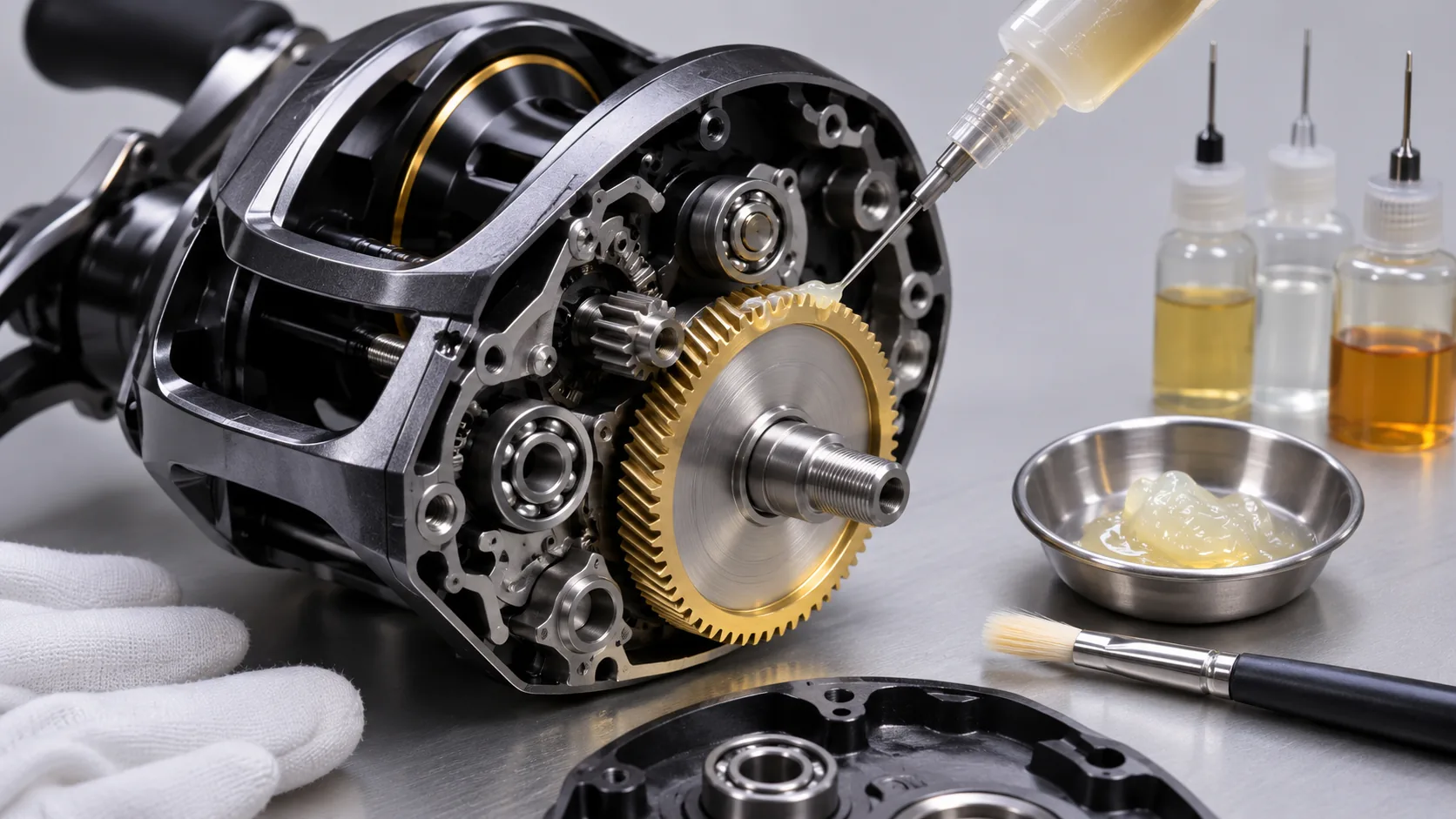
Figure: Schematic illustration. During assembly, measured amounts of grease are applied at specified points with precision dispensing tools, and different parts use different oils and greases.
03|Amount: More Is Not Better
| Amount | Possible problems |
|---|---|
| Too much | More rotational resistance and heavier cranking; migration onto drag washers, brake rings or the one-way bearing; collects dirt |
| Too little | Faster wear, more noise, rust |
| Inconsistent | Large variation in feel and drag within one batch |
The amount for each point should be specified at the design stage and applied in measured quantities during assembly, for example with dispensing tools, rather than by feel.
04|Why Reels Crank Heavier in the Cold
Grease and oil thicken and stiffen at low temperatures, increasing rotational resistance, which is a common reason reels crank heavier in winter. Thickened oil in the spool bearings also affects casting.
- Products for cold regions: choose lubricants with good low-temperature performance.
- Validation: confirm feel, drag and casting in a cold environment, which can be combined with high and low temperature testing.
For planning reliability tests, see How to Plan Fishing Reel Reliability Testing.
05|Lubrication for Saltwater Reels
Saltwater reels need particular attention to the water resistance and rust protection of their lubricants. Once seawater washes grease away, gears and bearings wear and rust quickly. Common practice is to use water-resistant grease together with sealed structures, and to explain cleaning and maintenance in the user manual.
06|Managing Lubrication in Factory Assembly
| Item | Content |
|---|---|
| Lubricant specification | State the lubricant for each point in the bill of materials |
| Lubrication point chart | Show in a diagram what goes where and how much |
| Measured application | Control amounts with dispensing tools or similar methods |
| Lot management | Track lubricant lots, shelf life and storage conditions |
| Cleanliness | Clean parts before assembly to keep chips and dust out |
| Change control | Re-validate feel, drag and durability whenever a lubricant changes |
Lubricants strongly affect feel and drag, so changing a lubricant amounts to changing the product; the brand should be notified and the product re-validated.
07|Maintenance Instructions for Users
- After use: rinse gently with fresh water, wipe dry and leave to dry in a ventilated place.
- Regular oiling: add a little oil at the specified points as the manual describes; do not add grease casually.
- Do not oil drag washers or brake rings: it changes drag and braking force.
- Do not use general-purpose anti-rust sprays in place of reel oil: they can wash out the original grease.
- Regular servicing: internal grease such as on the gears is best renewed by periodic professional servicing.
08|Information to Include in Your RFQ
| Information | Why it matters |
|---|---|
| Operating environment and region | Freshwater or saltwater; whether used in cold regions |
| Feel requirements | Smooth and quiet, or light and free-spinning |
| Drag type and washers | Determines how the drag is lubricated |
| Specified lubricants | Whether a brand or specification is required |
| Benchmark reels | Used to compare feel and drag |
09|How Zhongde Can Help
- Assembly and lubrication control: during reel assembly, lubrication is applied by specified point, type and amount, and lubricant lots are recorded.
- Feel and drag validation: rotation feel is checked in the assembled reel, and drag curves are confirmed with our line-pull drag tester.
- Baitcasting reel OEM: MOQ of 200 units for baitcasting reels; other reel types can be considered with sufficient volume.
- NDA first: check “An NDA is required first” in the RFQ form, and we will complete the NDA before reviewing your drawings.
Zhongde has worked with Japanese customers for more than 18 years, producing reel parts with demanding cosmetic and quality requirements.
Frequently Asked Questions
Should a fishing reel use oil or grease?
It depends on the part. High-speed or low-load parts such as spool bearings, the level wind and handle knob bearings usually use oil for low resistance. Load-bearing or noise-sensitive parts such as gears and the clutch mechanism usually use grease. Drag washers need a dedicated drag grease or run dry by design, and one-way bearings take a small amount of light oil or a specified lubricant.
Why does a reel crank heavier in cold weather?
A common cause is that grease and oil thicken and stiffen at low temperatures, increasing rotational resistance. Products for cold regions should use lubricants with good low-temperature performance, and feel should be validated in a cold environment. Thickened oil in the spool bearings also affects casting.
Can ordinary grease be used on drag washers?
It is not recommended. Drag washers need a grease designed specifically for drags, or should run dry if that is the design. Ordinary grease changes the friction coefficient and can noticeably lower drag or make it inconsistent. Likewise, oil on the brake ring of a centrifugal brake changes braking force. Users should not oil drag washers or brake rings during maintenance either.
Does more grease make a reel smoother?
No. Too much grease increases rotational resistance and makes cranking heavier, and it can migrate onto drag washers, brake rings or the one-way bearing, causing inconsistent drag, changed braking or anti-reverse slip, as well as collecting dirt. Too little causes wear, noise and rust. The amount for each point should be specified at the design stage and applied in measured quantities during assembly.
How often should users lubricate their reels?
It depends on how often and where the reel is used. Users are generally advised to rinse gently with fresh water after use, dry the reel, and add a little oil at the specified points as the manual describes, more often after saltwater use. Internal grease such as on the gears is best renewed by periodic professional servicing. General-purpose anti-rust sprays should not be used in place of reel oil, as they can wash out the original grease.