
In This Article
Need fishing reel or tackle parts? Upload drawings for a quote
Direct Answer
Fishing reel reliability testing should be planned from the failures users will actually experience, not copied from a generic checklist.
- Common tests: retrieve endurance, drag endurance, clutch endurance, anti-reverse shock, drop, high and low temperature, saltwater exposure, cosmetic durability and transit.
- Measure the same items before and after: rotation feel and torque, noise, drag curve, key dimensions and appearance, followed by a teardown of wear and lubrication, ideally alongside a benchmark reel.
- Conditions and acceptance criteria: there are no universal values; the brand and factory should agree on them in advance.
- By stage: prototypes validate the design, pilot builds validate production parts and processes, and changes after launch trigger re-validation.
01|Plan Tests From Failure Modes
The problems users complain about most rarely appear on day one; they show up after a period of use:
| What users experience | Possible causes | Matching test |
|---|---|---|
| Gritty feel after a few months | Gear wear, bearing deterioration, grease loss | Retrieve endurance test |
| Drag becomes inconsistent | Washer wear, heat, grease changes | Drag endurance test |
| Clutch stays down and will not return | Wear of clutch parts, spring fatigue | Clutch endurance test |
| Handle suddenly turns backward | One-way bearing slip | Anti-reverse shock test |
| Reel will not turn after being dropped | Frame or side plate deformation | Drop test |
| Heavy cranking in winter | Grease stiffening at low temperature | High and low temperature test |
| Rust or seizure after saltwater use | Corrosion, salt intrusion | Saltwater test |
| Color fading or worn-off logos | Anodic film wear, fading | Cosmetic durability test |
List the failures the product could experience first, then decide which tests to run and what to measure.
02|Common Test Items
| Test | What it simulates | Checked before and after |
|---|---|---|
| Retrieve endurance | Long-term retrieving under load | Feel, torque, noise, gear and bearing wear |
| Drag endurance | Repeated runs with drag washers heating up | Drag curve, washer wear, grease condition |
| Clutch endurance | Repeated clutch engagement and return | Clutch action, reliable return, part wear |
| Spool rotation endurance | High-speed spool rotation from repeated casting | Free spin, bearing condition, centrifugal block wear |
| Anti-reverse shock | Sudden reverse loads | No slip, no damaged parts |
| Handle strength | High force on the handle | No deformation or loosening of handle, main shaft or joints |
| Drop | Falling from a specified height onto a hard surface | Deformation, cracking, normal function |
| High and low temperature | Use and storage in a hot car or cold weather | Feel, drag, dimensions, grease and resin parts |
| Saltwater | Seawater, salt spray, wet-dry cycles | Corrosion locations, function, internal teardown |
| Cosmetic durability | Rubbing, sweat, sunlight | Film wear, fading, logo legibility |
| Transit packaging | Drops and vibration in shipping | Damage to packaging and product |
For saltwater validation methods, see Saltwater Fishing Reel Corrosion Protection.
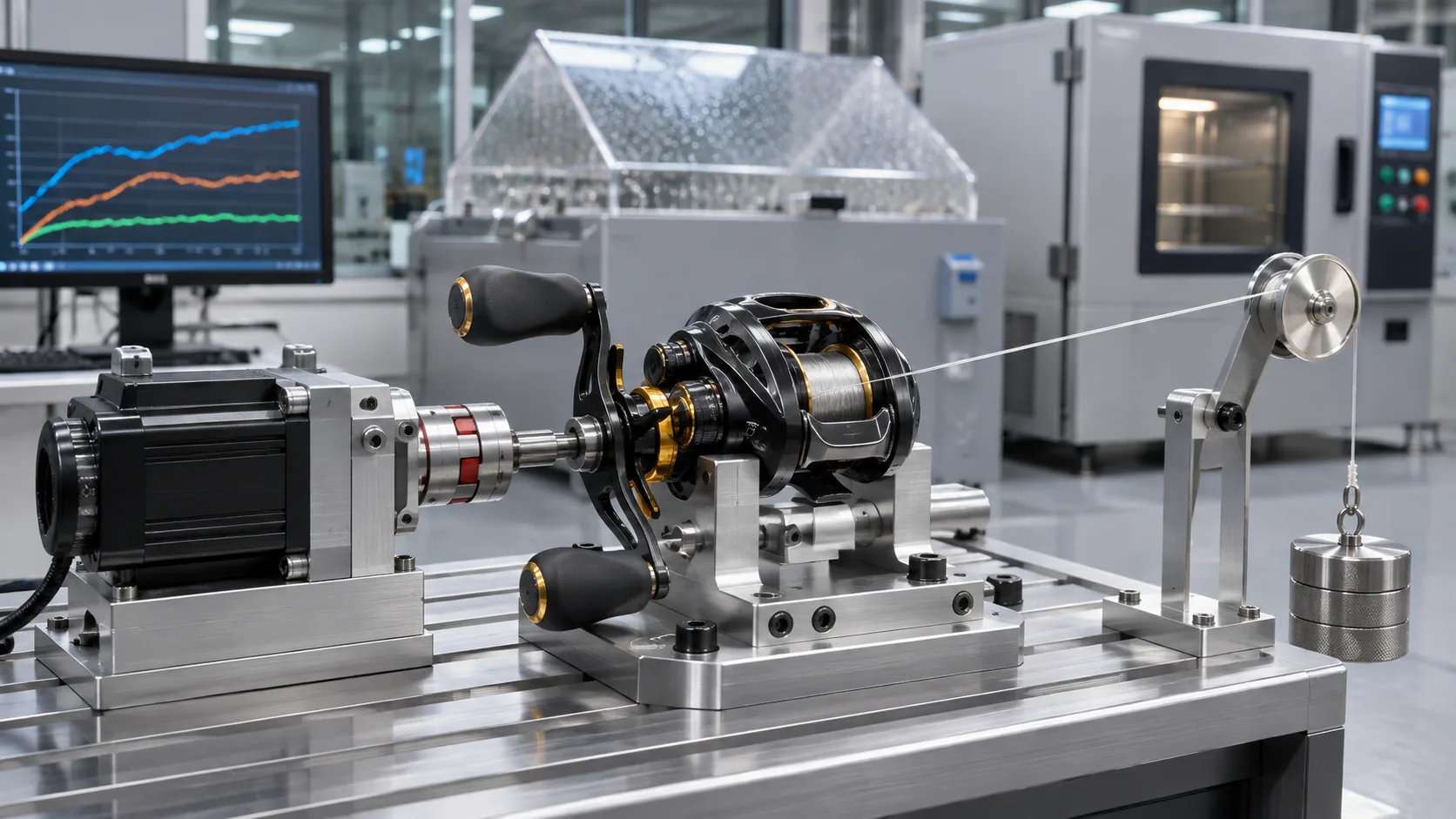
Figure: Schematic illustration. In a retrieve endurance test, a motor drives the handle to retrieve continuously under load; salt spray and temperature tests run in dedicated chambers.
03|What to Measure Before and After
The key to reliability testing is measuring the same items before and after the test and seeing how much they change:
- Rotation feel and torque: handle resistance and smoothness.
- Noise: any abnormal noise, and where and how often it occurs.
- Drag curve: average, fluctuation and startup peak recorded with a line pull test.
- Key dimensions: wear-prone features such as gears, shafts and bearing seats.
- Appearance: condition of the film, color and logo.
- Teardown: wear marks on gear teeth, bearing condition, grease color and distribution, and any metal particles.
Ideally test a benchmark reel alongside under the same conditions to judge whether results are good or bad. For drag test methods, see Fishing Reel Drag Washer Materials and Drag Consistency.
04|How to Set Test Conditions
There are no universal values for load, speed, cycle count or temperature. Set them from:
- Product position: entry-level, mid- to high-end or professional.
- Use scenarios: freshwater or saltwater, target species size, how often the reel is used.
- Benchmark reels: how they perform under the same conditions.
Also keep in mind:
- Keep accelerated tests realistic: raising the load too far to save time can create failures that never happen in real use and mislead the conclusions.
- Agree on acceptance criteria in advance: write down before testing what counts as a pass, for example how feel, noise and drag change will be judged.
05|Sample Size
Reel reliability tests usually use few samples, which makes statistical proof of reliability difficult. A more practical approach is:
- Use several samples per test and check that results are consistent, rather than testing one unit;
- Include benchmark reels as a reference;
- Focus on failure modes: in teardown, find what wears or fails first and use it to direct improvements.
06|What to Test at Each Stage
| Stage | Purpose | Focus |
|---|---|---|
| Prototype | Validate the design | A broad test set to find design weaknesses |
| Pilot build | Validate production parts and processes | Repeat key tests with parts from production tooling and processes |
| Production | Confirm production stability | Periodic sampling of key tests |
| After changes | Confirm a change introduced no new problems | Repeat affected tests when materials, suppliers or processes change |
Prototypes are often made by CNC or by hand, and their parts and assembly differ from production, so a passed prototype test does not mean production is problem-free. For validation when qualifying or transferring suppliers, see How Reel Brands Qualify a New Fishing Reel Parts Supplier.
07|When Problems Are Found
- Record the symptom: under what conditions, after how many cycles, and what happened.
- Tear down and analyze: find where and how the failure occurred, for example tooth wear, bearing corrosion or part deformation.
- Determine the cause: a design issue (material, dimensions, structure) or a manufacturing issue (machining, assembly, lubrication).
- Take countermeasures: change the design or improve the process.
- Re-validate: repeat the relevant tests to confirm the problem is solved and no new one has appeared.
08|What a Test Plan Should Specify
| Item | Content |
|---|---|
| Test items | Which tests, and which failure each addresses |
| Test conditions | Load, speed, cycles, temperature, duration and so on |
| Samples | Quantity, stage (prototype, pilot, production), whether benchmarks are included |
| Measurements | What is measured before and after, and how |
| Acceptance criteria | What counts as a pass |
| Responsibility | Factory, brand or third-party laboratory |
| Schedule and records | When tests run, and how results are recorded and shared |
09|How Zhongde Can Help
- Drag testing: our line-pull drag tester records drag curves, so changes before and after testing and against benchmark reels can be compared.
- Supporting your test plan: we can prepare samples to your test plan, help record before-and-after data and carry out teardown analysis.
- Baitcasting reel OEM: MOQ of 200 units for baitcasting reels; other reel types can be considered with sufficient volume.
- NDA first: check “An NDA is required first” in the RFQ form, and we will complete the NDA before reviewing your drawings.
Zhongde has worked with Japanese customers for more than 18 years, producing reel parts with demanding cosmetic and quality requirements.
Frequently Asked Questions
What reliability tests should a fishing reel have at minimum?
We generally recommend at least a retrieve endurance test, a drag endurance test, a clutch endurance test, a drop test, and high and low temperature or saltwater tests suited to the operating environment. Saltwater reels need stronger saltwater validation, and products with demanding cosmetic requirements should add wear and lightfastness tests. The exact list should be derived from the failures the product could experience.
How many turns should a retrieve endurance test run?
There is no universal figure. The number of turns, load and speed should be set from the product position, how often and where users fish, and benchmark reels, with acceptance criteria agreed in advance by the brand and the factory. A load set too high can create failures that never occur in real use; one set too low will not reveal problems. Testing a benchmark reel alongside is recommended.
Do salt spray test hours represent the real service life of a reel?
They cannot be converted directly. Salt spray tests are suited to comparing the relative corrosion resistance of materials, finishes and processes under the same conditions, but they differ greatly from the wet-dry cycles, sunlight, wear and maintenance of real saltwater fishing. For saltwater reels we recommend combining salt spray, immersion and drying cycle tests, and teardown after real use.
If prototypes pass, do production reels still need testing?
Yes. Prototypes are often made by CNC or by hand, so their parts and assembly differ from production. At the pilot stage, key tests should be repeated with production tooling, processes and parts to confirm performance and durability in the production condition. Periodic sampling tests after launch are also recommended.
Do tests need to be repeated after a change of material, supplier or process?
The affected items should be re-validated. For example, a new gear material calls for repeating retrieve endurance; new drag washers or grease call for repeating drag tests; a new surface treatment calls for repeating cosmetic and corrosion tests. We recommend change-point management that defines in advance which changes must be reported to the brand and which tests must be repeated.