
In This Article
Need fishing reel or tackle parts? Upload drawings for a quote
Direct Answer
After-sales service and spare parts are what small reel brands most often overlook. Plan them before the first order:
- Exploded view and parts list: give every part a part number for ordering and repair.
- Group the spares: wear parts, damage-prone parts, cosmetic parts and small hardware, each with its own stocking decision.
- Make spares with the first production run: the same material and surface treatment lots keep cost down and colors consistent; small quantities made separately later often cost much more per piece.
- Repairs and warranty: decide who repairs reels, and state clearly what is and is not covered.
- Return data: record, analyze and feed back to the factory for improvement.
- After discontinuation: decide how long spares are kept and make a final batch.
01|Why After-Sales Must Be Planned Before the First Order
Anglers judge a reel not only on price and feel but also on whether it can be repaired. Without spares and a repair channel, a small problem means replacing the whole reel:
- the brand’s costs rise and after-sales eats into margin;
- customers wait longer and reputation suffers;
- dealers are reluctant to carry a brand without after-sales support.
The types and quantities of spares tie directly into how the first production run is arranged, so plan them with the factory before ordering. For the overall launch process, see How to Start Your Own Fishing Reel Brand.
02|Exploded View and Parts List
The foundation of after-sales is an accurate exploded view and parts list:
| Item | Description |
|---|---|
| Part number | A unique number for each part, used for ordering and repair |
| Name | A consistent part name to avoid miscommunication |
| Quantity per reel | How many are used in one reel |
| Material and color | Colors must be stated for cosmetic parts |
| Applicable models | For shared parts, which models and gear ratios they fit |
| Revision | Update the revision after a change and state whether old and new parts are interchangeable |
Prepare two versions: a simplified version for customers (in the manual or on the website, for ordering common parts) and a detailed version for repair staff.
03|Which Parts to Stock
| Category | Examples | Stocking advice |
|---|---|---|
| Wear parts | Drag washers, bearings, one-way bearings, springs, level wind pawls | Essential; estimate from expected usage |
| Damage-prone parts | Handles, knobs, star drags, thumb bars, line guides | Recommended; easily damaged in drops and knocks |
| Cosmetic parts | Side plates, frames and so on, by color | Small quantities per color; watch batch color variation |
| Small hardware | Screws, clips, washers, E-rings | Stock generously; cheap and easily lost |
| Drive train parts | Main gears, pinions, shafts | As needed; frequently used in repairs |
Adjust the exact types and quantities based on the product design, repair experience with benchmark reels and actual return data.
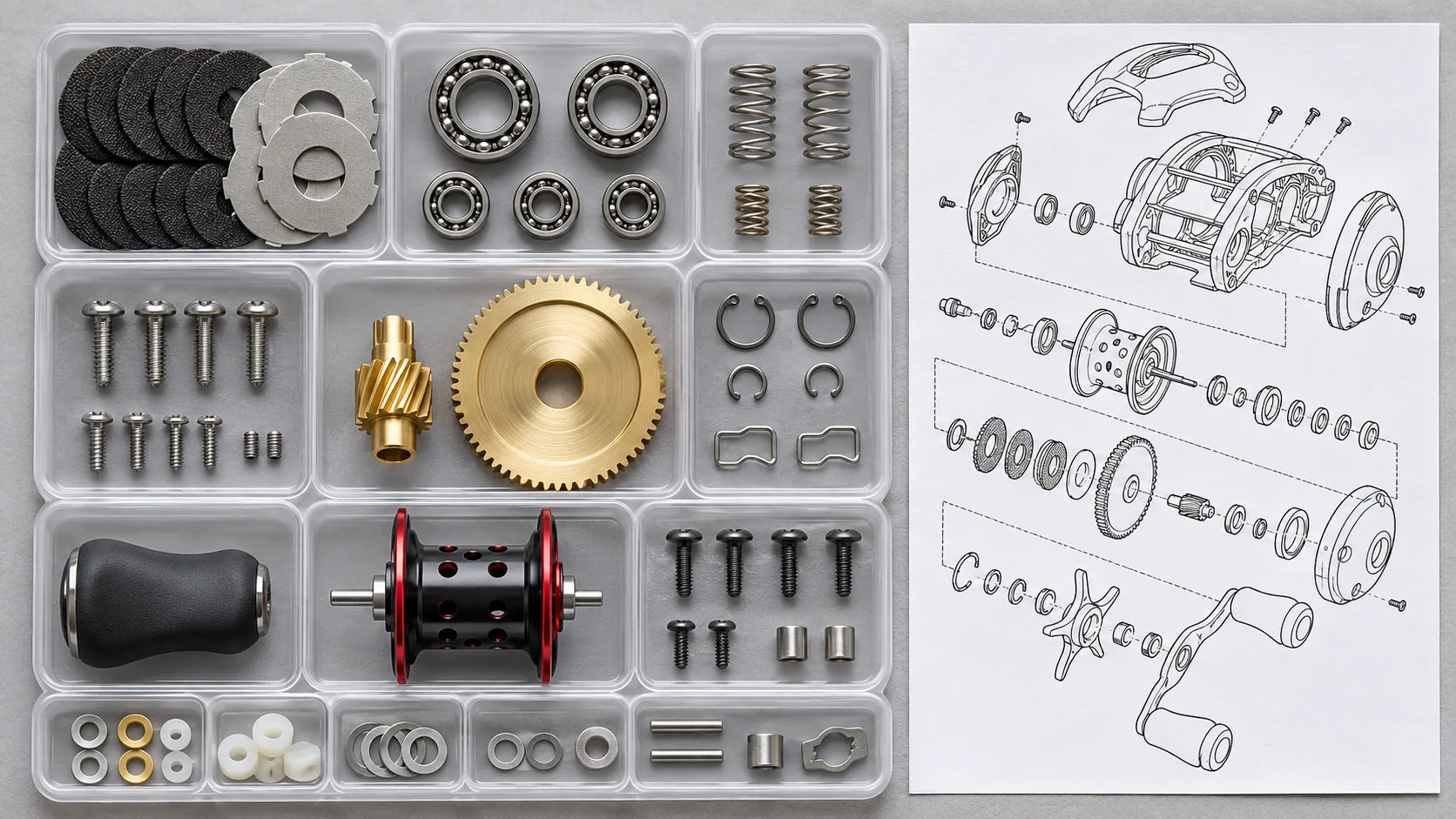
Figure: Schematic illustration. Spares sorted by part number in compartment trays, used with the exploded view and parts list, make it quick to find the right part during repair.
04|How Many to Stock, and When
- Make them with the first production run: the same material lot, machining setup and surface treatment batch give the lowest cost and consistent cosmetic colors.
- Estimating quantities: base them on forecast sales, how parts wear, and return experience with benchmark reels or earlier products, then adjust with real data after launch.
- Cost of later runs: each run needs its own material, programs, fixtures and surface treatment setup, so small later runs often cost much more per piece, and cosmetic parts need color matching and approval again.
05|Color Matching for Cosmetic Spares
Anodized color varies between batches. Cosmetic spares made separately later may not match the reel in the customer’s hands. We recommend:
- Process with the production lot: anodize cosmetic spares together with production parts.
- Keep color samples and approved samples: compare later runs against the approved samples.
- Replace in pairs: during repair, adjacent cosmetic parts such as left and right side plates can be replaced as a pair to reduce visible color differences.
For managing color consistency, see How Small Brands Customize Fishing Reels.
06|Organizing Repairs and Warranty
| Option | Advantages | Watch points |
|---|---|---|
| Brand repairs in-house | Fast; brand sees customer feedback directly | Needs trained staff, tools and service documentation |
| Local service partner | No need to invest in staff or facilities | Must supply documentation and spares, and manage repair quality |
| Return to the factory | Lowest investment for the brand | Slow; shipping and customs costs; long waits for customers |
Warranty terms should state clearly:
- What is covered: defects in materials and manufacturing, and for how long.
- What is not covered: for example misuse, drops, corrosion from lack of care after saltwater use, and user modifications.
- How to claim: proof of purchase, photos or videos, and whether the reel is returned or assessed locally.
07|Service Documentation
Documentation for repair staff should at least include:
- Disassembly order: which parts come off first, and what to watch when reassembling.
- Lubrication points and lubricants: what goes where and how much; see Fishing Reel Lubrication.
- Special tools: wrenches, fixtures and so on.
- Post-repair checks: how to confirm rotation feel, clutch, drag and casting brake function.
08|Using Return Data
Return and repair records are the most valuable data for improving a product:
- Record: model, lot number, failed part, symptom, length of use and environment.
- Analyze regularly: which parts and symptoms are most common, and whether they cluster in particular lots.
- Feed back to the factory: send the failed parts and ask the factory for teardown analysis, root cause and countermeasures.
- Improve and validate: after design or process improvements, re-validate the related items.
Combining reliability testing with return data finds weak points faster; see How to Plan Fishing Reel Reliability Testing.
09|Spares After a Model Is Discontinued
- Decide the retention period: based on target market requirements, the warranty period and the brand’s after-sales policy, decide before production ends how long spares will be kept.
- Final spares batch: estimate the quantity needed after discontinuation and make it with the last production run.
- Storage: protect against rust, and watch for lubricant aging in bearings and pre-lubricated parts.
- Substitute parts: if an original part can no longer be made, confirm the interchangeability of substitutes in advance.
10|How Zhongde Can Help
- Spares scheduled with production: spares can be planned together with the first production run, with cosmetic spares processed in the same lot to reduce color variation.
- Later runs by part number: spares can be made later by part number, with cosmetic parts compared against approved samples.
- Failure analysis: we support teardown analysis of returned parts and propose causes and countermeasures.
- Baitcasting reel OEM: MOQ of 200 units for baitcasting reels; other reel types can be considered with sufficient volume.
- NDA first: check “An NDA is required first” in the RFQ form, and we will complete the NDA before reviewing your drawings.
Zhongde has worked with Japanese customers for more than 18 years, producing reel parts with demanding cosmetic and quality requirements.
Frequently Asked Questions
Does a small brand need spare parts for its first shipment?
We recommend it. Reels have wear parts such as drag washers, bearings and springs, and parts such as handles, knobs and star drags that are easily damaged in a drop. Without spares, a small problem means replacing the whole reel, which is costly and hurts reputation. Spares are best made with the first production run, which keeps cost down and cosmetic colors consistent.
Which spare parts are used most?
Typically drag washers, bearings, one-way bearings, springs, and small hardware such as screws and clips, plus parts easily damaged by drops and knocks such as handles, knobs, star drags and thumb bars. Adjust the list based on the product design, repair experience with benchmark reels and actual return data.
Why do spares made separately later cost so much more?
Each run needs its own material, programs, fixtures and surface treatment setup, and that setup cost spread over a small quantity drives the unit price up; cosmetic parts also need color matching and approval again. Making spares with the first production run shares this setup and costs much less.
What if cosmetic spare parts do not match in color?
Anodized color varies between batches, so cosmetic spares are best processed with the production lot. If they must be made later, keep color samples and approved samples and compare against them. Adjacent cosmetic parts such as left and right side plates can also be replaced as a pair during repair to reduce visible color differences.
How long should spares be kept after a reel is discontinued?
There is no single rule; it depends on target market requirements, the warranty period and the brand after-sales policy. Decide the retention period before production ends, estimate the quantity needed, make a final batch of spares, and pay attention to storage conditions such as rust protection and lubricant aging.