In This Article
Need fishing reel or tackle parts? Upload drawings for a quote
Direct Answer
From idea to first shipment, launching your own fishing reel brand usually takes seven steps:
Define the product and customer → write a specification sheet → choose a route → select a factory and sign an NDA → prototypes and approval → pilot run → production, inspection and after-sales.
The most underestimated part of the process is feel and consistency. Cosmetic problems are visible at a glance, but feel problems only show up once the reel is assembled, turned and the drag is pulled. And a good prototype does not guarantee that every reel will be good. That is what the pilot run and inspection are for.
A common misconception is that measuring an existing reel gives you a design. It gives you the dimensions of one sample. It does not tell you how the original tolerances were allocated, which parts are matched, or how the reel is adjusted during assembly. That is why parts copied from a sample can each pass inspection and still bind or make noise when assembled.
Our advice for a first order: focus on one model in one or two colors, and make that one product right.
01|Answer four questions before you contact a factory
A factory needs to know what product you want before it can quote or advise. Once these four questions have an answer, every later step moves faster.
| Question | Why it matters | What it decides |
|---|---|---|
| Who is it for? | Freshwater or saltwater, target species, main sales regions | Strength, corrosion protection, size class, manual languages |
| What will it sell for? | The retail price range sets the cost ceiling | Materials, bearing count, finishes, packaging level |
| How is it different? | Without a difference, you can only compete on price | Private label, semi-custom or full custom |
| How many in the first year? | Sets the first order and the reorder rhythm | CNC or tooling, how colors and versions are split |
They do not need precise answers, only a direction. “Saltwater, mid-to-high price, light weight and strong styling, a few hundred units in year one” is already enough for a factory to start evaluating.
02|Turn the idea into a specification sheet a factory can quote
“A reel like model X” is the most common request and also the easiest to misread. Like it in appearance, size, feel or price?
Write the requirement down as a simple specification sheet. Where you have not decided, state the goal, not the solution.
| Item | Example of what to write |
|---|---|
| Reel type and size class | Low-profile baitcasting, round conventional or offshore, and size class |
| Gear ratio | A target ratio, or a high / standard / low-speed position |
| Line capacity | Target line size and length |
| Maximum drag | A target value, or “more than the reference reel” |
| Weight target | A target value, or “lighter than the reference reel” |
| Bearing count | A required number, or leave it to the factory to recommend |
| Main materials | Frame, side cover and spool materials, or “weight first” |
| Environment | Freshwater or saltwater, extra corrosion protection or not |
| Colors and logo | Number of colors, logo position and method |
| Handle and knobs | Single or double handle, knob shape and material |
| Left and right hand | Whether both are needed, and the rough split |
| Packaging | Box, manual languages, spare parts included or not |
| First order and annual volume | Units in the first order and expected first-year volume |
The sheet does not have to be perfect, but every later discussion builds on it, and it is the checklist you use when evaluating prototypes.
03|Choose a route: private label, semi-custom or full custom
The route sets MOQ, tooling cost, unit price and development time. In short:
- Private label: keep an existing platform and change colors, logo and packaging. Fastest and cheapest, but little differentiation.
- Semi-custom: keep the internal mechanism and redesign visible parts such as side covers, spool, handle and knobs. A balance of identity and investment.
- Full custom: redesign the frame, gear train, spool and drag system. The most differentiation, and the highest investment and longest timeline.
For a first reel, private label or semi-custom is usually the better start, so the first product can test the channel and price point. We compare the cost structure of the three routes in detail in Fishing Reel OEM Explained: How MOQ, Tooling Cost and Unit Price Are Set.
04|How to choose an OEM factory
Do not choose on price alone. For the same specification, a lower quote may hide trade-offs you cannot see in bearings, gear material or test items.
| What to check | How to judge it | Why it matters |
|---|---|---|
| Experience with similar reels | Look at reels and parts in production; customer names may be confidential | An experienced factory knows where problems appear |
| Key parts made in-house | Are frames, spools, gears and anodizing done in-house or outsourced | In-house processes are easier to control for quality and lead time |
| Assembly and testing | Is there an assembly line, which items are tested, with what gauges | Feel and consistency depend on assembly and testing |
| Prototype capability | How prototypes are made and how long one revision takes | Faster revisions mean a shorter development cycle |
| Communication | Can you talk directly to engineers, and is the language workable | Misunderstood specifications are the main cause of rework |
| Confidentiality | Willing to sign an NDA first, and how drawings are controlled | Protects your design and product plans |
| MOQ and payment terms | MOQ, prototype fees, tooling fees and payment milestones | Directly affects your cash flow |
If possible, visit the factory, or ask for a video walkthrough of machining, anodizing, assembly and testing. What matters is not the size of the building but whether the key processes are in the factory’s own hands.
05|Prototype stage: most feel problems come from the tolerance chain
The prototype stage deserves the most time, because design changes cost the least here.
As noted above, measuring a sample does not reveal the original tolerance design. A typical situation in development is that every part passes inspection to its drawing, yet the assembled reel binds, turns roughly or makes noise. The cause is rarely one part. It is several tolerances stacking up together, such as the alignment of the two bearing bores, the gear center distance or the spool end play.
That is why a dual-axis reel is best designed by first fixing the datums of three axes: the spool shaft (pinion axis), the drive gear shaft and the level-wind worm shaft, and only then developing the individual parts. Stable axis datums make every later part design and assembly adjustment simpler.
When you evaluate prototypes, check item by item:
| Check | How to check |
|---|---|
| Smoothness | Feel when cranking, free-spool smoothness, any notchiness |
| Gear mesh | Noise at slow and fast cranking, periodic roughness |
| Drag | Smooth line release, whether the target drag is reached, linear adjustment |
| Clutch | Crisp engagement and return, no sticking |
| Level wind | Smooth travel, synchronized with spool rotation |
| Appearance | Color variation, scratches, engraving or print, color harmony between parts |
| Weight and handling | Total weight, balance, handle and knob feel |
| Against the spec sheet | Gear ratio, line capacity, bearing count and so on |
Record problems with photos and video so the factory understands them exactly. Prototypes usually take one to several rounds of revision. Do not skip rounds to save time.
Finally, approve a golden sample: the brand and the factory each keep a signed reel, and production is judged against it. For cosmetic parts, also approve cosmetic limit samples that define acceptable color variation and blemishes.
06|Pilot run: from “we can make it” to “every unit is the same”
The prototype proves the reel can be made. The pilot run proves every reel can be made that way.
The pilot run fixes:
- Machining processes, fixtures and cutting tools.
- Gauges and methods for critical dimensions.
- Anodizing colors and cosmetic standards.
- Assembly methods, adjustment methods and final test items.
- Packaging and the manual.
A pilot run is usually a small share of the first order. What to look at afterwards is the variation within the batch, not a few hand-picked units.
07|Production and inspection
Inspection is the brand’s last gate before shipment. You can inspect yourself or use a third-party inspection company.
Inspection usually follows a sampling standard, such as AQL sampling under ISO 2859-1 or ANSI/ASQ Z1.4. More important than the sampling rate is agreeing with the factory in advance on how defects are classified:
| Defect class | Examples | Usual handling |
|---|---|---|
| Critical | A safety issue or unusable reel, such as clutch or drag failure | Not accepted |
| Major | Affects a main function, such as clear binding, noise or low drag | Tightly limited |
| Minor | Cosmetic issues that do not affect function, such as light scratches | Judged against limit samples |
Reel inspection cannot stop at appearance and quantity. Always sample the functions: smoothness, drag, clutch, level-wind sync and noise.
08|Beyond the first order: after-sales and spare parts
A brand reputation depends heavily on after-sales service. When you place the first order, also plan:
- Spare parts: spools, knobs, drag washers and common screws and springs are cheapest to produce with the first order.
- Exploded diagram and part numbers: so dealers and users can identify and order parts.
- Care instructions: especially for saltwater reels, rinsing and lubrication instructions prevent many service issues.
- Reorder consistency: keep the golden sample and cosmetic limit samples, and use them for anodizing color and feel on every reorder.
09|The most common first-order mistakes
| Mistake | Result | How to avoid it |
|---|---|---|
| Spec says only “like model X” | Different expectations, repeated prototype changes | Write a specification sheet, with goals where undecided |
| Too many colors and versions in order one | Higher unit price, scattered stock, longer lead time | One or two colors, split left and right hand by demand |
| Production ordered before sample approval | Disputes over what is acceptable | Approve the golden sample and limit samples first |
| Only appearance checked, not feel | Users discover binding and noise | Test functions at prototype and at inspection |
| Copying a major brand design | IP risk, and possible fit problems in production | Learn from the idea, do not copy protected structures or styling |
| Packaging and manual left to the end | Reels are ready, packaging is not | Start packaging design during the prototype stage |
| No agreement on tooling ownership | Tooling cannot move if you change factories | State ownership and permitted use in quote and contract |
| No spare parts prepared | No parts for service, damaged reputation | Order spare parts with the first order |
10|What Zhongde Precision can do
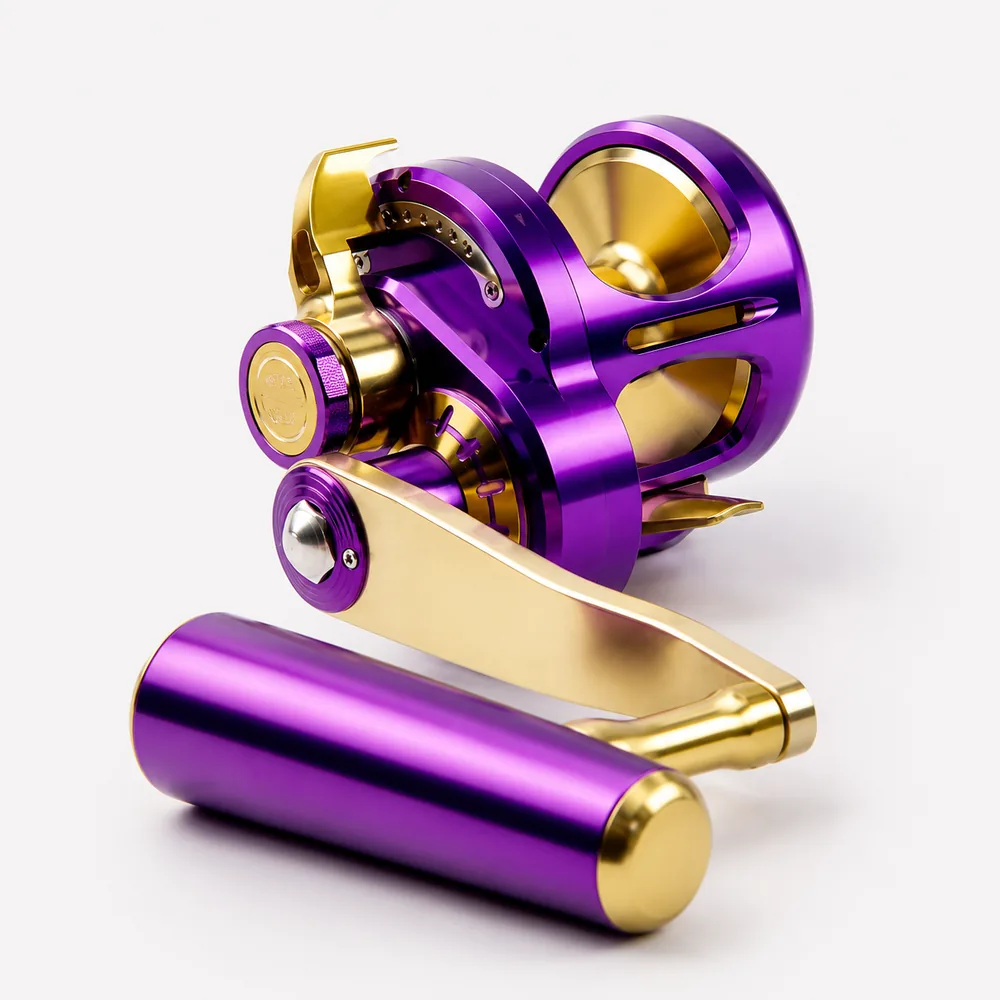
Figure: a 50-class dual-axis reel manufactured with Zhongde Precision.
- Dual-axis reel OEM: low-profile baitcasting and round conventional reels, with an MOQ of 200 units. Other reel types are evaluated project by project when the volume justifies it.
- Main processes in-house: mold design and manufacturing, CNC precision machining, anodizing and painting, and assembly and testing.
- Parts only is also possible: brands that already have an assembly partner can have us machine precision parts such as frames, side covers, spools, handle arms and knobs.
- NDA first: tick “An NDA is required first” when you submit an inquiry, and we will handle the NDA before reviewing your drawings.
Zhongde Precision has supplied Japanese customers for more than 18 years and knows the requirements for reel feel, cosmetic consistency and lot-to-lot stability.
Frequently Asked Questions
How much budget does a first private label reel order need?
There is no single figure. It depends mainly on the route and the quantity. Costs usually include prototypes, molds or fixtures (significant only for full custom), the first production order, printed packaging, freight and duties, and in some markets material compliance testing. Private label and semi-custom need far less upfront investment than full custom, and machining parts instead of building molds lowers it further for small orders.
How long does it take from finding a factory to receiving the first shipment?
It depends on whether new tooling is needed, how many prototype rounds are required, how many rounds of anodizing color approval it takes, and the lead time of purchased components and packaging. Private label is fastest and full custom is slowest. The most effective way to shorten it is a clear specification sheet from the start and giving every requirement before the golden sample is approved.
Can I start a reel brand without my own engineers?
Yes, many brands start that way. A semi-custom route keeps a proven internal mechanism, and the factory engineers handle structure and process. But the brand must own the product definition and acceptance criteria: who the reel is for, what it should feel like and what counts as acceptable. Those decisions should not be left to the factory.
The prototype felt great. Why do production reels feel different?
Usually the prototype was carefully adjusted by an experienced technician, while production processes, fixtures, gauges and assembly methods were not yet fixed, or part dimensions landed at the other end of the tolerance. Approve a golden sample and cosmetic limit samples, use the pilot run to fix processes and inspection standards, and check feel-related functions during inspection.
What are the risks of copying a major brand reel?
There are two. The first is intellectual property: structures and styling protected by patents or design registrations cannot be copied, and the better the product sells, the more likely it is to be challenged. The second is quality: measuring one sample gives its dimensions, not the original tolerance design or assembly adjustments, so copied parts can each pass inspection and still bind or make noise when assembled.