In This Article
Need fishing reel or tackle parts? Upload drawings for a quote
Direct Answer
When a reel prototype arrives, do not judge it after a few turns of the handle. Prepare the specification, a benchmark reel, a checklist and tools, then check in order:
- Cosmetics, weight and dimensions;
- Rotation feel and noise with and without load;
- Spool free spin and casting;
- Drag range and smoothness;
- Clutch and anti-reverse;
- Line lay;
- Teardown to inspect burrs, grease, shims and fits.
Compare feel against the benchmark reel under the same conditions. Record every issue in one issue list for the factory to follow up item by item. Before sign-off, confirm the final specification, golden and boundary samples, color samples, parts list, packaging and test results.
01|Preparing for the Review
| Item | Purpose |
|---|---|
| Specification | Check weight, dimensions, gear ratio, drag and so on against requirements |
| Benchmark reel | Compare feel, casting and drag under the same conditions |
| Checklist | Work through items in order so nothing is missed |
| Tools | Scale, caliper, rod and line, and line-pull force equipment if available |
| Recording method | Photos, video and an issue list template |
Ideally have several people take part in the review, including experienced anglers, so one person’s habits do not dominate the judgment.
02|Prototype Review Checklist
| Category | What to check | Method and tools |
|---|---|---|
| Cosmetics | Color, finish, logo, color boundaries, burrs, scratches, by surface class | Visual, color samples, agreed lighting |
| Weight and dimensions | Overall weight, main dimensions, fit on the reel seat | Scale, caliper, mounting on a real rod |
| Feel without load | Smooth handle rotation; any grittiness, tightness or play | By hand, compared with the benchmark |
| Feel under load | Changes in feel and noise when retrieving under load | Weight or line pull, compared with the benchmark |
| Noise | Abnormal noise during rotation and reversal; where and how often | Listening, audio recording |
| Spool free spin | Smooth spool rotation with the clutch open; any rubbing | Flick the spool the same way and compare |
| Casting | Distance and backlash at each brake setting | Fixed rod, line, lure and location |
| Drag | Adjustment range, smooth line release, any jerk at startup | Line pull test, compared with the benchmark |
| Clutch | Press feel, reliable return, full pinion disengagement when open | Repeated operation; return under load |
| Anti-reverse | Handle does not turn backward; no back-play | Reverse force under load |
| Line lay | Even lay, no piling at the ends, smooth reversal | Retrieve with the actual line |
| Teardown | Burrs, chips, grease type and amount, shims, fits, gear contact pattern | Open the reel and photograph |
03|Evaluating Feel
Feel is the first thing users notice and the hardest to describe. We recommend:
- Compare with the benchmark: alternate between the prototype and the benchmark under the same conditions.
- Blind testing: cover the cosmetics and have several people evaluate independently to reduce bias.
- Test with and without load: some problems only appear under load.
- Describe specifically: state whether it happens with or without load, at which handle position, whether once per turn or continuously, and whether it is grittiness, tightness, play or noise, ideally with a video.
The more specific the description, the easier it is for the factory to tell whether gears, bearings, fits or lubrication are responsible. For common causes of feel problems, see Why Fishing Reel Gears Feel Smooth or Rough.
04|What to Look For in a Teardown
Many prototype problems only show once the reel is opened:
- Burrs and chips: are part edges, threaded holes and areas around gears and bearings clean?
- Grease: is the type as specified, is the amount right, and has any reached the drag washers or brake ring?
- Shims: how many and where; are lots of shims being used to make up clearances?
- Fits: are bearing seats, shafts and gears too tight or too loose?
- Gear contact pattern: is contact on the tooth faces even?
- Assembly details: are clips and springs fully seated and screws tightened?
A large number of shims often means the tolerance stack-up has not been resolved yet, which tends to cause inconsistency in production.
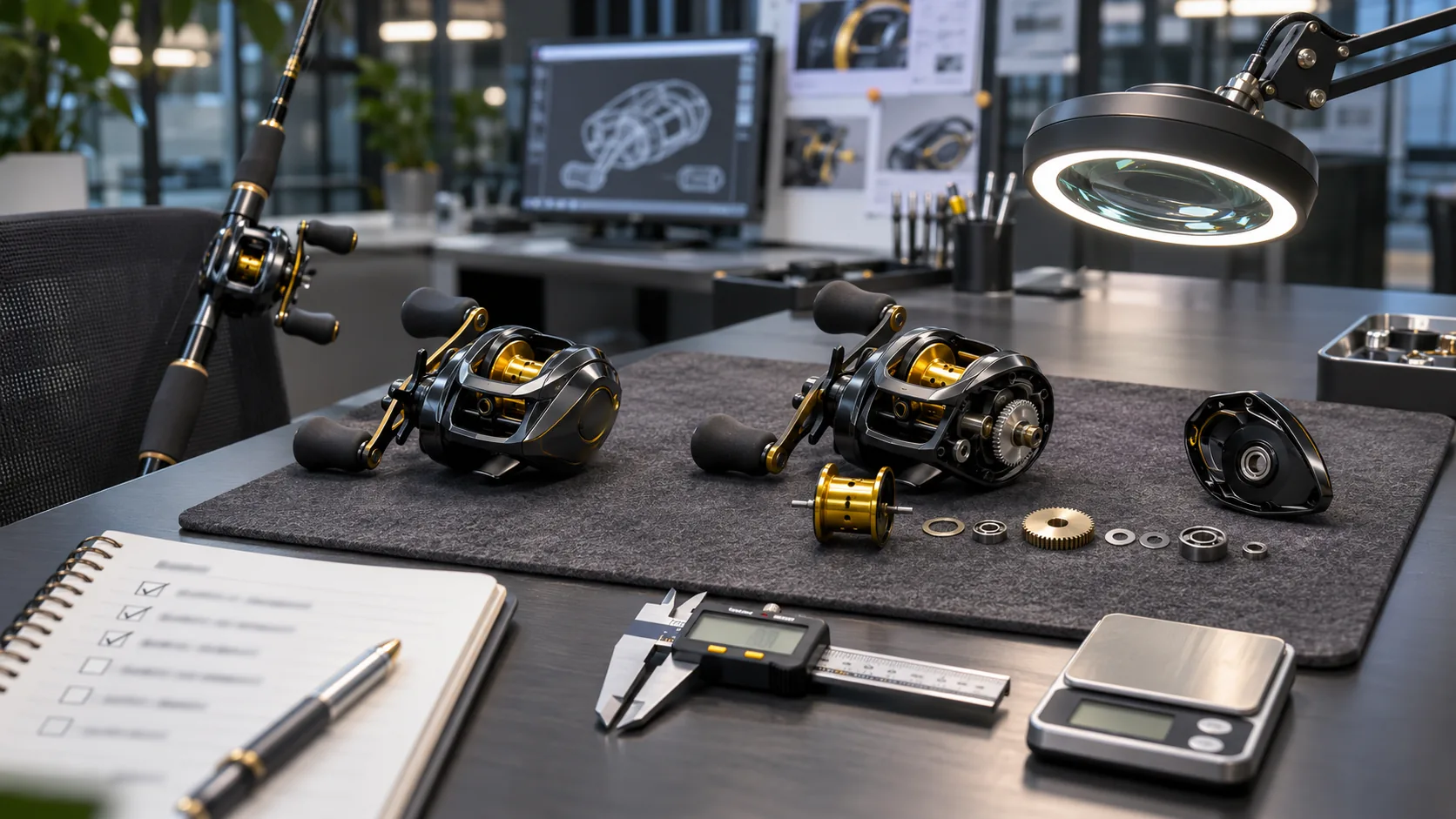
Figure: Schematic illustration. In a prototype review, items are checked against the checklist, and the prototype is opened with its parts laid out in order to inspect machining and assembly.
05|Recording and Feeding Back Issues
For each review round, compile one issue list rather than raising points piecemeal in chat:
| Column | Content |
|---|---|
| Number | For tracking and reference |
| Symptom | Specific description with photos or video |
| Conditions | With or without load, setting, position and frequency |
| Priority | Must fix, should fix, acceptable |
| Owner | Brand, factory, or to be confirmed by both |
| Countermeasure and due date | The factory’s proposed countermeasure and completion date |
| Status | Open, in progress, confirmed |
When the next prototype arrives, first confirm item by item that the previous issues are resolved, then start the new review.
06|How Many Prototype Rounds to Expect
| Stage | Purpose | Focus |
|---|---|---|
| Appearance and structure samples | Confirm shape, size and how the reel sits in hand | Cosmetics, dimensions, fit on the reel seat |
| Functional prototypes | Confirm feel and function | Rotation, casting, drag, clutch, teardown |
| Pilot samples | Confirm consistency with production processes and parts | Consistency between units, differences from the golden sample |
Each stage may need one or two revisions. Private label and color-change projects need fewer rounds; all-new developments need more. Prototypes are often made and adjusted by CNC or by hand, unlike production, so pilot samples must confirm the result after sign-off.
07|What to Confirm Before Sign-Off
- Final specification: weight, dimensions, gear ratio, drag, brake, bearing count and so on.
- Golden and boundary samples: the standard for feel and cosmetics, with each party keeping a set.
- Color samples: the color standard for cosmetic parts.
- Parts list and drawing revisions: part numbers, materials, surface treatments and revisions.
- Packaging and manual: approved proofs.
- Test results: endurance and environmental tests; see How to Plan Fishing Reel Reliability Testing.
- Inspection standard: sampling plan and acceptance criteria for shipment; see Fishing Reel OEM Pre-Shipment Inspection.
- Change control: how future changes to design, materials, processes and suppliers will be notified and approved.
For the overall process from product definition to first shipment, see How to Start Your Own Fishing Reel Brand.
08|How Zhongde Can Help
- Prototype builds: CNC machining and assembly are done in-house, so prototypes can be made and revised relatively quickly.
- Issue list follow-up: we analyze each item on the issue list, propose countermeasures and confirm them in the next prototype.
- Drag curves: our line-pull drag tester records drag curves for prototypes and benchmark reels for easy comparison.
- Baitcasting reel OEM: MOQ of 200 units for baitcasting reels; other reel types can be considered with sufficient volume.
- NDA first: check “An NDA is required first” in the RFQ form, and we will complete the NDA before reviewing your drawings.
Zhongde has worked with Japanese customers for more than 18 years, producing reel parts with demanding cosmetic and quality requirements.
Frequently Asked Questions
What should be checked first on a reel prototype?
Start by checking cosmetics, weight and main dimensions against the specification to confirm it is what you asked for. Then check rotation feel with and without load, which is the first thing users notice. Next check casting, drag, clutch and anti-reverse, and finally open the reel to inspect machining and assembly. Compare each item against a benchmark reel.
How should feel problems be described to the factory?
Be as specific as possible. State whether it happens with or without load, at which handle position, whether it occurs once per turn or continuously, and whether it is grittiness, tightness, play or noise, compare it with the benchmark reel, and ideally attach a video. Simply saying the feel is bad gives the factory little to work with; the more specific the description, the easier it is to tell whether gears, bearings, fits or lubrication are responsible.
How many prototype rounds does a reel usually need?
It depends on how much is customized. Projects typically pass through appearance and structure samples to confirm shape and size, functional prototypes to confirm feel and function, and pilot samples made with production processes to confirm consistency, and each stage may need one or two revisions. Private label and color-change projects need fewer rounds; all-new developments need more.
If the prototype passed, why can production still differ?
Prototypes are often made and adjusted by CNC or by hand, so their parts and assembly differ from production. Production switches to processes such as die casting or injection molding, or to different part lots, and dimensions and surfaces can change. That is why pilot samples made with production processes and parts should confirm feel, function and cosmetics after sign-off and before mass production.
What should be kept at sample sign-off?
At minimum: the approved golden sample, cosmetic boundary samples and color samples, the final specification, the parts list and drawing revisions, approved packaging and manual proofs, and test results. Each party should keep a set, and both should agree how future changes to design, materials, processes and suppliers will be notified and approved.