In This Article
Need fishing reel or tackle parts? Upload drawings for a quote
Direct Answer
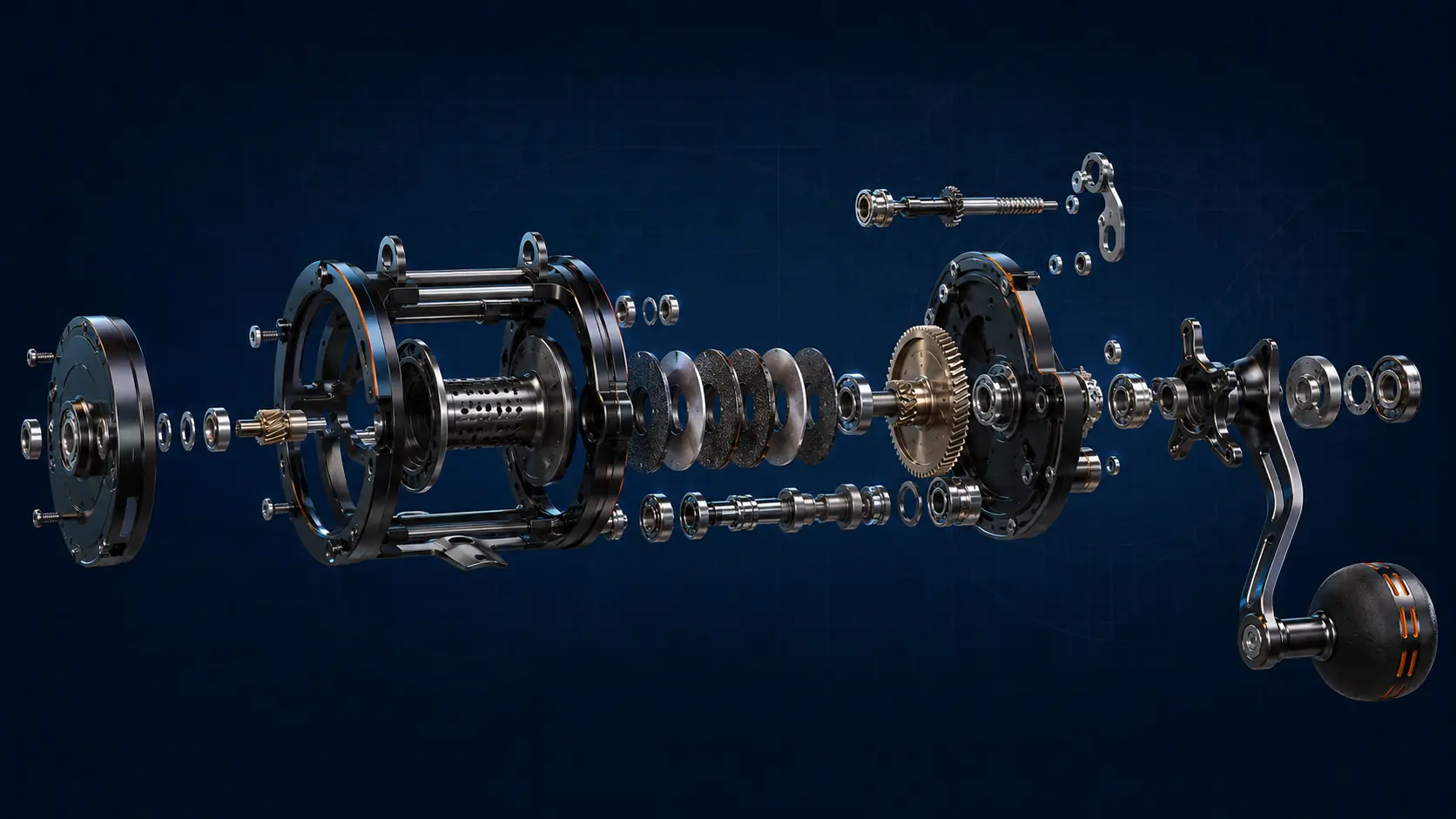
Baitcasting reel parts are easiest to understand in six functional groups.
| System | Main parts | What to control |
|---|---|---|
| Load-bearing structure | Frame, side plates, side covers, crossbars, reel foot | Bearing bore position, left-right parallelism, datums, distortion |
| Spool system | Spool, spool shaft, brake parts | Runout, balance, weight, shaft-end fits |
| Drive train | Drive gear, pinion gear, handle shaft | Tooth profile, center distance, shaft and bore fits |
| Drag and clutch | Star drag, drag pressure plates, clutch parts | Flatness, friction surfaces, repeatable movement |
| Controls | Handle, knobs, spool tension knob, brake dial | Strength, profile, mounting holes, feel |
| Level wind | Worm shaft, line guide, pawl | Straightness, groove condition, smooth movement |
Zhongde Precision has machined all of these metal parts. We have supplied Japanese customers for more than 18 years and have long produced reel parts with strict cosmetic and quality requirements. Bearings, drag washers, line and springs are purchased parts.
1. Load-Bearing Structure: Frame, Side Plates and Side Covers
The frame is the skeleton of the reel. Together with the left and right side plates, it supports the spool and gear shafts. Side covers hold bearings and carry the spool tension knob and brake dial.
| Part | Role | Common materials | Main processes |
|---|---|---|---|
| Frame | Main skeleton, supports the shafts | Aluminum alloy, magnesium alloy, resin | Machined from billet, or die cast and machined |
| Side plates | Support the spool and gear shafts | Aluminum alloy, magnesium alloy | CNC machining, anodizing |
| Side covers | Hold bearings, carry adjusting parts | Aluminum alloy, resin | CNC machining, anodizing, laser marking |
| Crossbars and reel foot | Tie both sides together, mount to the rod | Aluminum alloy, stainless steel | CNC machining |
The most important point is locating the left and right bearing bores from the same datum. Each side can be in tolerance on its own while the relationship between them is off, which tilts the shafts and shows up as rough winding and noise. Thin walls distort easily, so roughing and finishing are separated.
For more detail, see how to choose reel frame material and controlling frame and side plate distortion.
2. Spool System: Spool, Spool Shaft and Brake Parts
The spool decides casting distance and retrieve performance. It needs to be light, with low runout and good balance.
| Part | Role | Common materials | Main processes |
|---|---|---|---|
| Spool | Holds line, spins at high speed when casting | Aluminum alloy | Turning, drilling, balancing, anodizing |
| Spool shaft | Axis of the spool | Stainless steel | Turning, grinding |
| Brake parts | Magnet holders, centrifugal brake pins and similar | Aluminum alloy, resin | CNC machining |
Thin-walled spools distort easily during cutting and clamping, which goes straight into runout and balance. More lightening holes mean less strength and stiffness, so weight alone is not the right measure.
For more detail, see spool machining, runout and balance, spool size and line capacity and magnetic and centrifugal casting brakes.
3. Drive Train: Drive Gear, Pinion Gear and Handle Shaft
These parts carry the rotation of the handle to the spool. Much of the winding feel, durability and noise is decided here.
| Part | Role | Common materials | Main processes |
|---|---|---|---|
| Drive gear | Takes handle rotation and steps up the speed | Brass, aluminum alloy, stainless steel | Turning, gear cutting |
| Pinion gear | Drives the spool; engaged and released by the clutch | Brass, stainless steel | Turning, gear cutting |
| Handle shaft | Connects the handle and the drive gear | Stainless steel | Turning, grinding |
Gear accuracy alone is not enough. The gears turn smoothly only when the center distance to the side plate bearing bores and the shaft and bore fits are also right.
For more detail, see drive gear material selection, choosing a gear ratio and gear, shaft and bearing alignment.
4. Drag and Clutch
The drag lets line out under the pull of a fish. The clutch disconnects the spool from the gears for casting.
| Part | Role | Common materials | Main processes |
|---|---|---|---|
| Star drag | Adjusts drag force | Aluminum alloy, resin | CNC machining, anodizing |
| Drag pressure plates and metal washers | Clamp and press the drag washers | Stainless steel | CNC machining, stamping, flat finishing |
| Clutch parts | Engage the pinion, move the thumb bar | Stainless steel, brass, resin | CNC machining |
Drag stability depends not only on the washer material but also on the flatness and surface of the metal parts that press on the washers. Zhongde measures drag force and stability on a line-pull drag tester and is developing its own carbon drag washers.
For more detail, see drag washer materials and drag consistency and the clutch mechanism and thumb bar.
5. Controls: Handle, Knobs and Adjustment Knobs
These are the parts the angler touches. Beyond strength and feel, they are also cosmetic parts that shape how the brand looks.
| Part | Role | Common materials | Main processes |
|---|---|---|---|
| Handle | Transmits retrieve torque | Aluminum alloy, carbon fiber | CNC machining, anodizing, diamond cut edges |
| Handle knobs | Where the fingers grip | Aluminum alloy, titanium alloy, carbon fiber, engineering plastic | Turning, anodizing |
| Spool tension knob and brake dial | Adjust spool tension and casting brake | Aluminum alloy, resin | CNC machining, anodizing, laser marking |
A longer handle gives more torque, so strength around the mounting hole matters. Color, diamond cut edges and logo method change how the product is perceived.
For more detail, see handle knob materials and custom manufacturing and color and logo customization.
6. Level Wind: Worm Shaft and Line Guide
The level wind lays line evenly across the spool.
| Part | Role | Common materials | Main processes |
|---|---|---|---|
| Worm shaft | Shaft with crossed helical grooves that drives the guide back and forth | Stainless steel | Turning, groove machining |
| Line guide | Carries the line from side to side | Aluminum alloy, stainless steel, ceramic guide ring | CNC machining, assembly |
| Pawl | Rides in the worm shaft groove | Stainless steel, resin | CNC machining |
Poor groove condition or straightness makes the level wind stiff and the line uneven. For more detail, see the level wind and worm shaft.
7. Purchased and Non-Metal Parts
Bearings, drag washers, line, springs, screws and EVA or cork knobs are normally purchased parts. For complete reel OEM, their specifications are confirmed at the quoting stage. For bearings, see choosing reel bearings.
8. Why One Factory for the Full Set of Parts
- Same assembly datums: frame, side plate, gear and spool dimensions are controlled from one set of datums.
- Easier color matching: cosmetic parts go through the same anodizing line, which keeps part-to-part color differences under control.
- Faster changes: a design change needs only one point of contact.
If relying on one supplier is a concern, purchased parts and some machined parts can be sourced separately.
9. Parts Only or Complete Reel OEM
Custom aftermarket parts, spare parts and replacement cosmetic parts can be machined as individual parts, with quantities evaluated by part and color. The minimum order for complete baitcasting reel OEM is 200 units.
- Aftermarket parts: aftermarket custom parts OEM
- Quotes for custom parts: custom spools, custom handles and custom knobs
- Spare parts after launch: after-sales service and spare parts
- Preparing an RFQ: preparing a reel parts RFQ
New projects can start with samples: we make a small quantity from your drawings first, and volume production follows once machining, finishing and inspection are confirmed.
Frequently Asked Questions
Which reel parts has Zhongde Precision machined?
Frames, side plates, side covers, spools, spool shafts, drive gears, pinion gears, handle shafts, star drags, clutch parts, handles, knobs, adjustment knobs, worm shafts and line guides. We have machined all the metal parts of a baitcasting reel. Bearings, drag washers and line are purchased parts.
Can we order only some of the parts?
Yes. Custom aftermarket parts, spare parts or replacement cosmetic parts can be machined as individual parts, and quantities are evaluated by part and color. The minimum order for complete baitcasting reel OEM is 200 units.
What is the advantage of having one factory make the full set of parts?
Frame, side plate, gear and spool dimensions can be controlled from the same assembly datums, cosmetic parts go through the same anodizing line so colors match more easily, and design changes need only one point of contact. If relying on one supplier is a concern, purchased parts and some machined parts can be sourced separately.
Can you make spinning reel parts?
This article uses baitcasting reels as the example. Spinning reel rotors, spools and main shafts have a different structure, and we evaluate them from drawings. Complete OEM for other reel types can also be evaluated when the volume is large enough.
What should we prepare for a quote?
Please send 3D models and 2D drawings, materials, surface finish and color, quantities, and whether assembly is needed. For cosmetic parts, color chips or limit samples help align color and appearance standards faster.