In This Article
Need fishing reel or tackle parts? Upload drawings for a quote
Direct Answer
There is no single best material for a fishing reel frame; the choice depends on price point, volume, weight target, operating environment and appearance requirements.
- One-piece CNC aluminum: high rigidity, good accuracy, an attractive anodized finish and no tooling; longer machining time and higher unit cost.
- Die-cast aluminum: lower unit cost at volume, but needs a die; it usually does not anodize attractively and is normally painted.
- Magnesium: lighter, but with poor corrosion resistance and a need for complete surface protection; better suited to lightweight freshwater reels.
- Carbon-fiber-reinforced resin: light, rust-free and low cost in volume; less rigid than metal, sensitive to temperature and humidity, and needs a mold.
Frame rigidity directly affects gear mesh under heavy load, so the material should be chosen together with bearing seat accuracy and side plate design.
01|What the Frame Does in a Reel
The frame of a baitcasting reel is the datum and backbone of the whole reel:
- it carries the bearing seats for the spool shaft, main shaft and pinion;
- it locates the left and right side plates and determines whether the two bearing seats are concentric;
- it carries retrieve and fighting loads and holds the gear center distance;
- it is where the angler holds the reel, so it defines appearance and feel.
When the frame deflects under load, the gear center distance and shaft alignment change, showing up as a heavier feel, grittiness and noise. Frame material is therefore not only about weight and looks; it is also about rigidity and accuracy.
02|Common Frame Materials and Processes Compared
| Material and process | Advantages | Watch points | Typical finish | Best suited to |
|---|---|---|---|---|
| One-piece CNC aluminum | High rigidity, good accuracy, premium look; no tooling | Long machining time, higher unit cost, high material removal | Anodizing | Mid- to high-end, saltwater, small starting volumes |
| Forged blank + CNC | Continuous grain flow, good strength, less machining stock | Needs forging dies; suits meaningful volume | Anodizing | High-load, mid- to high-end production |
| Die-cast aluminum + CNC finishing | Low unit cost in volume; suits complex shapes | Needs a die; possible porosity; does not anodize attractively | Painting | Lower price points, higher volumes |
| Magnesium | Lighter than aluminum (density about two-thirds) | Poor corrosion resistance and needs complete protection; chips are a fire risk, so machining needs care | Conversion coating + paint | Lightweight freshwater reels |
| Carbon-fiber-reinforced resin (injection molded) | Light, rust-free, low cost in volume | Lower rigidity; dimensions shift with temperature and humidity; may creep under long-term load | Molded-in color or paint | Lightweight, price-sensitive models |
For general material selection principles, see Material Selection.
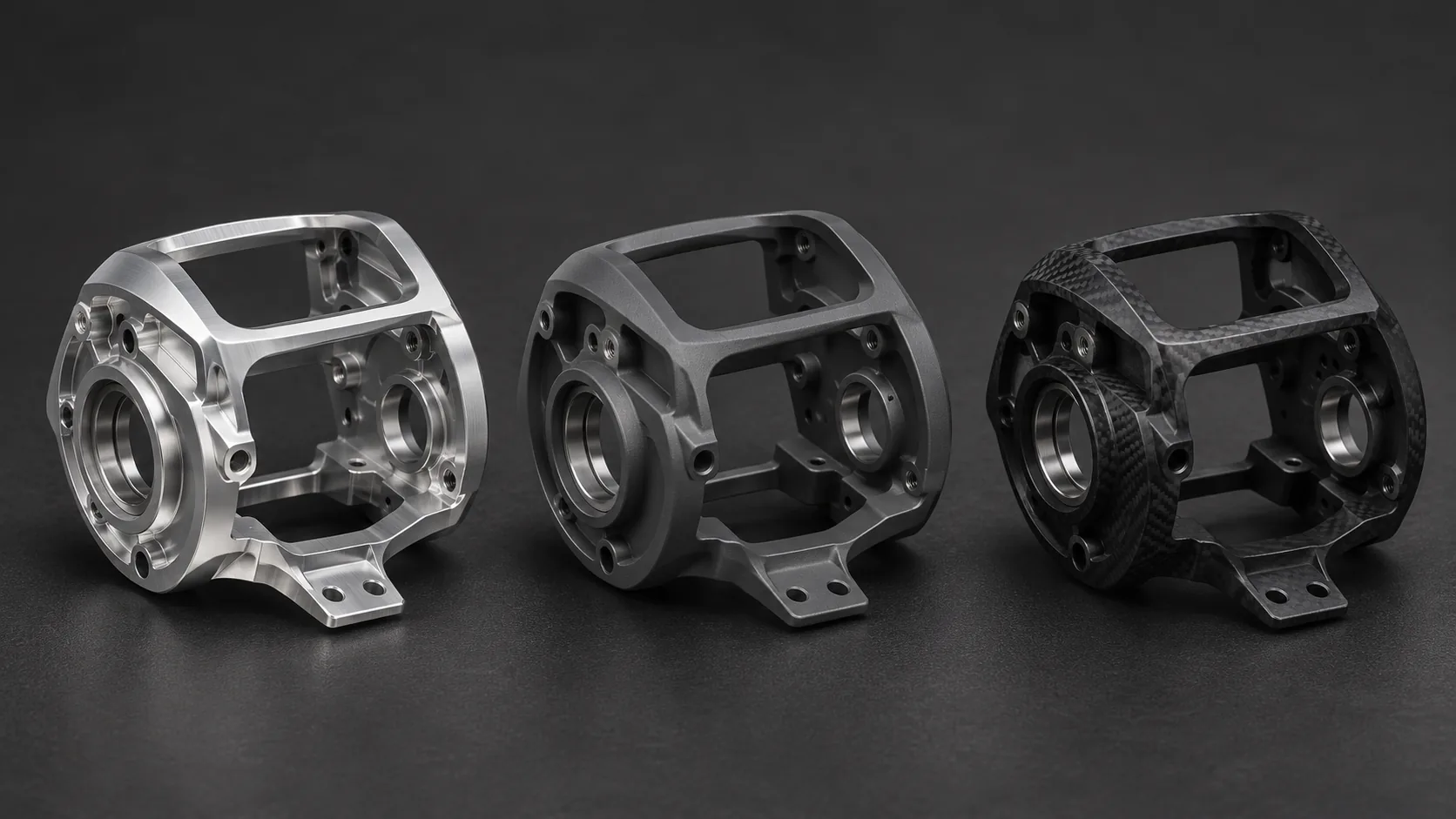
Figure: Schematic illustration. From left to right: a one-piece CNC aluminum frame, a die-cast metal frame and a carbon-fiber-reinforced resin frame. Each material differs in rigidity, weight, appearance and suitable volume.
03|Structural Choices
Besides material, frame structure also affects rigidity, weight and cost:
- One-piece frame or frame plus side plates: a one-piece frame is more rigid and makes it easier to keep the two bearing seats concentric; a split design is more flexible to machine and assemble.
- Skeletonizing: cut-outs reduce weight but also reduce rigidity, so their position and size must follow the load paths.
- Mixed materials: for example an aluminum frame with resin side plates, balancing weight, cost and rigidity. Joints between different materials need attention to galvanic corrosion and differential thermal expansion.
- Wall thickness: thin walls save weight but distort more easily during machining and anodizing, which must be considered at the design stage.
For machining distortion of thin-wall frames, see Why Fishing Reel Frames and Side Plates Deform.
04|Volume and Tooling Investment
Frame material choice depends heavily on volume:
| Method | Tooling investment | Unit cost | Flexibility for design changes |
|---|---|---|---|
| One-piece CNC | No dedicated tooling | Higher | High |
| Forging + CNC | Forging dies | Medium | Medium |
| Die casting + CNC | Die-casting die | Lower at volume | Low |
| Resin injection | Injection mold | Lowest at volume | Low |
For brands starting small, a one-piece CNC aluminum frame is often the better fit: it avoids tooling investment and keeps design changes flexible. Once sales are stable, die casting or injection molding can be evaluated. For how tooling and unit price relate, see Fishing Reel OEM Explained: How MOQ, Tooling Cost and Unit Price Are Set.
05|Surface Treatment and Color
Each material suits different surface treatments, which directly affects the look a brand wants:
- CNC aluminum (bar, plate or forged blank): suits anodizing, with a wide range of colors, two-tone finishes and diamond-cut edges.
- Die-cast aluminum: its relatively high silicon content makes anodized color dark and uneven, so it is normally painted.
- Magnesium: needs a conversion coating and paint; the integrity of the coating determines corrosion resistance.
- Resin: can use molded-in color or paint, but a metallic feel is hard to achieve.
If a brand wants multiple anodized colors or diamond-cut edges, a CNC aluminum frame is usually required. For color and logo customization, see How Small Brands Customize Fishing Reels.
06|Choosing a Frame for Saltwater Reels
Saltwater reels demand more corrosion resistance and rigidity, so anodized aluminum frames are usually preferred, with proper sealing, insulation between dissimilar metals and drainage design. Magnesium has poor corrosion resistance in seawater and is prone to galvanic corrosion in contact with stainless steel, so it is generally not recommended for saltwater reels. For detailed corrosion design, see Saltwater Fishing Reel Corrosion Protection.
07|How to Validate a Frame
| Validation item | Purpose |
|---|---|
| Feel and deflection under load | Retrieve under heavy load; confirm feel, noise and stable gear mesh |
| Bearing seat dimensions and concentricity | Confirm key dimensions, including after surface treatment |
| Drop and impact | Confirm the frame and side plates do not deform or crack after a drop |
| Coating adhesion and corrosion resistance | Coatings on die-cast aluminum and magnesium, and anodic film corrosion resistance |
| Dimensional stability | Dimensional change of resin frames at different temperatures and humidity |
| Endurance | Gear wear and change in feel after long-term use |
08|Information to Include in Your RFQ
| Information | Why it matters |
|---|---|
| Product position and price point | Sets the direction for material and process |
| Expected volume | Determines whether CNC, die casting or injection fits, and the tooling investment |
| Weight target | Whether magnesium, resin or skeletonizing is needed |
| Operating environment | Freshwater or saltwater |
| Appearance requirements | Anodized colors, diamond-cut edges or paint |
| Benchmark reels | Used to compare rigidity, weight and feel |
09|How Zhongde Can Help
- A range of processes: CNC machining, aluminum die casting, forging, injection molding, and in-house mold design and manufacturing, so frame material and process can be evaluated together based on volume and positioning.
- Surface treatment: anodizing and painting are done in-house, which helps control both appearance and dimensions.
- Baitcasting reel OEM: MOQ of 200 units for baitcasting reels; other reel types can be considered with sufficient volume.
- NDA first: check “An NDA is required first” in the RFQ form, and we will complete the NDA before reviewing your drawings.
Zhongde has worked with Japanese customers for more than 18 years, producing reel parts with demanding cosmetic and quality requirements.
Frequently Asked Questions
Is aluminum or carbon-fiber-reinforced resin better for a reel frame?
It depends on the product position. An aluminum frame is more rigid, keeps gear mesh more stable under heavy load and looks and feels more premium, which suits mid- to high-end and saltwater reels. A carbon-fiber-reinforced resin frame is lighter, does not rust and is cheaper in volume, which suits lightweight and price-sensitive models, but it is less rigid and its dimensions shift with temperature and humidity. Some designs combine an aluminum frame with resin side plates.
Why are die-cast aluminum frames usually not anodized?
Common die-casting aluminum alloys contain a relatively high amount of silicon, so anodizing gives a dark, uneven color and an attractive finish is hard to achieve. Die castings can also have porosity on and below the surface, which affects appearance and the coating. Die-cast frames are therefore usually painted, with mating surfaces such as bearing seats finished by CNC. For an anodized look, frames are normally CNC machined from aluminum bar, plate or forged blanks.
Is a magnesium frame suitable for saltwater fishing?
Generally not recommended. Magnesium is very light, but it is highly active in the galvanic series, has poor corrosion resistance and is prone to galvanic corrosion when in contact with metals such as stainless steel. A saltwater reel with a magnesium frame needs complete surface protection, insulation design and thorough saltwater validation. Magnesium is more commonly used in lightweight freshwater reels.
Which frame suits a brand starting with small volumes?
At low volumes, a one-piece CNC aluminum frame is often the better choice. It needs no die-casting or injection mold, design changes are easier, and high levels of appearance and rigidity are achievable. The unit cost is higher, but the tooling investment is avoided. Once sales are stable and volumes grow, die casting or injection molding can be evaluated to lower unit cost.
What are the symptoms of a frame that is not rigid enough?
Typical symptoms are a heavy, tight or gritty feel when retrieving under heavy load, gear noise, inconsistent drag behavior and faster gear wear over time. The cause is that the frame deflects under load and changes the gear center distance and shaft alignment. Frame rigidity should be designed and validated together with bearing seat accuracy and side plate design.