
In This Article
Need fishing reel or tackle parts? Upload drawings for a quote
Direct Answer
Saltwater reels rarely corrode only because the material is not good enough. The usual causes are material combinations and design details:
- Dissimilar metals in contact: an aluminum frame touching stainless steel screws, shafts or bearings forms a galvanic couple in seawater, and the aluminum corrodes first.
- Interrupted anodic coating: threaded holes, masked areas, post-machined faces and dents lack a complete coating and become starting points.
- Crevices and water traps: salt stays in gaps and accelerates corrosion through wet and dry cycles.
So corrosion protection cannot wait until problems appear. It belongs in the design stage:
Choose the right grades → control anodize thickness and sealing → isolate dissimilar metals → use corrosion-resistant bearings → reduce crevices and design drainage → validate by testing → write clear care instructions.
01|Why seawater is so hard on reels
| Factor | Effect on a reel |
|---|---|
| Chloride ions | Break down passive films and cause pitting in aluminum and some stainless steels |
| Wet and dry cycles | Seawater evaporates, salt concentrates and crystallizes, then corrosion speeds up when it gets wet again |
| Conductive seawater | Connects different metals in contact into a galvanic couple |
| Sand and salt crystals | Enter bearings and the drag, causing wear and sticking |
| Sun and heat | Age greases and rubber seals faster |
Compared with freshwater, saltwater use is far harsher. Many anglers also do not rinse their reels promptly, so reels are stored with salt on them and corrosion keeps working where nobody can see it.
02|Galvanic corrosion: which metal fails first?
When two metals with different potentials touch and are connected by a conductive liquid such as seawater, they form a galvanic couple. The metal with the lower (more active) potential corrodes faster, and the more noble metal is protected.
In seawater, common reel materials rank roughly as follows, from most to least prone to corrode:
Magnesium alloys → zinc → aluminum alloys → carbon steel → brass and bronze → stainless steel (passive) → titanium alloys
The most typical combination on a reel is aluminum touching stainless steel:
| Contact | Risk | Common measures |
|---|---|---|
| Aluminum frame or cover + stainless screws | Aluminum around threaded holes corrodes, screws seize or the coating blisters | Anti-corrosion grease or sealant on threads, isolating washers where needed |
| Aluminum part + stainless shaft or bearing outer ring | Corrosion around bearing seats affects fit and rotation | Keep the coating intact or protect the seat, use corrosion-resistant bearings |
| Aluminum part + brass part | The aluminum side corrodes | Reduce direct contact, isolate or protect the interface with grease |
| Magnesium part + any other metal | Magnesium is very active and carries the highest risk | Complete surface protection and isolation are essential; not recommended for exposed saltwater parts |
Watch the area ratio too. A small piece of aluminum surrounded by a large stainless area corrodes faster and more locally. Small aluminum parts such as aluminum screws or washers on large stainless parts carry a higher risk in seawater.
03|Choosing materials
| Material | Characteristics | Saltwater notes |
|---|---|---|
| 6061 aluminum | Balanced machinability and corrosion resistance, anodizes well | Common for frames and side covers |
| 7075 aluminum | High strength, suited to lightweight and loaded parts | Less corrosion resistant than 6061, relies more on anodize and sealing |
| Magnesium alloys | Very light | Poor corrosion resistance, needs complete surface protection for saltwater |
| 303 stainless steel | Free-machining, efficient to produce | Less corrosion resistant than 304 and 316, use with care on exposed parts |
| 304 stainless steel | General purpose, good corrosion resistance | Can still pit in seawater |
| 316 stainless steel | Contains molybdenum, better resistance to chlorides | Higher cost and harder to machine, suits critical exposed parts |
| Martensitic stainless (e.g. 440C) | Can be hardened, common in bearings | Less corrosion resistant than austenitic grades |
| Brass | Machines well, common in gears | Can dezincify in seawater, usually internal and protected by lubrication |
| Titanium alloys | Excellent corrosion resistance, high strength | High cost, difficult to machine |
| POM and other engineering plastics | Do not rust, useful as isolators | Strength, wear and dimensional stability need separate evaluation |
For more on aluminum grades, see 6061 vs 6063 vs 7075 aluminum alloy selection.
04|Anodizing: protection depends on thickness and sealing
The corrosion resistance of aluminum parts depends heavily on the anodic coating. But a good coating cannot be judged by color alone:
- Thickness: a coating that is too thin lacks both corrosion and wear resistance. State thickness on the drawing or specification and measure it at first article and on production lots.
- Sealing: the coating is full of fine pores and must be sealed to resist corrosion well. Insufficient sealing lets salt in.
- Where the coating is interrupted: threaded holes, masked contact faces, rack points and faces machined after anodizing have no complete coating.
- Dents and scratches: once the coating is broken, bare aluminum is exposed.
So for saltwater reels, design and process planning should consider where the coating will be missing and how those areas will be protected, for example by placing masked areas where seawater rarely reaches, or covering them with grease or sealant at assembly.
For anodized appearance and coating control, see cosmetic finish control for anodized aluminum reel parts.
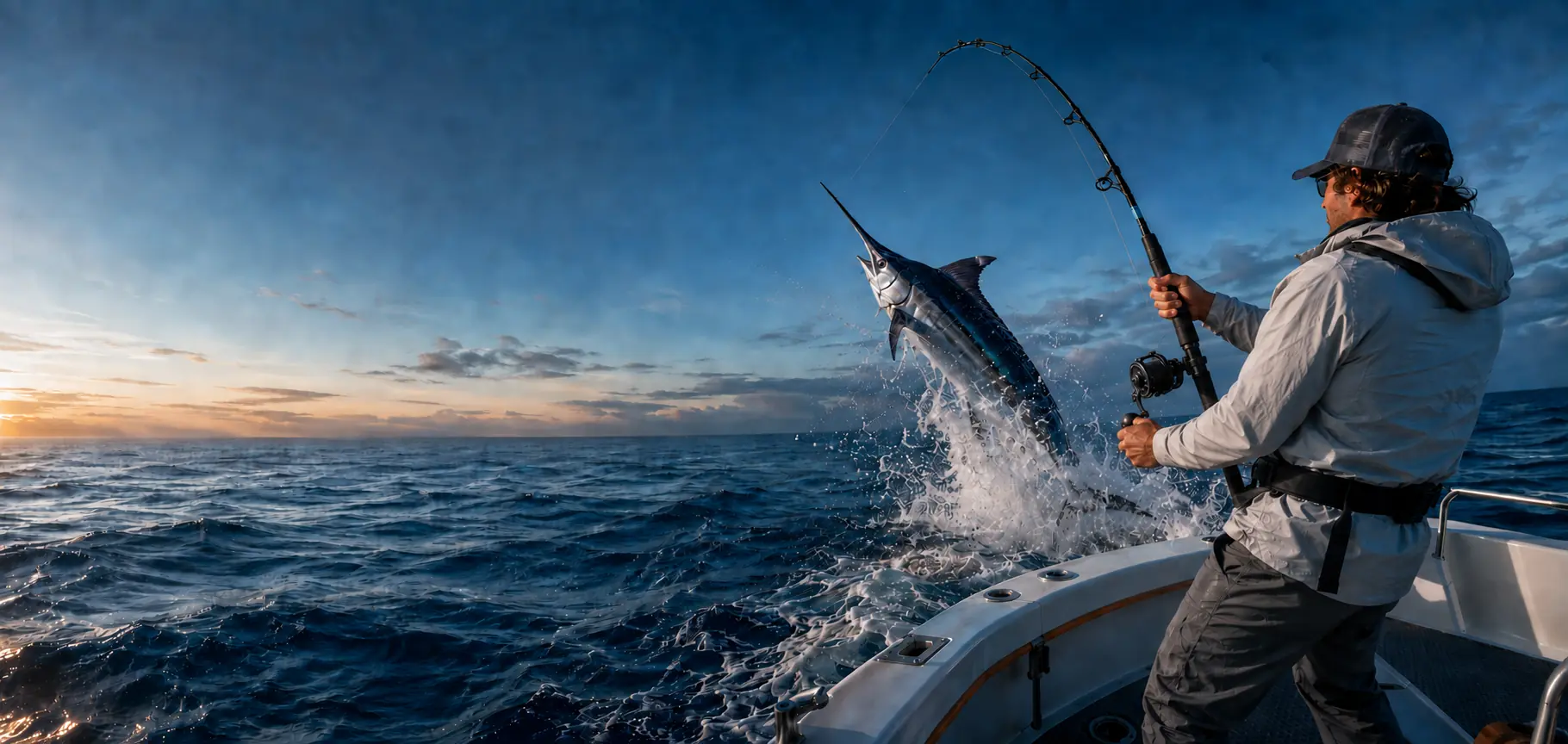
Figure: saltwater reels live with spray, salt mist and constant wet and dry cycles. Material combinations and design details decide how long they last.
05|Bearings and shafts: usually the first to fail
Bearings and shafts turn the most and are the most sensitive to corrosion. Once a bearing rusts, rotation becomes rough and noisy and can eventually seize.
| Location | Common practice |
|---|---|
| Spool bearings | Corrosion-resistant bearings with shields or seals, ceramic hybrids where justified |
| Drive-side bearings | Corrosion-resistant bearings, with water protection around the drag and gears |
| One-way bearing | Sensitive to corrosion and grease condition, needs special attention to sealing and lubrication |
| Shafts | Stainless grades with suitable corrosion resistance, no water traps at fits |
Note that corrosion resistance and precision class are different things. A high-precision bearing that is not corrosion resistant can fail sooner in saltwater than a standard-precision corrosion-resistant one.
06|Design: fewer crevices, a way for water to drain
A lot of corrosion starts in crevices. Seawater in a gap is hard to rinse out, leaves salt behind when it evaporates and creates a local corrosive environment.
| Design point | Approach |
|---|---|
| Fewer crevices and blind holes | Avoid unnecessary narrow gaps; drain or seal blind holes |
| Drainage paths | Let water that enters the body drain out instead of collecting at the bottom |
| Seal critical areas | Use seals or water-resistant designs for the drag and one-way bearing |
| Protect threaded joints | Anti-corrosion grease or sealant on threads to keep seawater out |
| Spool-to-frame clearance | Balance free rotation with keeping debris out |
Once water reaches the drag, the condition of washers and grease changes and drag force becomes unstable. Saltwater reels usually need a drag designed with water resistance in mind. For more on drag systems, see drag washer materials and drag consistency.
07|How to validate corrosion protection
| Method | What it is good for | Note |
|---|---|---|
| Neutral salt spray (e.g. ISO 9227 or ASTM B117) | Comparing materials, finishes and processes under identical conditions | Results cannot be converted into years of service |
| Immersion and drying cycles | Simulating repeated wetting and drying in saltwater use | Agree the conditions in advance and run with reference samples |
| Teardown after real use | Finding where corrosion actually happens | Record by location to find weak points |
| Coating thickness and sealing checks | Confirming the anodic coating meets the requirement | Include in first article and lot inspection |
The most common misunderstanding is that a number of salt spray hours equals a number of years in service. Salt spray is good for comparison, but it differs greatly from real use with its wet and dry cycles, sunlight, wear and maintenance. Combine several methods when validating a saltwater reel.
08|Care instructions are part of corrosion design
Even the best design fails without care. State clearly in the manual:
- Rinse after use: rinse gently with fresh water rather than spraying with high pressure, which drives salt water and sand into bearings and the drag.
- Tighten the drag before rinsing: this keeps water out of the drag.
- Dry thoroughly: wipe the reel and let it air-dry in a ventilated place before storing it.
- Oil regularly: oil or grease the specified points as the manual describes.
- Service periodically: after long saltwater use, strip and clean the reel periodically or send it for service.
Putting these steps in the manual, with a short reminder on the box or tag, noticeably reduces service problems.
09|Share this information when you request a quote
| Information | Why it matters |
|---|---|
| Environment | Freshwater, inshore, offshore, or both salt and fresh |
| Target species and maximum drag | Sets strength and structure |
| Materials for exposed parts | Whether specific aluminum and stainless grades are required |
| Anodizing requirements | Thickness, sealing, color |
| Bearing requirements | Count, corrosion resistance, sealing |
| Water resistance | Whether the drag and bearings must be water resistant |
| Validation requirements | Conditions and pass criteria for salt spray or immersion and drying cycles |
10|What Zhongde Precision can do
- Materials and finishing considered together: aluminum machining, anodizing and painting are done in-house, so materials, coatings and masked areas can be evaluated together at the design stage.
- Dual-axis reel OEM: low-profile baitcasting and round conventional reels, with an MOQ of 200 units.
- Parts only is also possible: frames, side covers, spools, handle arms and other precision parts can be machined separately.
- NDA first: tick “An NDA is required first” when you submit an inquiry, and we will handle the NDA before reviewing your drawings.
Zhongde Precision has supplied Japanese customers for more than 18 years, producing reel parts with demanding appearance and quality requirements.
Frequently Asked Questions
Where do saltwater reels usually corrode first?
Most often where aluminum parts touch stainless steel screws, shafts or bearings, and where the anodic coating is interrupted, such as threaded holes, masked contact faces, faces machined after anodizing, and dents or scratches. Crevices, blind holes and areas that trap water also tend to fail before open surfaces, because salt stays there through wet and dry cycles.
Will aluminum parts with stainless steel screws corrode?
In seawater there is a risk of galvanic corrosion, and aluminum is the side that corrodes. Common measures are keeping the anodic coating intact at the contact, using isolating washers or anti-corrosion grease or sealant on the threads, and avoiding small aluminum parts surrounded by large stainless areas. The right approach depends on the structure and the conditions of use.
Why do anodized reels still corrode?
The corrosion resistance of an anodic coating depends on its thickness and sealing quality. If sealing is insufficient, salt penetrates the pores of the coating. Threaded holes, masked areas, post-machined faces and dents also interrupt the coating and expose bare aluminum to seawater. So beyond color, control coating thickness, sealing quality and where the coating is interrupted.
Does a number of salt spray hours guarantee a number of years in service?
No, the two cannot be converted directly. Salt spray tests such as ISO 9227 or ASTM B117 are suited to comparing materials, finishes and processes under identical conditions, but they differ greatly from real saltwater fishing with its wet and dry cycles, sunlight, wear and maintenance. Combine salt spray with immersion and drying cycles and teardown inspection after real use.
How should a saltwater reel be cared for after use?
Rinse the outside gently with fresh water after use rather than spraying it with high pressure, which drives salt water and sand into bearings and the drag. Tighten the drag moderately before rinsing, then wipe the reel dry, let it air-dry in a ventilated place and oil the specified points regularly as the manual describes. Writing these steps into the manual noticeably reduces service problems.