
In This Article
Need fishing reel or tackle parts? Upload drawings for a quote
Direct Answer
Importing baitcasting reels from China into Australia comes down to five things:
- Duty and GST: fishing reels (tariff code 9507.30) have a general duty rate of Free, but 10% GST applies, which GST-registered businesses can usually claim back.
- Customs and biosecurity: sea freight needs a packing declaration, and solid timber packaging must meet ISPM 15.
- Origin claims: not mandatory, but any claim must be true and not misleading.
- Selling seasons: Christmas falls in the Australian summer, and the trade show is in the second half of the year, so schedule backwards from these dates.
- Specs: estuary and coastal conditions call for corrosion protection; big fish need margin in drag and gear strength.
Always confirm current tariff, biosecurity and regulatory requirements with official Australian sources and your customs broker. This article is general information, not legal or tax advice.
01|Duty and GST
| Item | Notes |
|---|---|
| Tariff code | Fishing reels are generally classified under 9507.30 |
| Duty | General rate Free; also duty-free under ChAFTA |
| GST | 10%, on customs value plus duty, transport to Australia and insurance |
| GST credits | GST-registered businesses importing for business use can usually claim credits |
| Deferral | Eligible importers can apply to defer GST |
| Records to keep | Import declaration, payment receipt and similar, needed to claim credits |
A few reminders:
- Certificate of origin: since reels already have a general duty rate of Free, a certificate of origin is usually not needed to reduce duty. If the same shipment includes other dutiable goods, check with your customs broker whether a ChAFTA certificate of origin should be used.
- Low-value goods: different rules apply to low-value goods of AUD 1,000 or less. Purchases by brands and retailers normally exceed this and go through a formal import declaration.
- Customs broker: we recommend using a local Australian customs broker to handle the import declaration, GST and biosecurity steps.
02|Biosecurity for Sea Freight
Australia applies strict biosecurity controls to imports. The reels themselves are rarely the issue; packaging and containers are:
- Packing declaration: both FCL and LCL sea consignments need a packing declaration from the party that packed the goods, stating whether timber or bamboo packaging is used and whether it has been treated.
- Timber packaging: solid timber pallets and crates must meet ISPM 15, treated and marked. Reconstituted wood such as plywood generally does not need to be declared.
- Container cleanliness: FCL containers need a cleanliness statement confirming they are free of soil and plant or animal material.
- Format: the declaration needs the packer’s letterhead or company stamp, a signature and a date, and must link to the specific consignment.
A reliable packing declaration reduces the chance of inspection on arrival. Import conditions for specific goods can be checked in the Australian Department of Agriculture’s import conditions database. For other packing and loading points, see reel packaging and export shipping.
03|Origin Claims and Consumer Guarantees
- Origin labels are not mandatory: according to ACCC guidance, the Australian Consumer Law does not require origin labels on non-food goods.
- Claims must be true: if you make an origin claim, it must be true and not misleading. For example, Made in Australia requires the last substantial manufacturing step to happen in Australia.
- Watch the overall impression: even if the words are correct, images and other wording that together mislead about origin can still be a problem.
- Consumer guarantees: the Australian Consumer Law includes quality guarantees for goods sold to consumers, so brands need a plan for repairs, refunds and spare parts. See after-sales and spare parts planning.
Origin markings on packaging and manual content should be confirmed by the brand and provided to the factory.
04|Selling Seasons and Lead Time
Australia is in the southern hemisphere, so seasons are the reverse of the northern hemisphere:
- Summer is peak season: Christmas and the New Year holidays fall in summer, a key period for tackle sales.
- The trade show is in the second half of the year: the Australian Fishing Trade Association show was held in August in 2026; brands often launch new products there and dealers place orders.
- Schedule backwards from these dates: from your launch date, work back through ocean freight, customs clearance, pre-shipment inspection, production, pilot run and prototypes. Chinese New Year falls in January or February, close to the Australian peak season, so plan around it.
For how to build the schedule, see planning reel OEM lead time.
05|What Australian Fishing Demands from a Baitcaster
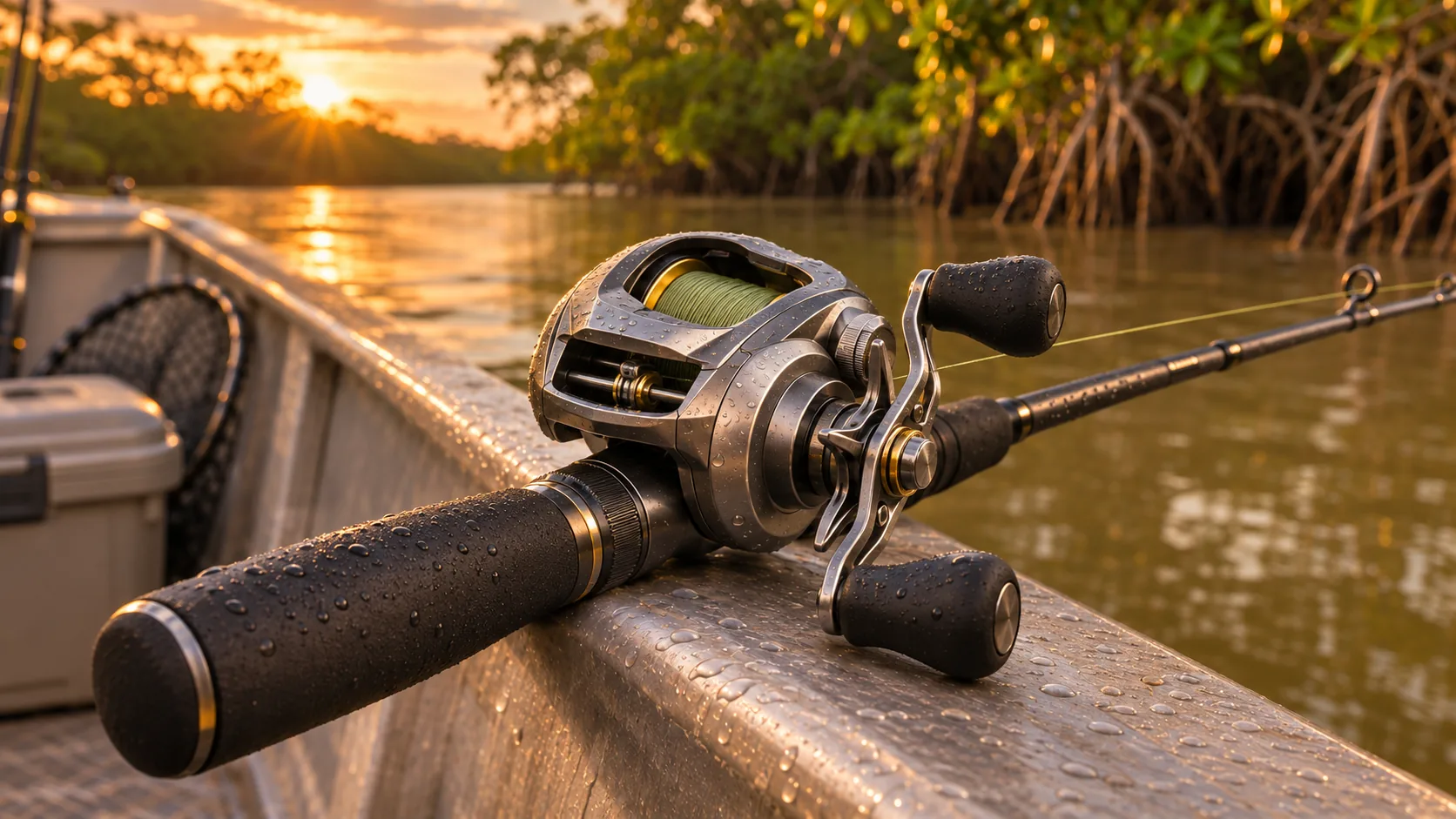
Figure: Schematic. Hot, humid estuary and coastal conditions with salt spray place high demands on corrosion protection.
| Fishing situation | Spec points to watch |
|---|---|
| Estuaries and coastlines | Rust prevention for bearings and exposed metal, anodizing seal, rinse after use |
| Barramundi and other big fish | Maximum drag, gear and shaft strength, handle stiffness |
| Heavy structure | Drag consistency, cranking power, gear ratio choice |
| Mainly braided line | Spool suited to braid, even level wind, wear-resistant line guide |
| Bass, Murray cod and other freshwater species | Cast control adjustment range, spool size and line capacity |
The most common spec problem is corrosion. Northern tropical estuaries are hot and humid, and without a rinse after saltwater use, bearings and exposed metal parts rust quickly. For design measures, see saltwater corrosion protection for reels; for drag consistency, see drag washers and drag consistency.
06|Types of Australian Buyers
| Buyer type | Typical needs |
|---|---|
| Local tackle brands | Own-brand baitcaster ranges, with focus on looks, feel and service |
| Retail chains | Private label products, with focus on price, lead time and lot consistency |
| Independent tackle stores | Small runs of distinctive products, or aftermarket parts |
| Online sellers | Several models in small quantities, with focus on packaging, barcodes and return rates |
Different buyers have different needs for MOQ, number of colors and packaging. For how MOQ relates to cost, see how MOQ, tooling and unit price are set.
07|How Zhongde Can Help
- Baitcasting reel OEM: MOQ of 200 units; other reel types can be considered with sufficient volume. Parts-only orders are also possible.
- Corrosion protection and finish: anodizing is done in-house, with sealing and cosmetic control for saltwater use.
- Drag testing: we have a line-pull drag tester to measure drag force and consistency, and we are developing our own carbon fiber drag washers.
- Export packaging: we sample and produce packaging from the brand’s artwork, check labels, barcodes and carton quantities before shipment, and prepare timber packaging to ISPM 15.
- NDA first: check “An NDA is required first” in the RFQ form, and we will complete the NDA before reviewing your drawings.
Zhongde has worked with Japanese customers for more than 18 years, producing reel parts with demanding cosmetic and quality requirements.
Frequently Asked Questions
Is there import duty on fishing reels from China into Australia?
Fishing reels (tariff code 9507.30) have a general duty rate of Free in Australia and are also duty-free under ChAFTA. However, 10% GST applies at import, calculated on the customs value plus duty, transport to Australia and insurance. Confirm with the current Australian Border Force tariff and your customs broker.
Can the GST paid at import be claimed back?
GST-registered businesses importing goods for business use can usually claim a GST credit, provided they keep documents such as the import declaration and the payment receipt. Eligible importers can also apply to defer GST. Please check with your accountant or customs broker.
What biosecurity requirements apply to sea freight into Australia?
Both FCL and LCL sea consignments need a packing declaration stating whether timber packaging is used and whether it has been treated. Solid timber pallets and crates must meet ISPM 15, and FCL containers also need a cleanliness statement. A reliable packing declaration reduces the chance of inspection on arrival.
Do fishing reels have to carry a country of origin label in Australia?
According to ACCC guidance, the Australian Consumer Law does not require origin labels on non-food goods, but any origin claim must be true and not misleading. For example, a Made in Australia claim requires the last substantial manufacturing step to happen in Australia.
What specs matter for baitcasters sold in Australia?
Many Australian fishing spots are estuaries and coastlines in a hot, humid climate, so corrosion protection of bearings, exposed metal parts and anodizing seal quality matters. For big fish such as barramundi, leave margin in drag and gear strength. Spools should suit braided line, with line capacity set for the target species.