In This Article
Need fishing reel or tackle parts? Upload drawings for a quote
Direct Answer
When anglers and distributors start their own reel brand, the first questions are usually: what is the MOQ, how much is tooling, and what is the unit price? Those three numbers matter, but they are not independent. They are all driven by the same question:
Which parts are new → what tooling or development they need → how much fixed cost each batch carries → MOQ and unit price.
By the number of new parts, reel OEM projects fall into three routes:
- Private label: keep an existing platform and change only colors, logos and packaging. Almost no new tooling and the lowest MOQ.
- Semi-custom: keep the internal mechanism and redesign visible parts such as side covers, spool, handle, knobs and clutch button. Some parts need development.
- Full custom: redesign the frame, gear train, spool and drag system. This needs molds or extensive CNC development and several rounds of prototype validation.
For small first orders, the most effective strategy is to machine the frame and side covers from solid aluminum instead of paying for die-casting molds. The unit price is higher, but upfront cost is low and design changes are fast. Once sales are stable, die casting can be evaluated.
Zhongde Precision manufactures dual-axis reels (low-profile baitcasting reels and round conventional reels) on an OEM basis with an MOQ of 200 units, and evaluates other reel types when the volume justifies it.
01|Where does the MOQ actually come from?
An MOQ is not an arbitrary barrier. Every batch carries costs that do not depend on quantity: they are the same for 10 reels and for 200. The fewer reels in the batch, the more of that cost lands on each one.
| Step | Fixed cost in every batch | Effect on MOQ |
|---|---|---|
| CNC machining | Programming, fixtures, first-article approval, setup changes | Fewer parts means more setup and first-article cost per reel |
| Anodizing | Racking, color matching, first-batch approval | Each color is a separate batch, so more colors means less per color |
| Purchased components | Bearings, drag washers, clutch parts and level-wind parts have supplier MOQs | Below the supplier MOQ, you either hold extra stock or pay more |
| Printing and packaging | Setup charges for boxes, manuals and labels | Very small print runs raise the cost of every box |
| Assembly and testing | Line setup, gauges and fixtures, first-unit approval | Every changeover needs adjustment, so tiny batches are inefficient |
So 200 reels in one color and one version and 200 reels in four colors split between left- and right-hand are completely different orders for a factory. In the second case each variant is 25 units, and anodizing, packaging and assembly all break into small batches.
That is why the color and version split of the first order should be stated at the quotation stage.
02|Private label, semi-custom or full custom: which route fits?
| Route | What changes | New tooling / development | MOQ pressure | Unit price | Main risk | Best for |
|---|---|---|---|---|---|---|
| Private label | Colors, logo, handle and knob options within the platform, packaging | Almost none | Lowest | Set by the platform cost | Looks similar to other brands on the same platform | First reel, testing a sales channel |
| Semi-custom | Side cover styling, spool, handle, knobs, clutch button, colors | Some visible parts need development, by CNC or limited tooling | Medium | Medium | Fit between new visible parts and the existing mechanism | Brands with a channel that need identity |
| Full custom | Frame, gear train, spool, drag system and styling all redesigned | Die-casting, injection or forging tooling, or extensive CNC development | Highest | Lowest at high volume | Long development, several prototype loops | Clear product definition, volume and budget |
A “platform” here means a design owned by the factory, or one the brand is licensed to use. Referencing a major brand is fine; copying structures or styling protected by patents or design registrations is not. The better the product sells, the bigger that risk becomes.
For most new brands, a safer path is to validate the channel and price point with private label or semi-custom first, and invest in full custom after the product has earned a reputation.
03|Where does the tooling money go?
“Tooling cost” is often quoted as one total, but it is spread across specific parts. Knowing where it goes shows what can wait.
| Part | Typical production process | Tooling or fixtures needed | Small-order alternative |
|---|---|---|---|
| Frame / side plates | Die casting + CNC finishing | Die-casting mold, CNC fixtures | CNC machining from solid aluminum |
| Side covers | Die casting or CNC | Die-casting mold or fixtures | CNC machining |
| Spool | Turning and milling from bar | Fixtures and cutting tools | Already CNC-based, little difference |
| Handle arm | Forging or stamping + CNC, or plate CNC | Forging die, stamping die | CNC from plate |
| Knobs, clutch button, star drag | Injection molding or CNC | Injection mold | Aluminum or POM machining, or platform parts |
| Main gear and pinion | Gear cutting + heat treatment | Dedicated gear cutters, gauges | Carry over the platform gear set |
| Washers, springs and small stampings | Stamping | Stamping die | Wire EDM or laser cutting for small quantities |
| Logo and text | Laser engraving, pad printing, screen printing | Pad-printing plates, screens | Laser engraving, with almost no tooling |
Beyond molds, inspection gauges and assembly fixtures are easy to overlook. Gear center distance, bearing bore position and drag force need dedicated gauges or fixtures to be measured and assembled consistently.
Ask three questions about tooling at the quotation stage:
- Is it charged upfront or amortized into the unit price? Amortization usually comes with an agreed cumulative quantity.
- Who owns the tooling, where is it stored, and who maintains it? Dedicated tooling paid for by the brand should have ownership and permitted use written into the contract.
- How are tool life and repairs handled? Die-casting and injection molds wear out. Agree in advance who pays for major repairs or replacement.
04|The key small-order strategy: CNC first, molds when volume arrives
For a new brand with uncertain annual sales, the biggest risk is not a slightly higher unit price. It is paying for a full set of molds and then needing a design change, or selling less than planned.
| Comparison | CNC from solid aluminum | Die casting + CNC finishing |
|---|---|---|
| Upfront cost | Low, fixtures and programs only | High, die-casting mold required |
| Cost per part | Higher, longer machining time | Lower at volume |
| Design changes | Fast, change the program | Slow, modify or remake the mold |
| Material | Wrought alloys such as 6061 and 7075 | Die-casting alloys, with porosity and wall-thickness limits |
| Appearance | Excellent anodized finish, wide color range | Anodizing limited by the casting alloy, often painted |
| Best stage | Prototypes, first orders, small batches | Frozen design, stable sales |
Note that moving from CNC to die casting is not just a process swap. Die-cast parts need draft angles, even wall thickness and a sensible parting line, so the CNC geometry often has to be redesigned, and assembly and feel have to be validated again.
So even if the first version is machined, set the key datums correctly from the start. For a dual-axis reel, the most important relationship is the position of three axes: the spool shaft (pinion axis), the drive gear shaft and the level-wind worm shaft. If those datums stay fixed, far less needs to be revalidated when the process changes.
05|What makes up the unit price?
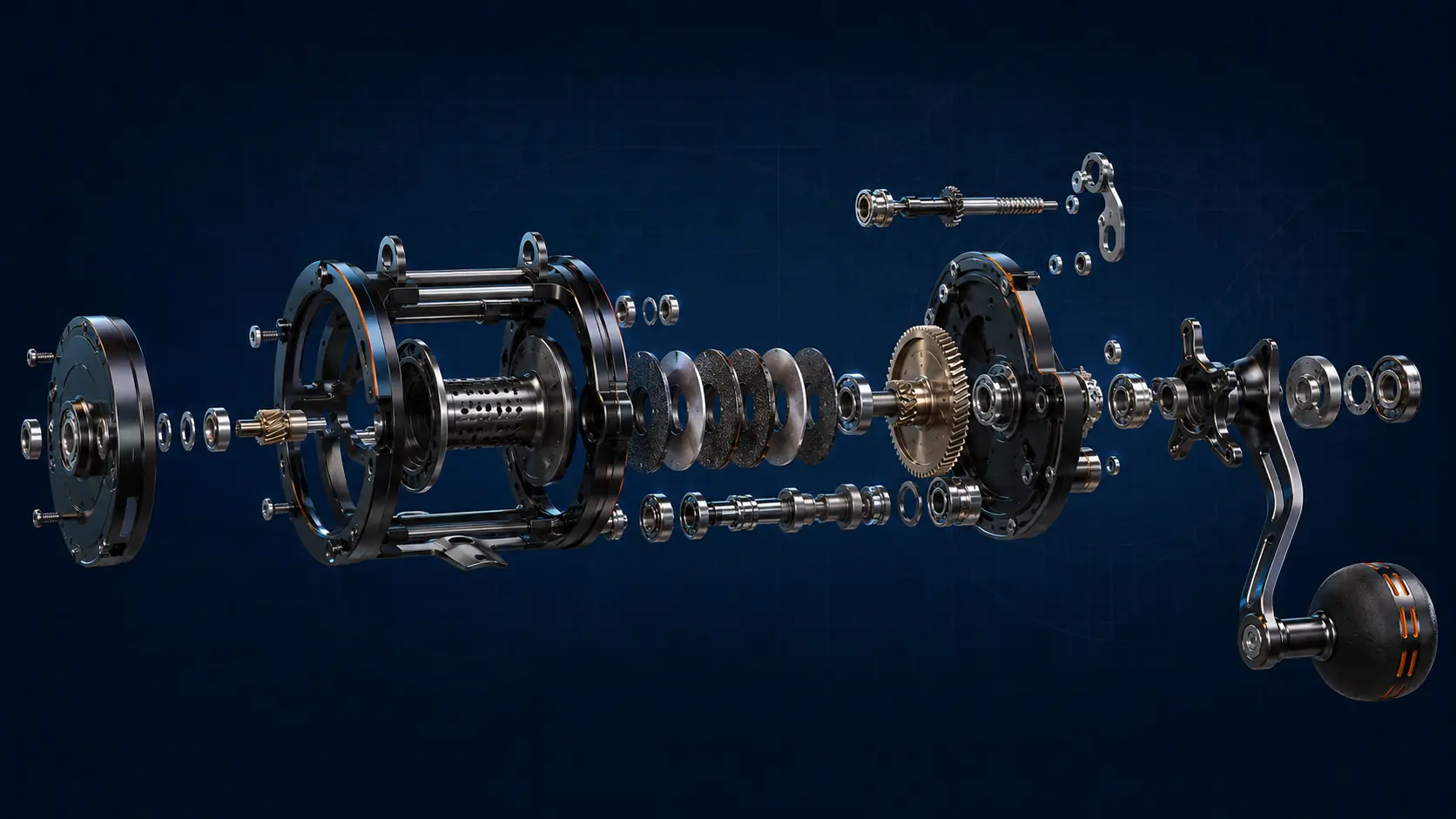
Figure: a dual-axis reel contains dozens to more than a hundred parts, including the frame, side covers, spool, gear train, drag system, bearings and handle. The unit price is the sum of those parts plus assembly, testing and packaging.
| Cost block | What it includes | Biggest drivers |
|---|---|---|
| Metal structural parts | Frame, side covers, spool, handle arm | Material, blank route, machining time, number of setups, lightening pockets |
| Drive parts | Main gear, pinion, shafts | Material (brass, stainless steel, alloy steel), gear accuracy, heat treatment |
| Purchased components | Bearings, one-way bearing, drag washers, springs, screws | Bearing count and grade (corrosion-resistant, shielded) is often the largest item |
| Surface finishing | Anodizing, blasting, polishing, logo | Number of colors, two-tone anodizing, masking, cosmetic grade |
| Assembly and testing | Assembly labor, adjustment, final testing | Test items (smoothness, drag force, clutch, noise) and sampling rate |
| Packaging and freight | Box, manual, carton, accessories | Custom printing, spare spool or tools in the box |
Some of this money is worth spending, and some can wait.
Worth spending on:
- The precision that defines feel: bearing bore position, gear center distance and spool runout. If these are wrong, no finish will rescue the reel.
- The drag system: drag washer material and pressure plate flatness decide whether the drag is smooth and stable.
- Saltwater protection: if the reel is positioned for saltwater, materials, finishes and sealing must be designed for it from the start.
Can wait:
- The number of colors in the first order.
- A high bearing count. More bearings do not mean a better reel. What matters is where the bearings are used and how accurately their seats are made.
- Complex multi-color anodizing and gradients.
- Custom accessories and premium packaging in the first order.
06|A 200-unit first order: how to avoid wasting money
Using a 200-unit first order of a dual-axis reel as the example, these choices clearly reduce cost and risk:
- Limit the first order to one or two colors. More colors mean more anodizing batches, higher cost per color and more inventory risk.
- Split left- and right-hand versions by real channel demand. If unsure, focus on the main version first.
- Prefer standard purchased components. Standard bearings and hardware have short lead times, stable prices and easy after-sales replacement.
- Start with a laser-engraved logo. It needs almost no tooling and is easy to change.
- Order spare parts with the first batch. Producing spools, knobs, drag washers and common screws at the same time avoids small reorders for after-sales service.
- Use a standard box structure with custom printing first. Develop a dedicated package once sales grow.
- Allow time to approve the prototype. One more change at the prototype stage costs far less than rework after production.
07|From inquiry to first shipment: what are the steps?
| Stage | What the brand does | What the factory does | Key output |
|---|---|---|---|
| 1. Inquiry and route | Share specifications, reference reel and quantities | Recommend a route, review manufacturability, quote | Quotation and development route |
| 2. Prototype | Approve appearance, feel and function | Build prototypes, record issues, revise | Approved golden sample and cosmetic limit samples |
| 3. Pilot run | Approve packaging, manual and markings | Fix processes, fixtures, gauges and test methods | Pilot results and inspection standard |
| 4. Production and shipment | Inspect the shipment, directly or through a third party | Produce to the golden sample, final testing | Shipment |
Overall lead time depends mainly on four things: whether new tooling is needed, lead time of purchased components, rounds of anodizing color approval, and rounds of prototype revision. Private label is fastest and full custom is slowest.
The most important step is the approved golden sample in stage 2. After production starts, feel, appearance and function are judged against that sample and the cosmetic limit samples. Give all requirements before approval. Changes after approval cost more time and money.
08|Share this information for an accurate quote
| Information | Why it matters |
|---|---|
| Reel type and size class | Low-profile baitcasting, round conventional and offshore reels differ widely in structure and cost |
| Reference reel or photos | Quickly aligns target appearance, size and function |
| Target market and retail price range | Sets the level of materials, bearings and finishes |
| Intended use | Freshwater or saltwater and target species define strength and corrosion requirements |
| Gear ratio, line capacity, maximum drag target | Define the gear train, spool and drag system |
| Bearing count | Directly affects purchased component cost |
| Colors and logo method | Decide anodizing batches and tooling |
| Packaging requirements | Decide printing and packaging cost |
| First-order quantity, color and hand split, annual volume | Decide CNC versus tooling, and how fixed costs are spread |
| Target delivery date | Shows whether there is time for tooling or CNC is required first |
If some specifications are not settled yet, share the goal instead, for example: “saltwater use, lighter than our current reel, a target retail range, 200 units for the first order.” The engineering team can then propose options across structure, materials, process and cost. If you are sourcing parts only, see preparing an RFQ for reel parts; for scheduling development, see planning reel OEM lead time.
09|How Zhongde Precision handles reel OEM
- Dual-axis reel OEM: low-profile baitcasting and round conventional reels, with an MOQ of 200 units.
- Other reel types: evaluated project by project when the volume justifies it.
- Parts only is also possible: if you already have an assembly partner, we can machine precision parts such as frames, side covers, spools, handle arms and knobs.
- Main processes in-house: mold design and manufacturing, CNC precision machining, anodizing and painting, and assembly and testing are done in-house. The same team carries a project from prototype to production, so issues can be traced inside the factory.
- NDA before drawing review: tick “An NDA is required first” when you submit an inquiry, and we will handle the NDA before reviewing your drawings.
Zhongde Precision has supplied Japanese customers for more than 18 years, with long-term production experience in reel feel, cosmetic consistency and lot-to-lot stability.
Frequently Asked Questions
What is the minimum order quantity for an OEM baitcasting or conventional reel?
At Zhongde Precision, the OEM MOQ for dual-axis reels, including low-profile baitcasting reels and round conventional reels, is 200 units. If the first order is split across colors or left- and right-hand versions, the split should be confirmed at the quotation stage, because it changes anodizing batches, purchased components and packaging quantities. Other reel types can be evaluated when the volume justifies it.
Do I need to pay for molds to launch a small reel brand?
Not necessarily. Metal structural parts such as the frame, side covers and spool can be CNC machined from solid aluminum without die-casting molds, at a higher cost per part. Plastic parts such as knobs and clutch buttons can also be machined or carried over from an existing platform for small orders. Once sales are stable, die casting or injection molding can be evaluated to lower the unit price.
Who owns the tooling, the brand or the factory?
It depends on the contract. Dedicated tooling paid for by the brand should have its ownership, storage location, maintenance responsibility, permitted use (for example, only for that brand) and end-of-relationship handling written into the quotation and contract. Tooling for a factory-owned platform normally stays with the factory.
Why do quotes for similar-looking reels vary so much between factories?
The differences are usually in what you cannot see: bearing count and grade, gear material and cutting method, die-cast versus CNC frames, drag washer material, number of anodizing colors, final test items, packaging, and the first-order quantity and color split. Compare quotes line by line against one specification sheet rather than comparing totals.
Can I approach an OEM with only an idea and a reference reel, without drawings?
Yes. Share a reference reel or photos, target positioning and retail price range, intended use, gear ratio, line capacity, bearing count, drag target, colors and logo method, first-order quantity and expected annual volume, and the engineering team can recommend private label, semi-custom or full custom. When referencing a major brand, do not copy structures or styling protected by patents or design registrations.