In This Article
Need fishing reel or tackle parts? Upload drawings for a quote
Direct Answer
The more complete the RFQ, the more accurate the quote and the less rework later. An RFQ for reel parts should include at least:
- Drawings and models: 2D drawings with a revision number, and 3D models of the same revision.
- Critical dimensions: the dimensions that affect assembly and feel.
- Material and finish: material grade and temper; surface treatment, color and coating thickness.
- Cosmetic surfaces: which surfaces are cosmetic and what defects are acceptable.
- Quantities: samples, pilot run and production, plus annual volume and lot size.
- Inspection, packaging, lead time and trade terms.
When comparing quotes from several suppliers, first align quantity, drawing revision, tolerance and cosmetic standards, one-time costs, inspection and packaging, and trade terms; otherwise the prices cannot be compared.
01|Why a Complete RFQ Matters
A quote is a price for the requirements written in the RFQ. When the RFQ is incomplete, the usual results are:
- Each supplier quotes on its own assumptions: some quote low and the samples miss the requirement; others price in the risk and quote high.
- Requirements added later change price and lead time: for example, declaring a surface cosmetic after the samples are made, or adding a full dimensional report.
- The quotes cannot be compared: each supplier assumed different conditions, so the cheapest-looking quote may not be the cheapest.
For the information needed when quoting a complete reel, see how MOQ, tooling and unit price are set. This article focuses on RFQs for parts.
02|RFQ Checklist
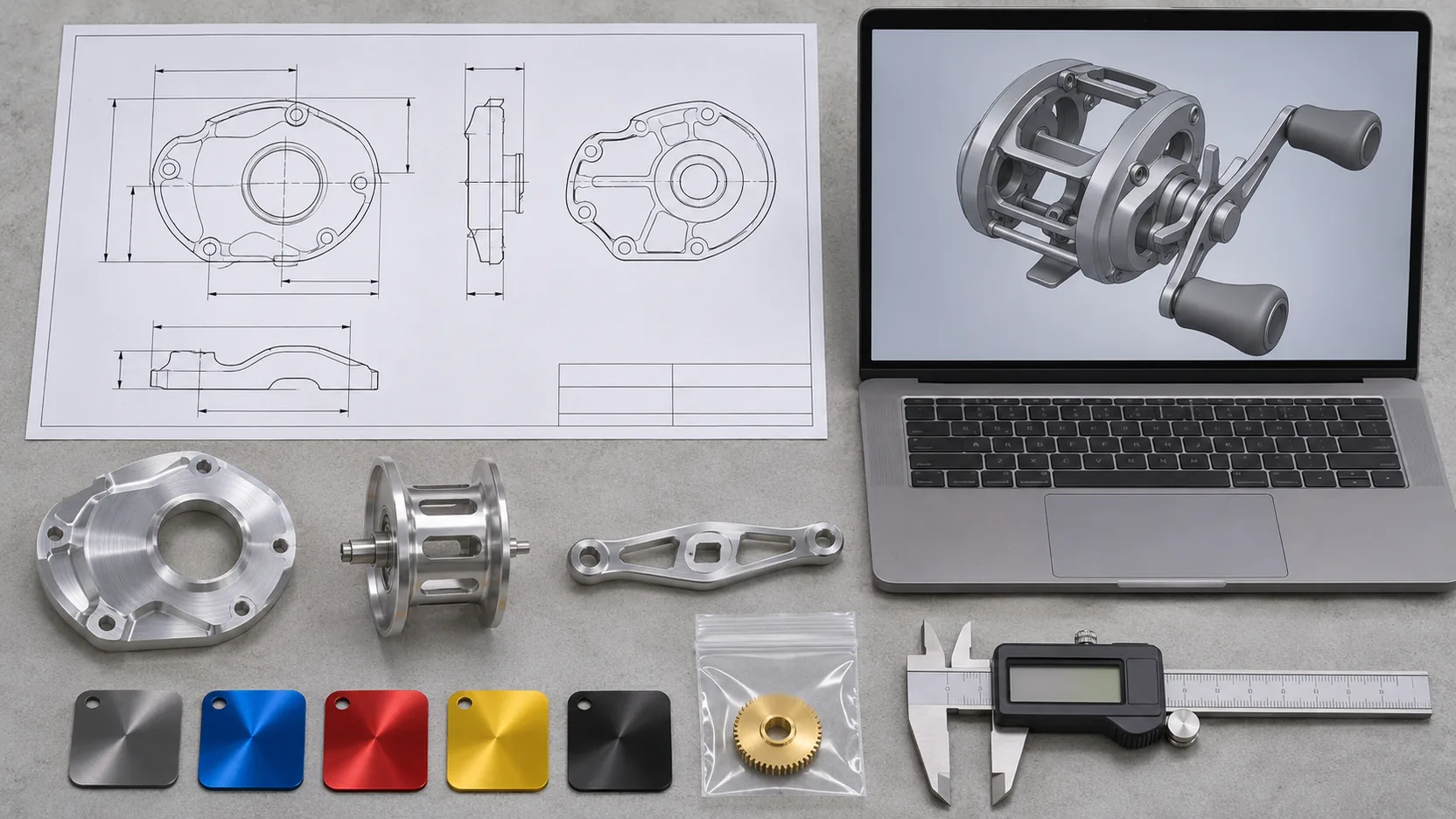
Figure: Schematic. A complete RFQ package usually includes drawings, 3D models and color requirements, plus current parts or samples when available.
| Item | What to include | Why it is needed |
|---|---|---|
| 2D drawing | Dimensions, tolerances, GD&T, technical notes, revision number | The basis for quoting and inspection |
| 3D model | A neutral format such as STEP, same revision as the drawing | Programming, machining time estimate, process choice |
| Critical dimensions | Dimensions that affect assembly, feel and appearance | Sets the machining method, gauges and check rate |
| Material | Grade and temper, for example the heat treatment state of the aluminum | Affects price, machinability and anodized color |
| Surface treatment | Process, color, thickness, sealing; blasting, brushing or polishing | Sets the finishing process and cosmetic risk |
| Cosmetic surfaces | Which surfaces are cosmetic, the grade and acceptable defects | One of the main cost drivers |
| Marking | Logo and text method (laser, screen or pad printing) and location | Needs fixtures and a separate operation |
| Quantities | Samples, pilot run, production lot size and annual volume | Sets the process route and how one-time costs spread |
| Inspection | First article report, full dimensional report, material certificate | Affects inspection time and equipment |
| Packaging | Individual protection, dividers, rust prevention | Cosmetic parts are most easily damaged in transit |
| Lead time and terms | Target date, delivery location, trade terms | Affects scheduling and freight |
| Confidentiality | Whether an NDA is needed first | Sign first, then share drawings |
03|What Drawings Most Often Leave Out
- 2D and 3D revisions do not match: the drawing was updated but not the model, or the other way round. Put the revision in both the file name and the title block.
- Critical dimensions are not marked: if every dimension is controlled the same way, cost rises and the dimensions that really matter get no special focus.
- Cosmetic surfaces are not defined: which surfaces are anodized, which must be free of clamp marks, and whether die-casting gates and ejector pins may sit on visible faces.
- Before or after anodizing is not stated: bearing bores, threads and fits change size after anodizing, so state which condition the dimension applies to. See dimension control before and after anodizing.
- Deburring and edge requirements are missing: many reel surfaces touch the line, and a sharp edge can damage it.
- Mating parts are not given: bearing model, mating shaft, screw size. The supplier needs to know where the part goes.
- Only photos or a sample: you can send the sample first and explain the critical dimensions and fits; whether the part can be developed from it depends on the part.
04|What to Specify for Each Type of Part
| Part | Be especially clear about |
|---|---|
| Spool | Material, wall thickness, runout and balance, porting pattern, anodized color, bearing seat |
| Frame and side plates | Cosmetic surfaces, flatness, bearing seats, threads, anodized color, diamond-cut edges |
| Handle arm | Appearance, hole spacing, polish or bright finish, mating knobs and nuts |
| Handle knobs | Material, shape, internal bearings or bushings |
| Gear-related parts | Tooth data, material, heat or surface treatment, mating gear |
| Star drag, thumb bar and small parts | Cosmetic requirement, color, mating features |
| Die-cast, forged and molded parts | Tooling cost, tool ownership, tool life, machined features and requirements |
Spools and gears directly affect feel, so it helps to state which parts they mate with and what feel problem exists today. See spool machining, runout and balance and gear, shaft and bearing alignment.
05|How to State Quantities
Quantity is one of the biggest factors in price. State separately:
- Sample quantity: to verify dimensions, assembly and feel.
- Pilot run quantity: to confirm the process is stable.
- Production lot size and annual volume: to decide whether dedicated fixtures or molds are worthwhile.
- Split by color and hand: for the same part, how many of each color and how many left- and right-hand.
Quantity matters because one-time preparation such as programming, fixtures, machine setup and anodizing racks is spread over each lot; quantity also decides between CNC machining and tooling. If quantities are not fixed, ask for quotes at several levels and say which is most likely.
06|What a Quote Is Made Of
| Item | Description | Charged |
|---|---|---|
| Material | Bar, plate, die casting, forging or molded part | Per piece |
| Machining | CNC machining time and number of operations | Per piece |
| Surface treatment | Anodizing, blasting, painting and similar | Per piece |
| Marking | Laser marking, screen or pad printing | Per piece |
| Inspection | Full or sampling inspection, reports | Per piece or lot |
| Packaging | Individual protection, dividers, rust prevention | Per piece |
| Fixtures and gauges | Dedicated fixtures and gauges | One-time |
| Molds | Die-casting, forging and injection molds | One-time |
| Samples | Usually quoted separately at the sample stage | Per round |
| Freight | Under the agreed trade term, who pays which leg | Per shipment |
For where each cost comes from and how to reduce cost without changing feel, see reel parts cost structure and VA/VE.
07|How to Compare Quotes from Several Suppliers
Before comparing, check that these conditions are the same:
- Quantity: lot size and color split.
- Drawing revision: all quotes are based on the same revision.
- Tolerance and cosmetic standards: the same reading of critical dimensions and cosmetic surfaces.
- One-time costs: whether molds, fixtures and samples are included, and who owns the molds.
- Inspection and packaging: whether inspection reports and individual protective packaging are included.
- Trade and payment terms: delivery location, trade term and payment conditions.
- Quote validity and lead time.
If a quote lists assumptions, confirm each one. Also, the lowest unit price is not always the lowest total cost: yield, cosmetic consistency, rework and late delivery all add cost. For the process of bringing in a new supplier, see qualifying a new reel parts supplier.
08|Questions the Factory Will Often Ask
When engineers review the drawing, they often ask:
- Why is this dimension so tight, and can it be relaxed? Relaxing dimensions that do not affect function can lower cost.
- Is this a cosmetic surface? It decides the clamping method and machining sequence.
- Can the material or process change? For example, changing a part machined from solid to a die casting with finish machining, or combining parts.
- Is this dimension before or after anodizing?
- Is there measurement data from the current part? When transferring a part, data from the current part matters as much as the drawing. See transferring reel parts without changing feel.
These questions are a normal manufacturability review and help reduce cost and risk. Answering them early also speeds up the quote.
09|How Zhongde Can Help
- RFQ process: we sign an NDA first when needed; our engineers review the drawings to confirm critical dimensions, cosmetic surfaces and the process route; we propose manufacturability changes where useful; and we list unit price, one-time costs, samples and lead time separately in the quote.
- In-house processes: mold design and making, CNC machining, die casting, forging, injection molding, anodizing and painting, laser marking, screen and pad printing, assembly and inspection are all done in-house.
- Parts or complete reels: we can make parts only, such as side plates, spools, handle arms and gear-related parts; baitcasting reel OEM has an MOQ of 200 units, and other reel types can be considered with sufficient volume.
- NDA first: check “An NDA is required first” in the RFQ form, and we will complete the NDA before reviewing your drawings.
Zhongde has worked with Japanese customers for more than 18 years, producing reel parts with demanding cosmetic and quality requirements.
Frequently Asked Questions
Can we request a quote with only a sample and no drawing?
Yes, you can start there. Send the sample, or clear photos with the main dimensions, and tell us which dimensions are critical, which parts it mates with, and what material and surface treatment it uses. Whether the part can be developed from the sample, and what measurement and confirmation are needed, depends on the part; we will let you know after our review.
Do we have to provide a 3D model?
We recommend it. A 3D model is used for programming, estimating machining time and choosing the process, so the quote is faster and more accurate. The 2D drawing defines dimensions, tolerances and technical requirements. Both should be the same revision, with the revision number in the file name or title block.
Why do quotes from different suppliers vary so much?
Usually because the quotes are based on different conditions: different quantities, different readings of tolerance and cosmetic standards, molds and fixtures included or not, inspection reports and packaging included or not, and different trade and payment terms. Align these conditions first, then compare prices.
How should we request a quote if quantities are not yet fixed?
Ask for quotes at several quantity levels, for example samples, the first order and the expected annual volume, and say which is most likely. Quantity affects the process route and how one-time costs are spread, so tiered quotes are more useful.
Should we sign an NDA before sending drawings?
If the drawings show an unreleased design, we recommend it. Check the NDA option in the Zhongde RFQ form, and we will complete the NDA before reviewing your drawings.