
In This Article
Need fishing reel or tackle parts? Upload drawings for a quote
Direct Answer
Reel packaging has three jobs: the reel does not move or carry load in the box, it does not get damp or rust in transit, and all markings are correct.
- Insert: support the frame without pressing on the handle, knobs, star drag or thumb bar.
- Moisture and rust control: pack only when the product is dry, add desiccant, and take extra care with saltwater reels.
- Master carton: strong enough, quantity per carton matching the order split, clear shipping marks.
- Transit testing: once the packaging sample is fixed, run drop and vibration tests with real product and full cartons.
- Labels: correct model, color, gear ratio, hand and barcode; country of origin and warning labels per the target market.
01|The Layers of Reel Packaging
| Layer | Common practice | Purpose |
|---|---|---|
| Unit protection | Dust bag, reel cover, PE bag | Prevent scratches and dust |
| Insert | Molded pulp, EVA or EPE foam, paperboard | Hold the reel and prevent impact |
| Retail box | Printed box or window box, with hang tab | Display, identification, retail shelf |
| Accessories and documents | Manual, warranty card, tool, oil, spare parts | Use, maintenance and after-sales |
| Master carton | Corrugated carton, with dividers where needed | Transport protection, shipping marks |
| Pallet | Wooden or plastic pallet | Container loading and handling |
Packaging artwork is usually provided by the brand, and the factory handles sampling and production. For retail box and logo customization, see customizing reels for small brands.
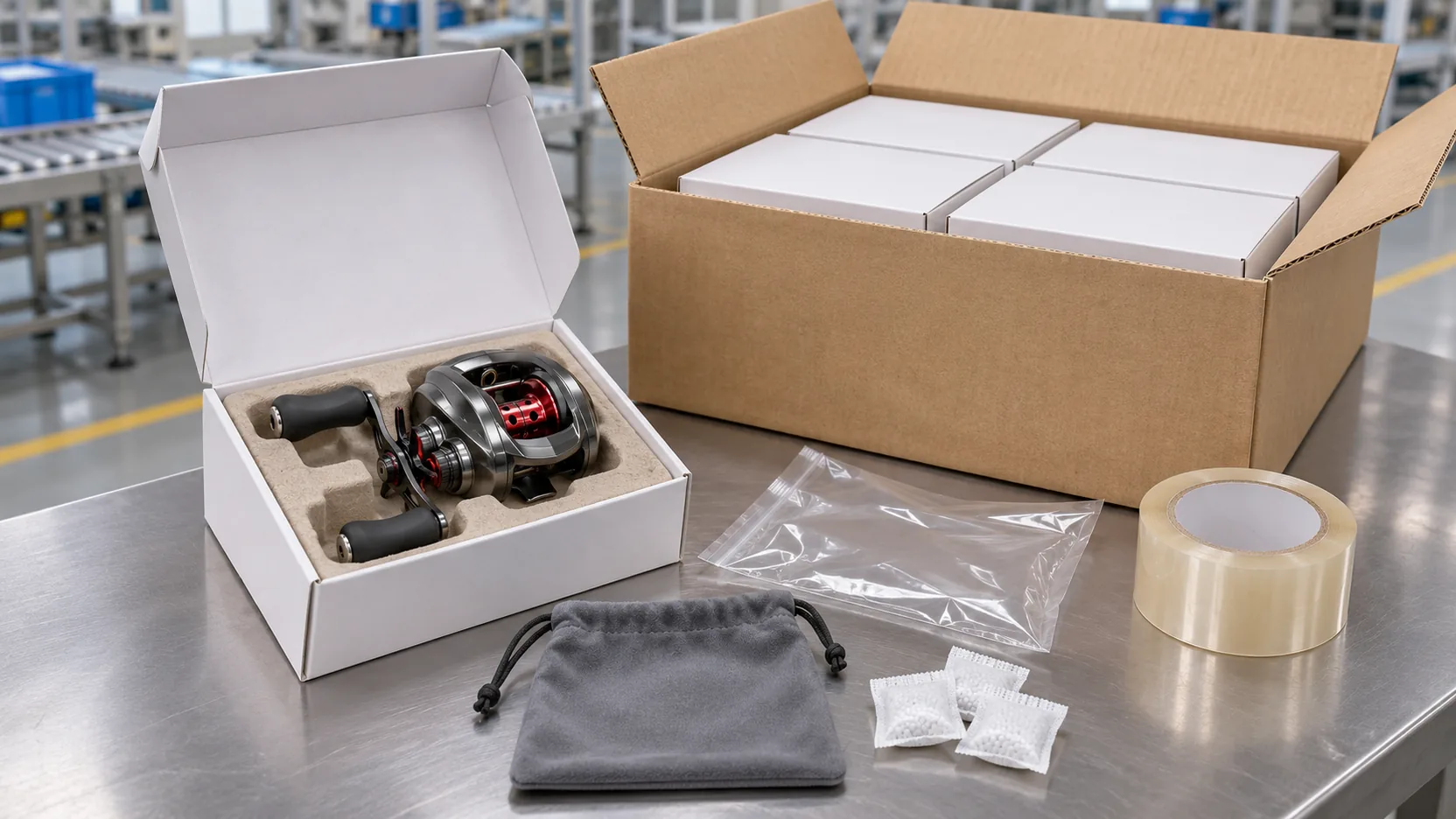
Figure: Schematic. Unit protection, insert, retail box and master carton each have their own job.
02|How the Insert Should Hold the Reel
- Support the frame: put the load on the frame and reel foot, not on the spool, handle or knobs.
- Keep clear of controls: the star drag, thumb bar and brake adjustment knobs must not be pressed, or they may deform or change setting.
- No movement: the reel must not shift inside the box or touch the box walls.
- Drag setting: agree how the drag is set at shipment; keeping it tight for a long time can affect the drag washers.
- Easy to remove and replace: users should be able to put the reel back, which also helps when it is returned for service.
| Insert material | Characteristics | Notes |
|---|---|---|
| Molded pulp | Eco-friendly, neat appearance | Needs a mold; allow time for tooling |
| EVA or EPE foam | Good cushioning, suits premium reels | A plastic material; needs a cutting die |
| Paperboard | Lowest cost | Limited cushioning; suits entry level |
Insert molds and cutting dies take time, so prepare them in parallel with the prototypes. See planning reel OEM lead time.
03|Moisture and Rust Control
Temperature and humidity change a lot during ocean freight, and condensation forms easily inside containers. Reels have bearings, springs and exposed metal parts that rust when damp. We recommend:
- Pack only when dry: after cleaning and assembly, confirm the product is completely dry so no moisture is sealed in.
- Add desiccant: in the retail box or master carton, sized to the package and transit time.
- Moisture barrier bags or VCI materials: consider them for long ocean voyages or tropical routes.
- Carton condition: damp cartons lose strength, so keep them dry in the warehouse and during loading.
- Saltwater reels: take extra care with bearings and exposed metal parts. See saltwater corrosion protection for reels.
04|Master Cartons, Packing and Container Loading
- Carton strength: choose cartons by packed weight and stacking height, with double-wall board and dividers where needed.
- Quantity per carton: match the order split where possible, for example one model, one color and one hand per carton, which makes distribution easier for dealers.
- Shipping marks: model, color, quantity, gross and net weight, carton number, country of origin and similar.
- Size optimization: retail box size sets how efficiently cartons and pallets load, which affects freight cost. For air freight and express, volumetric weight also matters.
- Pallets: wooden pallets for export must meet ISPM 15 heat treatment and marking requirements.
- Container loading: heavy cartons at the bottom and light ones on top, models grouped by zone, with a loading list recorded.
For packing declarations, timber packaging and container cleanliness when shipping to Australia, see importing baitcasting reels into Australia.
05|Transit Testing
Once the packaging sample is fixed, run transit tests with real product and full cartons:
| Test | Purpose |
|---|---|
| Drop test | Simulate drops during handling, for single boxes and full cartons |
| Vibration | Simulate vibration on trucks and at sea |
| Compression | Confirm cartons are not crushed when stacked |
Use standards such as ISTA as a reference, or a method agreed by both sides. After testing, check:
- Appearance: scratches, dents and chipped coating.
- Parts: bent handles, knobs or star drags, and loose screws.
- Function: smooth rotation, and normal clutch, drag and cast control.
For packaging checks before shipment, see reel OEM pre-shipment inspection.
06|Labels and Markings
- Retail box label: model, color, gear ratio, hand and barcode. Gear ratio and hand are the easiest to mix up, so check them carefully.
- Barcode: usually obtained by the brand from a barcode numbering organization. Before shipment, confirm it scans correctly and matches the product.
- Carton shipping marks: in the format required by the brand or dealer.
- Country of origin: some markets require the country of origin to be marked on the product or packaging.
- Warnings and instructions: requirements differ by country, so the brand should confirm them and provide them to the factory; confirm the language versions of the manual too.
07|Shipping Samples and Small Orders
- Samples by express: protect each sample, describe the goods and purpose clearly, and declare the actual value.
- Oil and other liquids: if lubricant is packed with the reel, check transport requirements before air or express shipment.
- Tariff codes and duties: the tariff classification and duties in the importing country should be confirmed by the brand or its forwarder.
- Small orders by air: fast but expensive, and retail box and carton size affect cost even more.
08|Trade Terms and Shipping Methods
| Trade term | In short | Suits |
|---|---|---|
| EXW | Buyer collects at the factory and arranges all further transport | Brands with their own forwarder and import experience |
| FOB | Seller delivers the goods on board at the port of shipment | The most common; buyer arranges ocean freight and import |
| CIF | Seller pays freight and insurance to the destination port | Brands that want the seller to arrange ocean freight |
| DDP | Seller delivers to the destination with import duties paid | Both sides familiar with the destination rules |
For shipping, use LCL (shared container) for small quantities and FCL (full container) when volume allows; urgent shipments can go by air. Whichever term is used, state clearly who pays for each leg of transport, insurance and duties.
09|How Zhongde Can Help
- Packaging sampling and production from your artwork: the brand provides artwork, and the packaging sample is approved together with the reel prototype.
- Assembly and packing in-house: assembly, function testing and packing are done in-house, and cartons can be packed by color and hand split.
- Transit testing: where needed, we can run drop tests by an agreed method or use a third-party test lab.
- Checks before shipment: retail box labels, barcodes, quantity per carton and shipping marks.
- Baitcasting reel OEM: MOQ of 200 units; other reel types can be considered with sufficient volume.
- NDA first: check “An NDA is required first” in the RFQ form, and we will complete the NDA before reviewing your drawings.
Zhongde has worked with Japanese customers for more than 18 years, producing reel parts with demanding cosmetic and quality requirements.
Frequently Asked Questions
What material is best for a reel insert?
Common choices are molded pulp, EVA or EPE foam, and paperboard. Molded pulp is eco-friendly and looks neat but needs a mold; foam cushions well and suits higher-priced reels; paperboard is the lowest cost and suits entry-level or simple packaging. What matters is that the insert supports the frame, the reel does not move, and nothing presses on the handle, knobs or star drag.
Can reels rust during ocean freight?
Yes, there is a risk. Temperature and humidity change a lot during ocean freight, and condensation forms easily inside containers. Make sure the product is completely dry before packing, add desiccant to the retail box or master carton, and use moisture barrier bags or VCI materials where needed. Take extra care with bearings and exposed metal parts on saltwater reels.
Does the packaging need a drop test?
We recommend it. Once the packaging sample is fixed, run drop and vibration tests with real product and full cartons, using standards such as ISTA as a reference or a method agreed by both sides. Afterwards, check for scratches, bent handles or knobs, and whether rotation, clutch and drag still work normally.
Who provides the barcode on the retail box?
Usually the brand. Barcodes are obtained from a barcode numbering organization and tied to the brand and product. The factory prints or applies the barcode provided by the brand, and before shipment checks that it scans correctly and matches the model, color, gear ratio and hand.
Which trade term suits a small brand for its first order?
Common terms are EXW, FOB, CIF and DDP. A brand with its own forwarder and import experience can choose EXW or FOB; a brand that wants the seller to arrange shipping to the destination port can choose CIF. Whichever term is used, state clearly who pays for each leg of transport, insurance and duties.