In This Article
Need fishing reel or tackle parts? Upload drawings for a quote
Direct Answer
For a small brand, the most economical starting point for reel customization is changing colors, adding a logo and using its own packaging, without changing molds or structure.
- Colors: CNC aluminum cosmetic parts can be anodized in a wide range of colors, but color differences occur and some colors fade faster, so approve them against physical samples.
- Two-tone and diamond-cut edges: need masking, multiple anodizing passes or CNC edge cutting, which add processes and cost.
- Logos: laser marking needs no tooling and is the most common choice for small volumes; CNC engraving gives more depth; pad and screen printing allow multiple colors; separate badges look the most premium.
The more colors and custom items, the smaller each quantity and the greater the pressure on unit price and lead time. A first order should keep to a few colors and expand once sales grow.
01|Levels of Customization
| Level | What changes | Investment | Best suited to |
|---|---|---|---|
| Color + logo + packaging | Colors of cosmetic parts, logo, retail box and manual | Lowest; no change to molds or structure | Brands just starting out |
| Custom cosmetic parts | Side plate shape, handle arm, knobs, star drag and so on | Medium; may need new programs or tooling | Brands wanting a distinctive look |
| Structural and functional changes | Gear ratio, brake, frame and so on | Higher; needs development and validation | Brands with a clear position and volume |
For the MOQ, tooling and unit price that come with each level, see Fishing Reel OEM Explained: How MOQ, Tooling Cost and Unit Price Are Set.
02|Anodized Colors: What Is Possible and What to Watch
CNC aluminum cosmetic parts can be anodized in many colors; common ones include black, gold, silver, gunmetal, red, blue, purple and green. Keep in mind:
- Color difference: different aluminum alloys take dye differently, and film thickness, batch, part shape and surface condition also cause variation. Parts on the same reel can look different if their materials or processes differ.
- Fading: lightfastness of dyed anodized colors varies by color, and some colors fade faster in long-term sunlight. For outdoor products, lightfastness validation is recommended.
- Printed color guides rarely match exactly: anodized color is a translucent effect on metal and looks different from printed color references, so judgments should be made against physical samples.
- Die-cast aluminum and resin parts: are usually color-matched with paint; watch for differences in color and texture against anodized parts.
Approve colors with physical color samples, and agree on lighting, viewing angle and allowable color difference, using a colorimeter where needed. For managing color consistency, see Fishing Reel Aluminum Surface Finishing.
03|Two-Tone Anodizing and Diamond-Cut Edges
- Two-tone anodizing: two colors on one part usually require masking and two anodizing passes, or anodizing the whole part, stripping the film locally and anodizing again. It involves many steps and precise masking, and the sharpness of the color boundary is a key inspection point.
- Diamond-cut edges: after anodizing, CNC cuts a bright band of bare aluminum along the edge of the part to create contrast. The cut aluminum has no anodic film, so without protection it oxidizes and dulls over time, especially in saltwater; a second clear or colored anodizing pass is usually applied for protection.
- Laser patterns: geometric patterns laser-marked on anodized surfaces need no tooling and suit limited editions.
All of these add processes, inspection and scrap risk, and raise unit price and lead time accordingly.
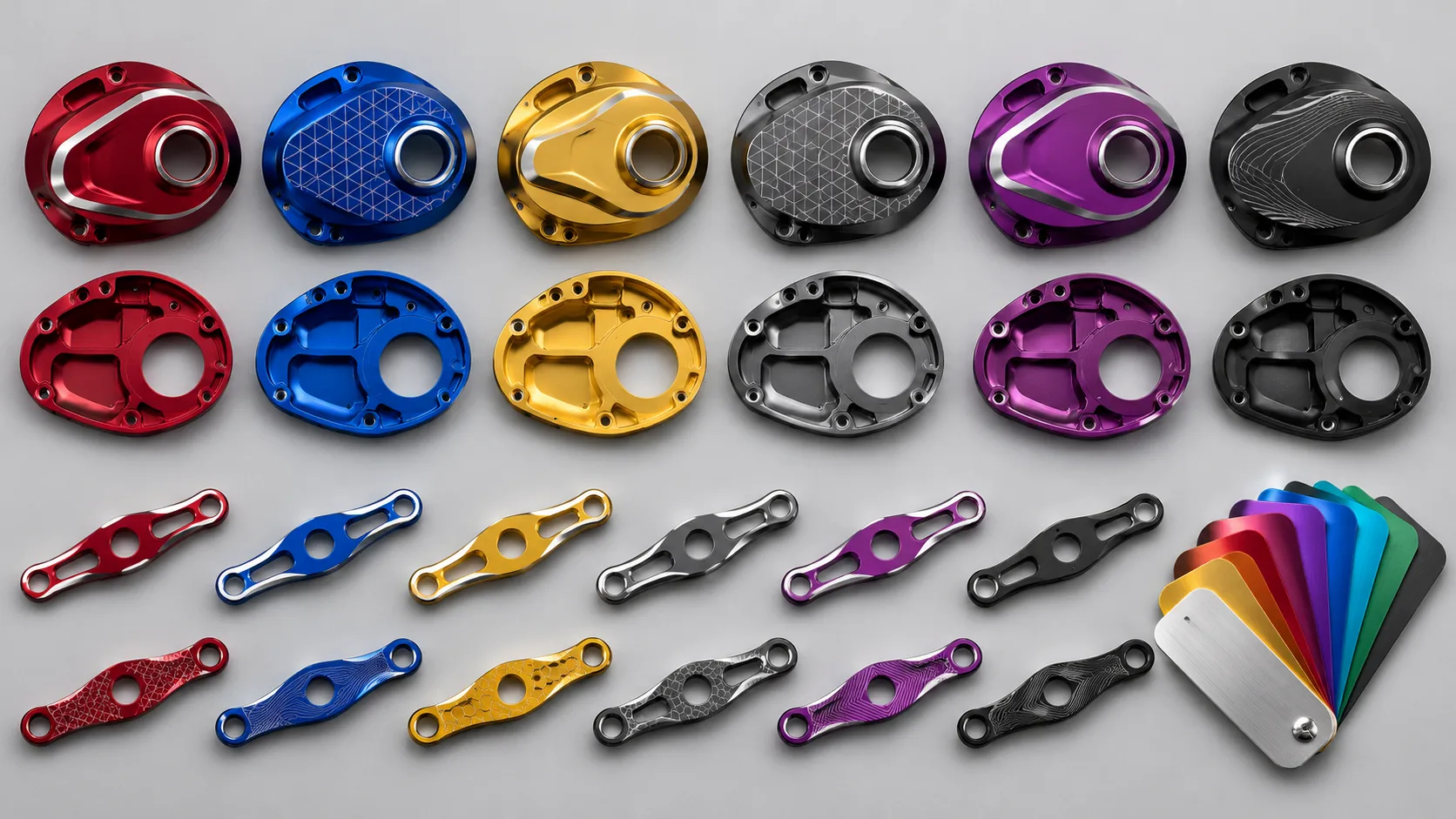
Figure: Schematic illustration. Anodized side plates and handle arms in different colors, some with diamond-cut edges and laser patterns, with color swatches used for approval and comparison.
04|Ways to Apply a Logo
| Method | Characteristics | Watch points | Best suited to |
|---|---|---|---|
| Laser marking | No tooling; wear resistant; easy to change; fine detail | On anodized surfaces usually gives a white or light mark | Small volumes, many variants |
| CNC engraving | Depth and a premium feel; can be color-filled | Longer machining time | Mid- to high-end looks |
| Pad printing | Multiple colors; works on curved surfaces | Needs plates and fixtures; wear depends on ink and protection | Multi-color logos, curved surfaces |
| Screen printing | Multiple colors with rich color | Best on flat surfaces; needs screens | Multi-color graphics on flat areas |
| Separate badge | Metal or resin badge; the most premium look | Extra part, possibly tooling; must be securely fixed | Flagship models, brand identity |
Provide logo artwork in vector format (such as AI, PDF or SVG), with size, position and color specified.
05|Knobs and Other Accessories
Handle knobs, star drags and brake knobs are also common places for brand differentiation:
- Color: matched to the frame or used as an accent color.
- Material: aluminum, carbon fiber, engineering plastics, EVA, cork and so on, each with a different feel and cost.
- Shape: different knob shapes suit different techniques and hand sizes.
For knob material choices, see How to Choose Materials for Fishing Reel Handle Knobs.
06|Packaging and Manuals
Packaging and manuals form the first impression when a customer receives the product:
- Retail box and insert: size, material, printing process and whether the product is held securely.
- Manual: language versions, use and maintenance instructions, and warnings required by target markets.
- Labels and barcodes: model, color, barcode and markings such as country of origin required by target markets.
The brand usually provides packaging artwork, and the factory handles sampling and production. For what to check at shipment, see Fishing Reel OEM Pre-Shipment Inspection.
07|How Colors and Custom Items Affect Cost and Lead Time
| Custom item | Effect on cost and lead time |
|---|---|
| Each extra color | Another anodizing batch and color approval; smaller quantity per color |
| Two-tone, diamond-cut edges | More processes, inspection and scrap risk |
| Laser-marked logo | Very small investment; easy to change |
| Pad and screen printing | Needs plates and fixtures; more steps for multiple colors |
| Separate badges, new shapes | New parts, possibly tooling |
More colors also make inventory harder to manage: one color selling well while another sits on the shelf is common. For a first order, use one or two main colors to test the market, then add colors and limited editions once sales grow.
08|Approval Process
- Provide design data: vector logo files, color requirements, position and size.
- Color sample approval: the factory makes color samples with the actual material and process for the brand to approve.
- First article approval: a first article with color and logo to confirm appearance, position and effect.
- Sample sign-off: approve golden and boundary samples, with each party keeping a set.
- Packaging proofs: approve the retail box, manual and labels.
09|Ownership of Trademarks and Designs
- Trademark: the brand should register its own trademark in its target markets, and the factory uses the logo only for that brand.
- Exclusive designs: ownership of exclusive cosmetic designs and tooling paid for by the brand should be written into the contract.
- Confidentiality: an NDA can be signed before design data is shared.
For details, see How to Protect Your Fishing Reel Design When Working with an OEM Factory.
10|How Zhongde Can Help
- Surface treatment and logos in-house: anodizing, painting, laser marking, screen printing and pad printing are all done in our factory, which helps control color, position and lead time.
- Color samples and sign-off: color samples are made with the actual material and process, and production starts after approval.
- Baitcasting reel OEM: MOQ of 200 units for baitcasting reels; other reel types can be considered with sufficient volume.
- NDA first: check “An NDA is required first” in the RFQ form, and we will complete the NDA before reviewing your drawings.
Zhongde has worked with Japanese customers for more than 18 years, producing reel parts with demanding cosmetic and quality requirements.
Frequently Asked Questions
What colors can a fishing reel be made in?
CNC aluminum cosmetic parts can be anodized in many colors; common ones include black, gold, silver, gunmetal, red, blue, purple and green, and two-tone finishes are also possible. Die-cast aluminum and resin parts are usually color-matched with paint. The achievable colors and effects should be confirmed with physical color samples, because anodized colors rarely match printed color guides exactly.
Why does the same color look different on different parts?
Anodized color depends on many factors: different aluminum alloys take dye differently, and film thickness, batch, part shape and surface condition also cause variation. So if the frame, side plates and handle arm of one reel use different materials or processes, color differences can appear. The solution is to standardize materials and processes as far as possible, approve colors against physical samples and agree on inspection conditions and allowable color difference.
How are diamond-cut edges made, and do they dull over time?
Diamond-cut edges are machined by CNC after anodizing, cutting a bright band of bare aluminum along the edge of the part to create contrast. The cut aluminum has no anodic film, so without protection it oxidizes and dulls over time, especially in saltwater. A second clear or colored anodizing pass is therefore usually applied for protection, which adds processes and cost.
Is laser marking or pad printing better for a logo?
It depends on what you need. Laser marking needs no tooling, is wear resistant and easy to change, and is the most common choice for small volumes, but on anodized surfaces it usually produces a white or light-colored mark. Pad printing allows multiple colors and works on curved surfaces, but needs printing plates and fixtures, and its wear resistance depends on the ink and protective treatment. For more depth, use CNC engraving; for the most premium look, use a separate metal badge, which requires an extra part.
How many colors should a first order include?
We recommend keeping to a few. Each extra color adds an anodizing batch and a color sample approval, reduces the quantity of each color, increases pressure on unit price and lead time, and makes inventory harder to manage. Start with one or two main colors to test the market, then add colors and limited editions once sales grow.