In This Article
Need fishing reel or tackle parts? Upload drawings for a quote
Direct Answer
Most aftermarket reel parts are CNC-machined aluminum and need no molds, which suits many models and colors in small batches. Four things decide whether they succeed:
- Fit: the shaft end shape, threads, bearing seats, brake system and clearances must match the original reel. Measure several real reels and confirm fit before every shipment.
- Lightweight spools: lighter starts faster, but thin walls deform and run out more easily, so validate by casting.
- Color batches: anodize parts sold as a set in the same batch.
- IP: state compatible models descriptively, without the original maker trademarks, and do not copy protected designs.
01|The Aftermarket: Common Parts and Buyers
| Part | Why users change it | Typical manufacturing |
|---|---|---|
| Handle arm | Feel, cranking power, looks | CNC aluminum or titanium, anodized |
| Handle knobs | Grip, weight, looks | CNC aluminum, carbon fiber, EVA, cork, wood |
| Spool | Casting light lures, line capacity | CNC aluminum, ported for weight |
| Star drag | Looks, adjustment feel | CNC aluminum, anodized |
| Drag washers | Higher and more consistent drag | Carbon fiber and other materials |
| Bearings | Smoother rotation, rust resistance | Purchased standard parts |
| Brake dials, thumb bars | Looks and operating feel | CNC aluminum, anodized |
There are four main types of buyer: aftermarket parts brands, tackle shops offering customization, reel brands launching upgrade parts lines, and online sellers.
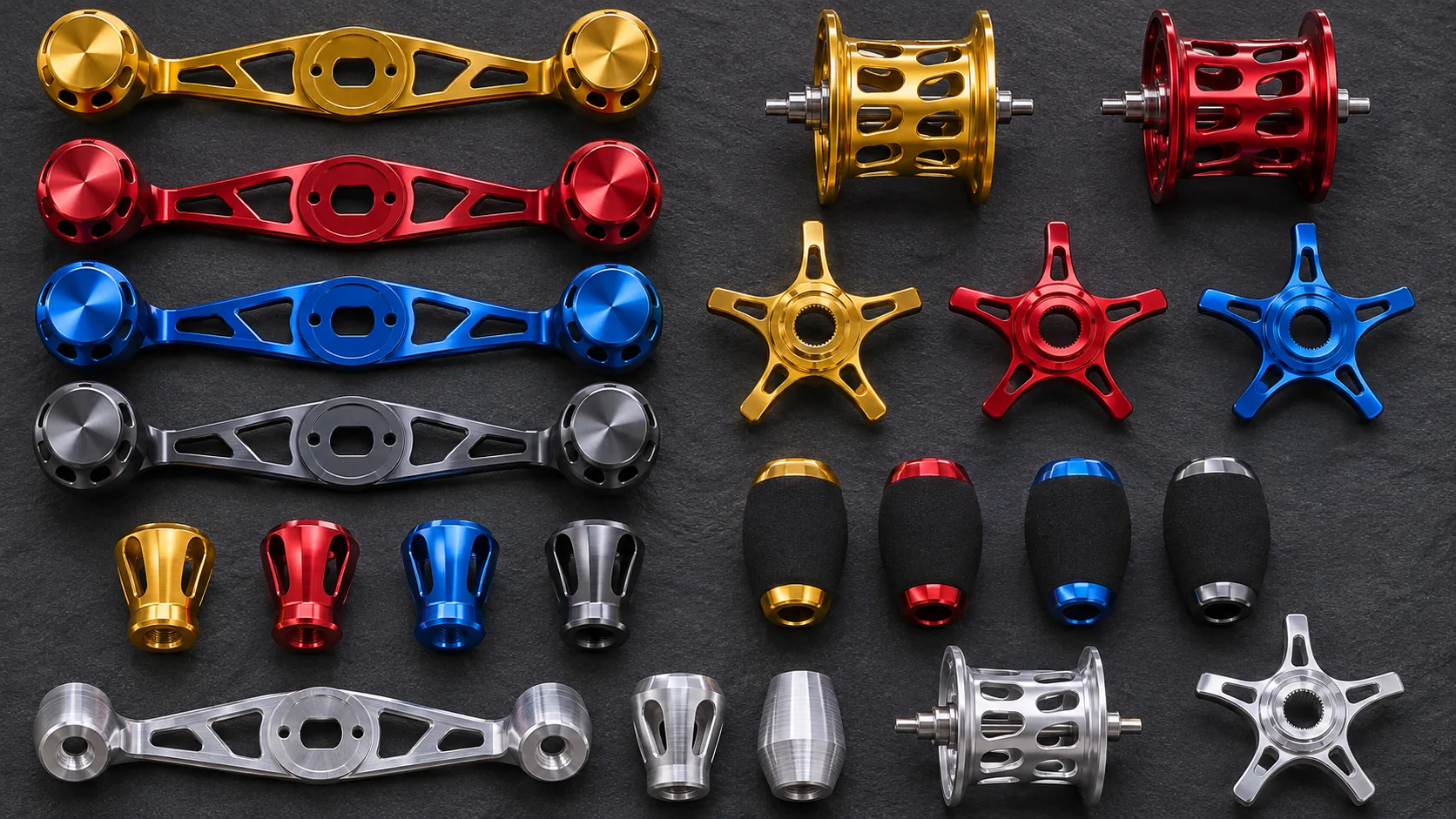
Figure: Schematic. Most aftermarket parts are CNC machined and then anodized, often in several colors per part.
02|The Biggest Risk: Fit with the Original Reel
| Part | Fit dimensions that must match |
|---|---|
| Handle arm | Shaft end shape and size, retaining nut thread and direction, lock plate, clearance to frame and star drag |
| Knobs | Knob shaft diameter and length, bearings or bushings, retention method |
| Spool | Spool shaft diameter and length, bearing seats, brake system fit, clutch pin, clearance to frame and level wind |
| Star drag | Thread, shape, clearance to the handle |
Points to watch in particular:
- Model years and hands: within one series, fit dimensions can differ between model years, left- and right-hand versions and gear ratios.
- Original parts have tolerances too: measuring a single reel may catch one end of the tolerance. Measure several real reels to confirm the range.
- Brake system: the spool must work with the original brake system, such as where a magnetic brake acts and what material the spool is, or how centrifugal brake blocks mount.
- Clearance: a longer or more offset handle can leave too little clearance between the knobs, star drag and frame.
For knob interfaces, see handle knob materials and custom manufacturing.
03|Development Process
- Choose target models: start with a few high-volume models, and get several real reels, including both left- and right-hand.
- Measure fit dimensions: measure shafts, threads, bearing seats and clearances, and record them in an interface drawing.
- Design: design the shape on top of the interface drawing, and set the target weight and material.
- Samples: CNC machine samples and fit them on several real reels.
- Function tests: rotation, clutch, drag and casting; for spools, also runout and balance.
- Color approval: make color samples and confirm color and logo position.
- Small-batch production: produce to the approved samples, and confirm fit on real reels or gauges before every shipment.
04|What to Watch with Lightweight Spools
Lightweight spools are the most technically demanding aftermarket parts:
- Lighter starts faster: good for casting light lures, but thinner walls deform more easily during machining and use.
- Porting: weight-saving holes affect strength and balance, so their position and shape must be even and symmetrical.
- Runout and balance: at high speed, runout and imbalance cause noise and unstable casts.
- Brake system fit: changing the spool material or shape changes how the brake works.
Validate every design by casting on a real reel. For spool machining control, see spool machining, runout and balance; for weight-saving methods and their trade-offs, see lightweight reel design.
05|Materials and Finishes
| Material | Characteristics | Suitable parts |
|---|---|---|
| 6061 aluminum | Good machinability, more even anodized color | Knobs, star drags, side covers |
| 7075 aluminum | Higher strength, but harder to anodize evenly | Handle arms, spools |
| Titanium | Strong and corrosion resistant, higher machining cost, limited colors | Handle arms, screws |
Common finishes include single-color anodizing, two-tone anodizing, diamond-cut edges and laser-marked logos. Parts sold as a set, such as a handle, knobs and star drag, should be anodized in the same batch for matching color. For color and logo methods, see customizing reels for small brands.
06|Producing Many Models and Colors in Small Batches
Aftermarket parts mean many models, many colors and small quantities per model. We recommend:
- Share common parts: use the same knobs and star drags across several models where possible to reduce part count.
- Batch production: machine all colors of one part in a single run, then anodize in color batches.
- Color plan: keep the first run to a few colors and add more as sales grow.
- Stock and forecast: stock popular colors and models ahead, and make slow sellers in small quantities.
- Packaging and instructions: protect each part from scratches, and include fitting instructions plus any screws and washers needed.
Each run needs programming, fixtures and anodizing setup, so very small quantities raise the unit price. For how quantity affects cost, see reel parts cost structure and VA/VE.
07|IP and Stating Compatibility
- Do not use the original maker trademarks: not on the product, packaging or store pages.
- State compatibility descriptively: for example, say which models the part fits, without suggesting it is an original or authorized part.
- Do not copy protected designs: original parts may be protected by design patents, and some structures by patents.
- Protect your own designs: consider design registration before your own designs go public, and sign an NDA before showing drawings to a factory.
Laws differ by country, so have a local lawyer check before launch. See protecting your design with an OEM.
08|Inspection Before Every Shipment
- Fit dimensions: check bores and threads with thread gauges, pin gauges and similar.
- Fit on real reels: sample each batch onto real reels to confirm they fit, turn smoothly and do not interfere.
- Appearance: compare anodized color with the approved sample, and check for scratches, clamp marks and edge cuts.
- Weight: weigh lightweight parts to confirm they are within the target range.
- Spools: sample-check runout and balance.
09|How Zhongde Can Help
- CNC machining and anodizing in-house: handles, knobs, spools, star drags and other parts can go from machining through anodizing, two-tone and diamond-cut finishing in one place.
- Logos: laser marking, screen printing and pad printing are done in-house.
- Drag washers and drag testing: we have a line-pull drag tester to measure drag force and consistency, and we are developing our own carbon fiber drag washers.
- Parts-only orders welcome: we can take on aftermarket parts alone, with quantities assessed by part and color; complete baitcasting reel OEM has an MOQ of 200 units. To request a quote for baitcasting or spinning reel parts, see our pages for custom spools, custom handles and custom knobs. For Japanese buyers, ordering steps, shipping and Japanese taxes are covered in ordering small lots of custom reel parts from China.
- NDA first: check “An NDA is required first” in the RFQ form, and we will complete the NDA before reviewing your drawings.
Zhongde has worked with Japanese customers for more than 18 years, producing reel parts with demanding cosmetic and quality requirements.
Frequently Asked Questions
What is the biggest risk with aftermarket reel parts?
Fit. Aftermarket parts go onto original reels, so the shaft shape and size, threads, bearing seats and the clearance to the frame must all match, and fit dimensions can differ between model years and between left- and right-hand reels. Measure several real reels, and confirm fit on real reels or gauges before every shipment.
Can we say which reel models our parts fit?
Compatible models can usually be stated descriptively, but do not use the original maker trademarks or logos, and do not suggest the parts are original or authorized. Also avoid copying parts protected by design patents. Laws differ by country, so have a local lawyer check before launch.
Can aftermarket parts be made in small batches?
Yes. CNC-machined aftermarket parts need no molds, which suits many models and colors in small batches. Each run still needs programming, fixtures and anodizing setup, so very small quantities raise the unit price. Share common parts such as knobs across several models where possible.
Will colors differ between batches?
Anodized color varies between batches, and alloys such as 7075 are harder to color evenly than 6061. Keep color standards and approved samples, and anodize parts sold as a set, such as a handle, knobs and star drag, in the same batch where possible.
What should we watch with lightweight spools?
A lighter spool starts faster, but thinner walls deform and run out more easily, and porting affects strength and balance. Fit with the original brake system must also be checked, such as where a magnetic brake acts or how centrifugal brake blocks mount. Validate every design by casting on a real reel.