
In This Article
Need fishing reel or tackle parts? Upload drawings for a quote
Direct Answer
A lighter reel reduces fatigue over long days of casting and improves sensitivity, but every gram saved has a cost.
- Where the weight sits: frame and side plates, gears, spool, handle and knobs, and small hardware such as screws.
- Methods: material substitution, skeletonizing and thinner walls, and part integration.
- Costs: lower rigidity, reduced durability, corrosion concerns, machining distortion and higher cost.
- Two different ideas: overall weight affects fatigue in the hand, while spool inertia affects casting and matters more with light lures.
We recommend setting a weight budget for each part early in development, tracking it through every prototype, and re-validating rigidity, durability and feel after weight is removed.
01|Why Make Reels Lighter
- Less fatigue: casting hundreds of times a day, overall weight directly affects the wrist and arm.
- More sensitivity: a light reel on a light rod makes it easier to feel what is happening underwater.
- Balance with the rod: weight and center of gravity shape the balance of the whole outfit, and how it feels in hand matters more than the number.
- Light-lure casting: the lighter the spool, the lower its inertia, the faster it starts and the farther light lures fly.
But lighter is not always better. For heavy-duty saltwater reels, rigidity and durability usually matter more than weight.
02|Where the Weight Sits
| Part | Characteristics | Ways to save weight |
|---|---|---|
| Frame and side plates | The largest share of reel weight | Material choice, skeletonizing, thinner walls |
| Gears | Brass is dense, and the main gear is heavy | Aluminum gears or lightening holes, at a cost in wear |
| Spool | Drives casting inertia | Porting, thinner walls, light alloys |
| Handle and knobs | Sit far out, affecting balance and feel | Carbon fiber handle arms, lighter knobs |
| Screws and small parts | Light individually, but numerous | Titanium screws, fewer parts |
| Bearings | More bearings add weight | Bearings only where needed; ceramic balls are lighter |
03|Common Weight-Saving Methods
| Method | Examples | Watch points |
|---|---|---|
| Material substitution | Aluminum to magnesium or resin, brass gears to aluminum, steel screws to titanium, metal handle arms to carbon fiber | Changes in rigidity, wear, corrosion and cost |
| Skeletonizing | Lightening holes in side plates, spools and handle arms | Lower rigidity and strength; holes must be symmetrical |
| Thinner walls | Thinner frames and spools | Distortion during machining and anodizing |
| Part integration | Combining several parts into one | May increase machining difficulty and tooling |
| Smaller size | More compact frames and spools | Limits line capacity and gear size |
For frame material choices, see How to Choose a Fishing Reel Frame Material; for knob materials, see How to Choose Materials for Fishing Reel Handle Knobs.
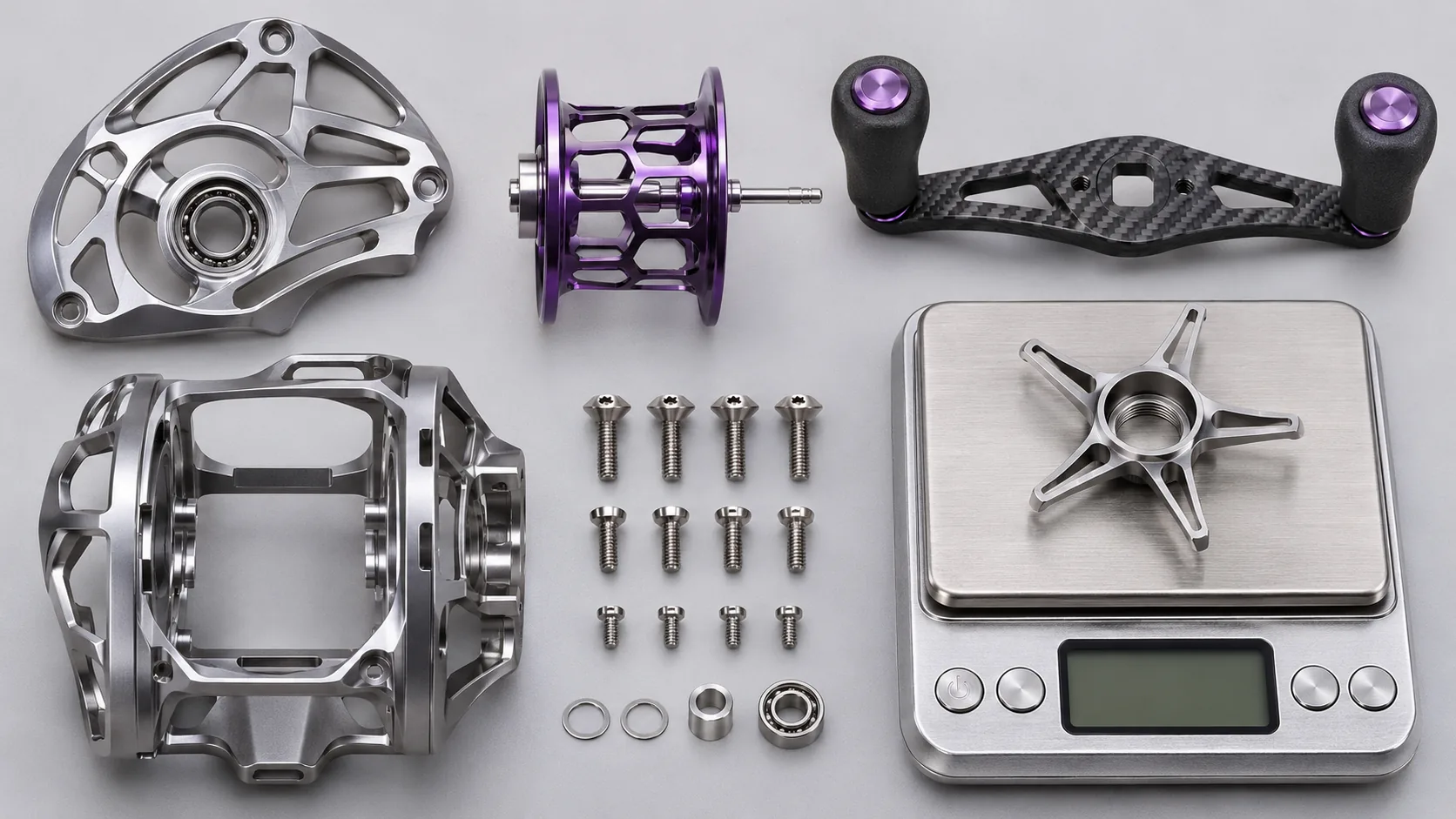
Figure: Schematic illustration. Weight saving usually works through materials, skeletonizing, thinner walls and part integration, with every part weighed against the weight budget.
04|What Weight Saving Costs
- Lower rigidity: thinner, skeletonized frames and side plates deflect under heavy load, changing gear center distance and shaft alignment, which shows up as a heavier feel, grittiness and noise.
- Wear and durability: aluminum gears are lighter than brass but wear faster; thin-wall parts deform more easily in a drop.
- Corrosion: magnesium has poor corrosion resistance and needs complete surface protection; titanium screws in aluminum parts need attention to galvanic corrosion.
- Machining difficulty: thin-wall parts distort during machining and anodizing, raising scrap rates and cost.
- Cost: titanium, carbon fiber, high-strength aluminum and complex skeletonizing all raise the unit price.
- Changed feel: a lighter spool has less inertia, so the original casting brake setting may become too strong and need re-tuning.
For gear material trade-offs, see Fishing Reel Drive Gear Materials.
05|Overall Weight Versus Spool Inertia
These two ideas are often mixed up:
- Overall weight: affects fatigue when holding and casting, and the balance with the rod.
- Spool inertia: affects how the spool starts and stops during the cast, deciding whether light lures cast far and how easily backlashes occur.
For finesse reels, lightening the spool usually has a more noticeable effect than lightening the frame. For spool specifications, see Specifying a Baitcasting Reel Spool.
06|Managing Development With a Weight Budget
- Set a target: set the overall target weight from benchmark reels and positioning.
- Allocate the budget: divide the target among the parts and write it into the parts list.
- Track every round: weigh each prototype round against the budget to find overweight parts.
- Assess the effect: record how each weight saving affects rigidity, durability and cost.
- Re-validate: after removing weight, re-check feel under load, durability and casting.
This avoids discovering at the last moment that the reel is overweight and hastily weakening critical parts.
07|How to Validate
| Validation item | Purpose |
|---|---|
| Part and overall weight | Compare against the weight budget |
| Feel and deflection under load | Confirm rigidity is sufficient and gear mesh stays stable |
| Endurance testing | Confirm durability of lightened gears, shafts and frames |
| Drop | Confirm thin-wall and skeletonized parts do not deform or crack |
| Casting | Re-tune and validate casting brakes after lightening the spool |
| Corrosion | Validate corrosion and galvanic corrosion where magnesium or titanium screws are used |
08|Information to Include in Your RFQ
| Information | Why it matters |
|---|---|
| Target weight | For the whole reel and main parts |
| Use and target species | Sets rigidity and durability requirements |
| Target lure weights | Determines spool weight and inertia |
| Acceptable materials and cost | Whether magnesium, titanium, carbon fiber and so on are acceptable |
| Benchmark reels | Used to compare weight, rigidity and feel |
09|How Zhongde Can Help
- Thin-wall and skeletonized parts: frames, side plates, spools and handle arms can be machined to drawing with distortion of thin walls under control.
- A range of processes: CNC machining, aluminum die casting, forging, injection molding and in-house mold design and manufacturing, so weight-saving options can be evaluated together.
- Baitcasting reel OEM: MOQ of 200 units for baitcasting reels; other reel types can be considered with sufficient volume.
- NDA first: check “An NDA is required first” in the RFQ form, and we will complete the NDA before reviewing your drawings.
Zhongde has worked with Japanese customers for more than 18 years, producing reel parts with demanding cosmetic and quality requirements.
Frequently Asked Questions
Is a lighter reel always better?
No. Saving weight reduces fatigue and improves sensitivity, but brings lower rigidity, reduced durability and higher cost. For heavy-duty saltwater reels, rigidity and durability usually matter more than weight; for light-lure and finesse reels, spool inertia matters more than overall weight. Decide where and how much to save based on the target use and price point.
Which parts give the biggest weight savings?
Generally the frame and side plates make up the largest share of reel weight, so material choice and skeletonizing there save the most. Switching gears from brass to aluminum also saves a fair amount, but affects wear resistance. For casting performance, spool weight and inertia matter most. Small parts such as screws and knobs are light individually, but there are many of them, so savings add up.
What are the risks of using aluminum gears to save weight?
Aluminum is much lighter than brass, but has lower wear resistance and load capacity, wears faster under heavy load, and the feel may deteriorate with long use. It suits lighter-duty reels. If used, pair it with suitable lubrication and mating gear material, and run thorough retrieve endurance tests.
Are titanium screws worth it?
Titanium screws are lighter than steel and resist corrosion well, but cost much more, and screws make up only a small share of total reel weight. They suit products chasing minimum weight or using them as a selling point on flagship models. On aluminum parts, watch for galvanic corrosion and insulate or protect the joint where needed.
How can reel weight be controlled during development?
Set a weight budget for each part early in development and write it into the parts list; weigh every prototype round and compare against the budget to find overweight parts; record the effect of each weight saving on rigidity, durability and cost; and re-validate after removing weight. This avoids discovering at the last moment that the reel is overweight and hastily weakening critical parts.