In This Article
Need fishing reel or tackle parts? Upload drawings for a quote
Direct Answer
Spool line capacity is set by the arbor diameter, the filled outer diameter, the width between the flanges and the line diameter:
- Volume: the space for line is roughly the ring area between the fill diameter and the arbor diameter multiplied by the width.
- Line diameter matters most: in the same volume, halving the line diameter fits about four times as much line.
- State capacity by diameter: lines with the same pound test differ in diameter between brands, so their capacities differ.
Deep spools hold more line and suit heavy line and long runs; shallow spools are lighter with less inertia and suit thin line and light lures. Ported lightweight spools need attention to line pressure deformation. Spool specifications should be set during product definition together with target line, lure weight and application.
01|What Determines Line Capacity
| Dimension | Effect on capacity |
|---|---|
| Arbor diameter | A larger arbor leaves less room for line but retrieves more per turn |
| Filled outer diameter | Set by the flange diameter and the recommended fill level |
| Width between flanges | Wider holds more line and lengthens level wind travel |
| Line diameter | The biggest factor; capacity is roughly inversely proportional to diameter squared |
The space for line is roughly the ring area between the fill diameter and the arbor diameter, multiplied by the width. Dividing that volume by the cross-section of one strand, and allowing for gaps between strands, gives an estimate of how many meters fit. Real capacity also depends on winding tension and line type, so confirm it by winding the actual line.
02|Why Capacity Should Be Stated by Line Diameter
Fishing line is usually sold by pound test or by a numbered size, but capacity depends on line diameter. Lines of different brands and materials (nylon, fluorocarbon, braid) can differ widely in diameter at the same pound test.
- Specification tables: state capacity by line diameter, or note which line was used for measurement.
- Half the diameter, about four times the capacity: which is why thin line fits on a shallow spool.
- Help users understand: give examples with common lines in the manual or on the product page.
03|Deep and Shallow Spools
| Type | Characteristics | Best suited to |
|---|---|---|
| Deep spool | Holds more line; suits heavy line | Big fish, long runs, saltwater |
| Standard spool | Balance of capacity and weight | General use |
| Shallow spool | Lighter, less inertia, faster start | Thin line, light lures, finesse casting |
Using thin line on a deep spool often requires a layer of backing to build up the diameter, which adds weight and inertia. A shallow spool takes thin line directly with no backing.
Many brands offer a shallow spool as a spare alongside the main spool to widen the range of uses. A spare spool must fit the same frame and work with the brake system and level wind.
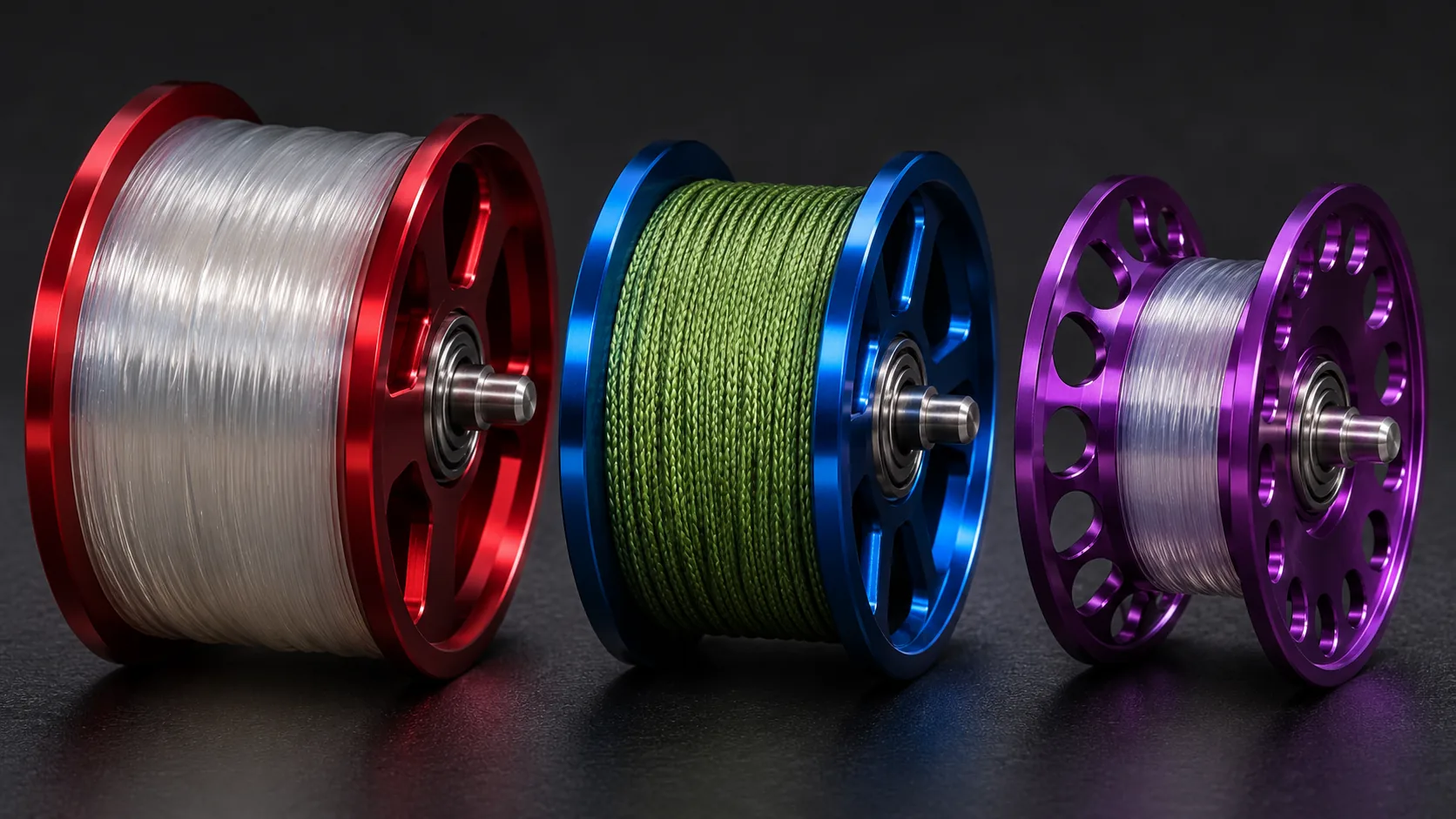
Figure: Schematic illustration. From left to right: a deep spool, a standard spool and a ported shallow spool. Spool depth, width and weight should be set from the target line and lure weight.
04|Effects of Spool Diameter and Width
- Larger diameter: more line per turn and lower spool speed during the cast, but a heavier spool with more inertia that starts more slowly with light lures.
- Smaller diameter: less inertia and a faster start, suiting light lures, but less line per turn.
- Wider: more capacity, but longer level wind travel and a wider frame.
- Narrower: a compact frame that palms well, but less capacity.
Spool diameter and gear ratio together set line per crank; see How to Choose a Fishing Reel Gear Ratio. For how spool inertia relates to casting brakes, see Baitcasting Reel Casting Brakes.
05|Fill Level
Line should be wound to a small margin below the flange edge, as set by the design:
- Overfilled: backlashes become more likely and line can slip off the flange edge.
- Underfilled: the line-layer diameter shrinks, line per turn drops and casting distance suffers.
State the recommended fill level in the user manual, and calculate the capacity in the specification table at that level.
06|Porting and Line Pressure Deformation
To reduce spool weight and inertia, many spools have ports machined through the arbor and flanges. Keep in mind:
- Line pressure: nylon and fluorocarbon line wound under tension, or contracting after absorbing water, press hard on the spool.
- Strength: thin walls with many ports lose strength, and the spool may deform, rub against the frame or spin unevenly.
- Balance: port positions and sizes must be symmetrical to avoid imbalance at high speed.
- Machining: thin, ported parts distort easily during machining and anodizing, so the process must be controlled.
For spool machining, runout and dynamic balance, see How Fishing Reel Spools Are Machined.
07|How to Validate a Spool
| Validation item | Purpose |
|---|---|
| Actual line capacity | Wind real line to the recommended fill level and measure the length |
| Weight and free spin | Confirm weight and inertia, and smooth free spin |
| Line pressure deformation | Wind nylon or fluorocarbon under tension, soak if needed, and check deformation |
| Casting | Confirm distance and backlash at the target lure weights |
| Line lay | Confirm the level wind lays line evenly across the full width |
| Spare spool interchangeability | Confirm brake and line lay work correctly with the spare spool fitted |
For how the level wind matches spool width, see Baitcasting Reel Level Wind.
08|Information to Include in Your RFQ
| Information | Why it matters |
|---|---|
| Target line types and diameters | Determines spool depth and capacity |
| Required line length | Set by target species and technique |
| Target lure weights | Determines spool weight and inertia |
| Whether a spare spool is needed | For example a shallow spool, which affects lineup planning |
| Spool material and finish | For example aluminum grade and anodized color |
| Benchmark reels | Used to compare capacity, weight and casting |
09|How Zhongde Can Help
- Spool machining: thin-wall and ported lightweight spools can be machined to drawing, with runout, wall thickness and balance managed as critical characteristics.
- Surface treatment: anodizing is done in-house, which helps control dimensions and appearance.
- Baitcasting reel OEM: MOQ of 200 units for baitcasting reels; other reel types can be considered with sufficient volume.
- NDA first: check “An NDA is required first” in the RFQ form, and we will complete the NDA before reviewing your drawings.
Zhongde has worked with Japanese customers for more than 18 years, producing reel parts with demanding cosmetic and quality requirements.
Frequently Asked Questions
How is spool line capacity calculated?
The volume available for line is roughly the ring area between the filled outer diameter and the arbor diameter, multiplied by the width between the flanges. Dividing that volume by the cross-section of one strand of line, and allowing for gaps between strands, gives an estimate of how many meters fit. Real capacity also depends on winding tension and line type, so it should be confirmed by winding the actual line.
Why do lines with the same pound test give different capacities?
Because capacity depends on line diameter, not pound test. Lines from different brands and materials can differ widely in diameter at the same pound test. Halving the diameter fits about four times as much line. Capacity tables are therefore best stated by line diameter, or should note which line was used for measurement.
How do I choose between a deep spool and a shallow spool?
A deep spool holds more line and suits heavy line, big fish and techniques that need long runs; a shallow spool is lighter with less inertia and starts faster, suiting thin line and light lures without the need for backing. Many brands offer a shallow spool as a spare alongside the main spool to widen the range of uses.
How full should the spool be filled?
Usually a small margin is left below the flange edge, as set by the design. Overfilling makes backlashes more likely and can let line slip off the flange edge; underfilling reduces the line-layer diameter, shortening line per turn and reducing casting distance. The recommended fill level should be stated in the user manual.
Can a ported lightweight spool deform?
It can. Nylon and fluorocarbon line wound under tension, or contracting after absorbing water, presses hard on the spool; thin walls with many ports lose strength, and the spool may deform, rub against the frame or spin unevenly. Wall thickness and porting should be checked for strength at the design stage, and validation should wind real line under tension and check spool deformation.