In This Article
Need fishing reel or tackle parts? Upload drawings for a quote
Direct Answer
A baitcasting reel level wind uses a worm shaft with crossing helical grooves and a pawl that rides in those grooves to move the line guide back and forth across the spool width, laying line evenly on the spool.
- Uneven lay and line piling at the ends: usually a mismatch between level wind travel and spool width, slipping drive gears or a worn pawl.
- Binding and clicking at reversal: usually poor groove shape or surface at the reversal points, a worn or dry pawl, or guide rails not parallel to the spool.
- Braided line wearing the line guide: line guides need wear-resistant materials such as ceramic or hardened metal.
The material, hardness and surface roughness of the level wind parts and the parallelism of the guide rails should be managed as critical characteristics and validated with the actual line for lay and endurance.
01|How a Level Wind Is Built and Works
| Part | Function |
|---|---|
| Worm shaft | Carries two crossing helical grooves that drive the pawl back and forth as it turns |
| Pawl | Rides in the helical grooves and reverses automatically at each end |
| Line guide | Carries the guide ring, follows the pawl and leads line onto the spool |
| Guide rails | Support the line guide so it travels straight and smoothly |
| Drive gears | Transfer handle rotation to the worm shaft and set the speed relationship between level wind and spool |
In most modern baitcasting reels the level wind is driven by the handle: it travels back and forth during the retrieve and stays still during the cast, with the line swinging inside the guide. Some designs move the level wind with the spool during the cast to reduce line resistance.
02|Common Causes of Uneven Line Lay
| Symptom | Common causes |
|---|---|
| Line piles up at one end of the spool | Travel range offset to one side, or travel that does not match spool width |
| Both ends high, center low | Travel too short, or reversal points too far inboard |
| Center high, ends not filled | Travel too long, or too little dwell at reversal |
| Line overlaps too much at certain positions | Level wind to spool ratio poorly chosen, causing periodic overlap |
| Lay is sometimes good, sometimes poor | Slipping or worn drive gears; worn pawl occasionally skipping grooves |
How many spool turns occur per level wind cycle is set at the design stage from spool width, line diameter and application. A poorly chosen ratio makes line overlap periodically at certain positions, which affects line release and casting.
03|Binding and Clicking at Reversal
At each end of the spool the pawl moves from one helical groove into the other, and this is where problems are most likely:
- Groove shape and surface at reversal: if the transition is not smooth, or has burrs or a rough finish, the pawl binds and clicks as it reverses.
- Worn or wrongly sized pawl: too loose a fit in the groove causes wobble and skipping; too tight causes drag.
- Lack of oil or sand intrusion: the worm shaft is often exposed, and sand and salt in the grooves cause binding and wear.
- Guide rails not parallel to the spool: the line guide binds as it travels, most noticeably at reversal.
A light reversal sound is normal in some designs, but obvious binding and noise call for checking these parts.
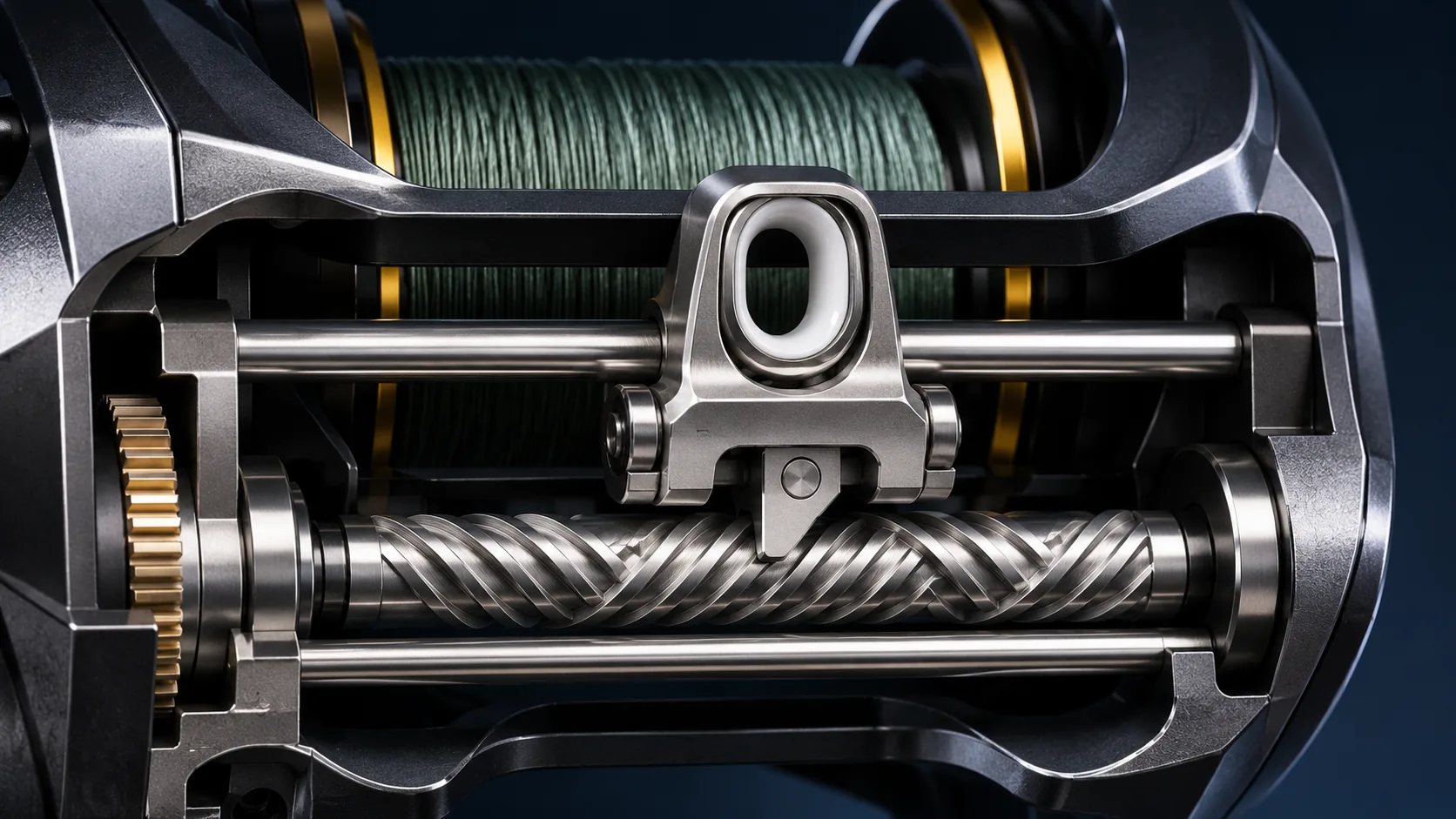
Figure: Schematic illustration. As the worm shaft turns, the pawl travels along the crossing helical grooves and moves the line guide back and forth across the spool width, laying line evenly.
04|Braided Line and Line Guide Wear
Braided line is thin and hard. Long-term friction cuts grooves into softer guide materials, and those grooves then damage the line and can even cause breakoffs.
- Guide material: reels intended for braided line usually use ceramic or hardened and coated metal guides.
- Surface condition: the inside of the guide should be smooth with rounded edges to avoid scratching the line.
- Validation: run abrasion tests under load with the line the reel is meant for, and inspect wear on both guide and line.
05|Materials and Machining Points for Level Wind Parts
| Part | Material and treatment | Machining and inspection points |
|---|---|---|
| Worm shaft | Corrosion- and wear-resistant material such as stainless steel, with surface treatment where needed | Groove profile, transition at reversal, surface roughness, deburring |
| Pawl | Wear-resistant material with hardness matched to the worm shaft | Fit with the groove; contact face shape and finish |
| Line guide | Ceramic, or hardened or coated metal | Smooth inner surface, rounded edges |
| Guide rails | Corrosion-resistant material | Straightness and parallelism to the spool shaft |
| Frame holes | Same as frame material | Positions of rail and worm shaft holes set the level wind’s relationship to the spool |
The crossing helical grooves are usually machined on a lathe with live tooling or on dedicated equipment, and the transition at the reversal points is the difficult part. The relationship between the rail and worm shaft holes and the spool shaft depends on frame accuracy; see Why Fishing Reel Frames and Side Plates Deform.
06|How the Level Wind Affects Casting
During a cast the line passes through the line guide, and the guide adds resistance through:
- Opening size: too small an opening increases friction as the line swings, reducing distance.
- Position: the distance and height of the guide relative to the spool affect the angle at which line leaves.
- Inner surface: a rough surface adds resistance and line wear.
Some models reduce casting resistance by enlarging the guide opening, changing its position, or moving the level wind with the spool during the cast. For how the casting brake and spool interact, see Baitcasting Reel Casting Brakes.
07|How to Validate a Level Wind
| Validation item | Purpose |
|---|---|
| Line lay | Retrieve the actual line type and diameter; check for even lay and no end piling |
| Reversal feel and sound | Confirm there is no obvious binding or noise at reversal |
| Endurance | After long cycling, check worm shaft and pawl wear and any change in lay |
| Line guide abrasion | Validate under load with braided line and other actual lines |
| Salt and sand | For saltwater reels, confirm operation and corrosion after sand and salt exposure |
| Casting comparison | Compare guide resistance during casting against benchmark reels |
08|Maintenance Instructions for Users
The worm shaft is often exposed and picks up sand, salt and dust easily. We recommend the user manual explains:
- After use: rinse gently with fresh water, wipe dry and leave to dry in a ventilated place.
- Regular cleaning: remove sand and old oil from the worm shaft and pawl.
- A little oil: add a small amount of oil to the worm shaft as specified; avoid sticky grease, which collects dirt.
09|Information to Include in Your RFQ
| Information | Why it matters |
|---|---|
| Main line types and diameters | Braided, nylon or fluorocarbon; determines guide material and lay design |
| Spool width and line capacity | Determines level wind travel and ratio |
| Operating environment | Freshwater or saltwater |
| Casting performance requirements | Sets the direction for guide opening and position |
| Benchmark reels | Used to compare line lay and feel |
10|How Zhongde Can Help
- Level wind parts: worm shafts, pawls, guide rails, line guides and frame hole positions can be machined to drawing, with helical grooves, surface condition and parallelism managed as critical characteristics.
- Assembly validation: line lay and reversal feel can be checked in the assembled reel.
- Baitcasting reel OEM: MOQ of 200 units for baitcasting reels; other reel types can be considered with sufficient volume.
- NDA first: check “An NDA is required first” in the RFQ form, and we will complete the NDA before reviewing your drawings.
Zhongde has worked with Japanese customers for more than 18 years, producing reel parts with demanding cosmetic and quality requirements.
Frequently Asked Questions
Why does line lay unevenly or pile up at one side of the spool?
Common causes are level wind travel that does not match the spool width; a level wind to spool ratio that makes line overlap too much at certain positions; slipping or worn drive gears; a worn pawl that skips grooves at reversal; and a level wind travel range that is offset to one side. Check the travel range and reversal positions first, then the condition of the pawl, worm shaft and drive gears.
Why does the level wind click or bind when it reverses?
At each end of the spool the pawl has to move from one helical groove into the other, and this is where problems are most likely. Common causes are poor groove shape or surface at the reversal points, a worn or wrongly sized pawl, lack of oil or sand in the grooves, and guide rails that are not parallel to the spool, which makes the line guide bind. A light reversal sound is normal in some designs, but obvious binding and noise call for checking these parts.
Does braided line wear out the line guide?
Yes. Braided line is thin and hard, and long-term friction cuts grooves into softer guide materials; those grooves then damage the line. Reels intended for braided line therefore usually use wear-resistant guides such as ceramic or hardened and coated metal, and validation should include abrasion testing with the actual line.
Does the level wind affect casting distance?
To some extent. During a cast the line passes through the line guide, and the guide opening size, position and inner surface all add resistance. In most modern baitcasting reels the level wind is driven by the handle and does not move during the cast, so the line swings within the guide; some designs move the level wind with the spool during the cast instead. Some models reduce casting resistance by enlarging the guide opening or changing its position.
How should the level wind be maintained?
The worm shaft is often exposed and picks up sand, salt and dust easily. Users are generally advised to rinse gently with fresh water after use and dry the reel, clean the worm shaft and pawl regularly, and add a small amount of oil to the worm shaft as the manual specifies. Avoid sticky grease, which collects dirt. These points should be included in the user manual.