In This Article
Need fishing reel or tackle parts? Upload drawings for a quote
Direct Answer
Gear ratio is the number of spool turns per handle turn, set by the tooth ratio between the main gear and the pinion. What anglers actually feel is line retrieved per crank:
Line retrieved per crank = gear ratio × circumference of the line layer on the spool
So the same ratio retrieves at different speeds on spools of different diameters.
- High ratio: retrieves faster but cranks harder under load; the pinion is smaller and wears more easily.
- Low ratio: retrieves slower, with less effort and a more powerful feel.
Choose the ratio by technique. In design terms, offering several ratios on one frame requires keeping the center distance unchanged, achieved through tooth counts, module or profile shift.
01|Gear Ratio and Line Retrieved per Crank
A baitcasting reel’s gear ratio is usually written like “6.3:1”, meaning the spool turns 6.3 times for each turn of the handle. It is set by the tooth counts of the main gear and the pinion:
Gear ratio = main gear teeth ÷ pinion teeth
The retrieve speed the angler experiences, however, depends on line retrieved per crank:
| Factor | Effect on line retrieved per crank |
|---|---|
| Gear ratio | The higher the ratio, the more the spool turns per crank |
| Spool diameter | The larger the spool, the more line each spool turn retrieves |
| Line on the spool | A fuller spool has a larger line-layer diameter; less line means less retrieved per crank |
So a reel with a higher ratio but a smaller spool does not necessarily retrieve more line per crank. When comparing retrieve speed between reels, look at line retrieved per crank and confirm how much line was on the spool when it was measured.
02|Why High Ratios Crank Harder
Ignoring friction, the force needed at the handle is roughly:
Cranking force ≈ line tension × line retrieved per crank ÷ circumference of the handle’s path
Two things follow:
- More line per crank means a heavier handle: whether the retrieve comes from a high ratio or a large spool, cranking effort rises at the same line tension.
- A longer handle means less effort: a longer handle reduces the force needed, but the hand travels further each turn, so the cranking rhythm slows.
That is why techniques that need torque, such as high-resistance hard baits or big fish, often use a low ratio or a long handle, while techniques that need fast retrieves use a high ratio and accept a heavier handle.
03|Common Ratio Ranges and Suitable Techniques
On the market, baitcasting reel ratios are commonly grouped roughly as follows (exact figures vary by brand and model):
| Category | Approximate range | Characteristics | Typical uses |
|---|---|---|---|
| Low | Around 5.x | Less effort, strong torque, slow retrieve | High-resistance deep-diving hard baits; big fish needing torque |
| Medium | Around 6.x | Balanced speed and torque | General purpose; most hard baits and soft plastics |
| High | Around 7.x | Fast retrieve | Bottom-contact soft plastics (picking up slack, setting the hook); topwater |
| Extra-high | 8 and above | Very fast retrieve; heavier under load | Techniques needing fast pickup and maximum efficiency |
Saltwater uses such as vertical jigging and slow-pitch jigging have their own torque and speed requirements and are often designed around large spools, long handles or lower ratios.
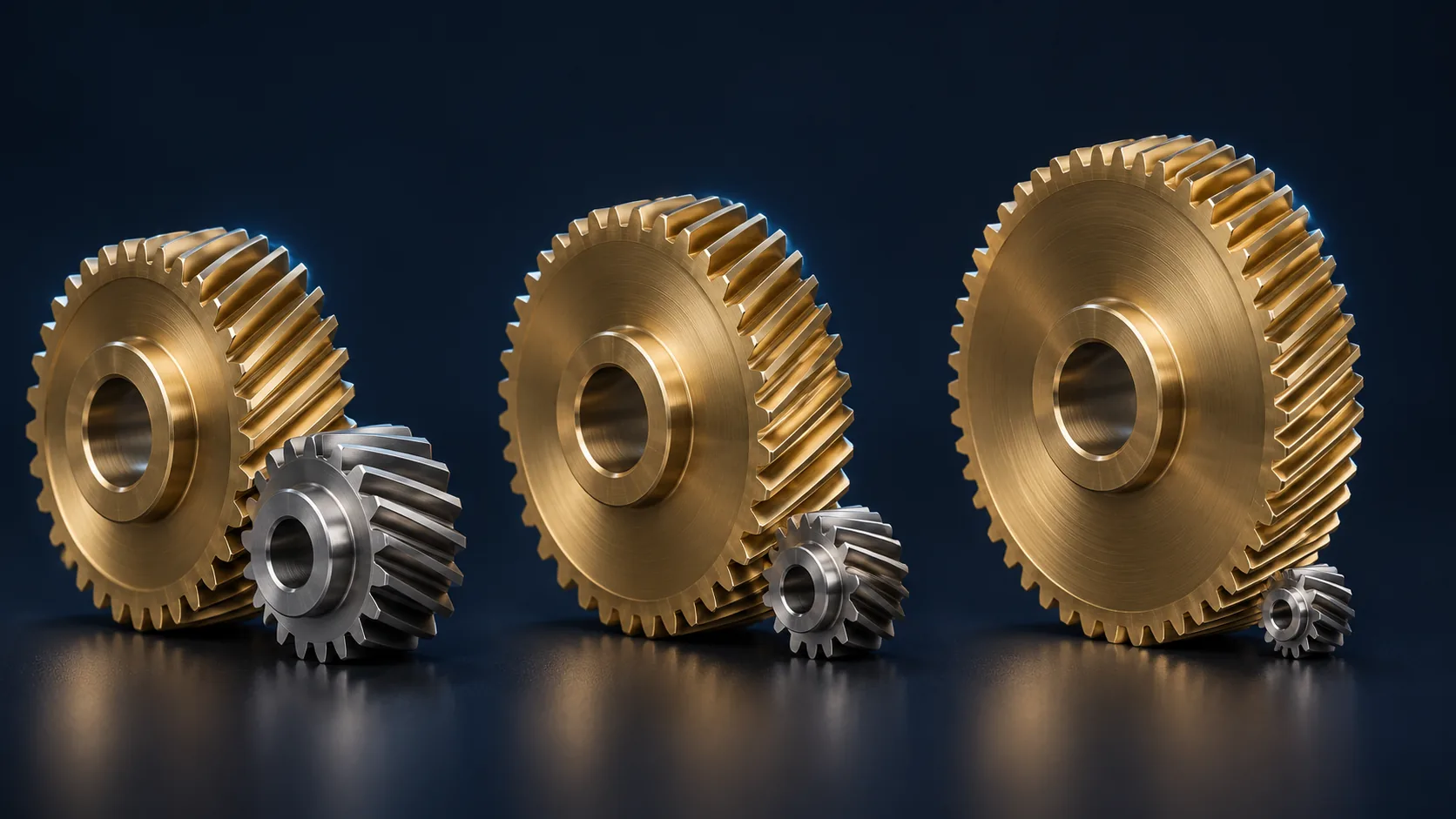
Figure: Schematic illustration. Three sets of brass main gears and stainless pinions; from left to right the pinion becomes relatively smaller and the gear ratio rises.
04|Design Points
| Point | Explanation |
|---|---|
| Pinion strength | The higher the ratio, the smaller the pinion and the fewer its teeth, so tooth strength drops and wear rises |
| Tooth count and undercut | Pinions with very few teeth are prone to undercut and often need profile shift |
| Center distance | Center distance defines the frame and side plate design; changing it means changing the frame |
| Helical gears | Helical gears run smoother and quieter, and the helix angle also helps adjust center distance |
| Spool diameter | Together with the ratio, determines line per crank and cranking effort |
| Handle length | Affects cranking effort and rhythm; can differentiate models |
For pinion materials and wear resistance, see Fishing Reel Drive Gear Materials.
05|Several Ratios on One Frame
Many brands offer several ratios on the same frame to extend their lineup at lower cost. The key is to keep the center distance between the main gear and the pinion unchanged, so the frame and side plates can be shared and only the gear set changes.
Ways to achieve this:
- Adjust tooth counts: change the main gear and pinion tooth combination within what the center distance allows;
- Adjust module: pair different modules with different tooth counts;
- Profile shift: use profile-shifted gears to change the tooth ratio without changing the center distance;
- Adjust helix angle: helical gears gain extra design freedom from the helix angle.
Note that high-ratio versions have a smaller pinion, so strength and wear must be validated separately, and the pinion bore, clutch-related parts and bearing positions may also need adjustment. It is best to plan for multiple ratios at the product planning stage to avoid changing the frame later.
For how gear mesh relates to bearing seats, see Why Fishing Reel Gears Feel Smooth or Rough.
06|How to Validate
| Validation item | Purpose |
|---|---|
| Line retrieved per crank | Measure with a specified spool fill and confirm it meets the design value |
| Handle feel under load | Retrieve under a specified load and confirm effort and smoothness |
| Gear endurance | Especially for high-ratio pinions, confirm wear and feel after long use |
| Noise and grittiness | Confirm mesh condition when different gear sets are fitted to the same frame |
| Benchmark comparison | Compare retrieve speed and handle feel with benchmark reels under the same conditions |
07|Information to Include in Your RFQ
| Information | Why it matters |
|---|---|
| Target techniques and species | Sets the direction for ratio and torque |
| Target line per crank or gear ratio | Whether there are firm values already |
| Lineup plan | Whether several ratios are needed on one frame |
| Spool diameter and line capacity | Determines line per crank together with the ratio |
| Handle length and type | Affects cranking effort |
| Benchmark reels | Used to compare retrieve speed and feel |
For the overall product planning process, see How to Start Your Own Fishing Reel Brand; for handle knob choices, see How to Choose Materials for Fishing Reel Handle Knobs.
08|How Zhongde Can Help
- Drive train parts: main gears, pinions, shafts and side plate bearing seats can be machined to drawing and validated together in assembly.
- Planning multiple ratios: center distance, gear sets and shared parts can be evaluated together at the product planning stage, reducing the risk of changing the frame later.
- Baitcasting reel OEM: MOQ of 200 units for baitcasting reels; other reel types can be considered with sufficient volume.
- NDA first: check “An NDA is required first” in the RFQ form, and we will complete the NDA before reviewing your drawings.
Zhongde has worked with Japanese customers for more than 18 years, producing reel parts with demanding cosmetic and quality requirements.
Frequently Asked Questions
Is a higher gear ratio always better?
No. A high ratio retrieves line faster but cranks harder under load, and its pinion is smaller and wears more easily. A low ratio retrieves more slowly but takes less effort and feels more powerful. Choose by technique and target species: low ratios for high-resistance hard baits and big fish, medium ratios for general use, and high ratios for techniques that need slack picked up quickly.
How does line retrieved per crank relate to gear ratio?
Line retrieved per crank equals the gear ratio multiplied by the circumference of the line layer on the spool. At the same ratio, a larger spool or a fuller spool retrieves more line per crank; conversely, a reel with a higher ratio but a smaller spool does not necessarily retrieve more per crank. When comparing retrieve speed between reels, look at line retrieved per crank and confirm how much line was on the spool when it was measured.
Why does a high-ratio reel feel harder to crank?
Ignoring friction, the force needed at the handle is roughly the line tension multiplied by line retrieved per crank, divided by the circumference the handle travels in one turn. The more line retrieved per crank, the heavier the handle feels at the same line tension. A longer handle reduces the effort, but the hand also travels further each turn.
Can one reel model be offered in several gear ratios?
Yes, and many brands extend their lineup this way. The key is to keep the center distance between the main gear and the pinion unchanged, so the frame and side plates can be shared and only the gear set changes. This is done by adjusting tooth counts or module, or by using profile-shifted gears. Note that higher-ratio versions have a smaller pinion, so strength and wear must be validated again.
Which parts change when the gear ratio changes?
At minimum, the main gear and the pinion. If the center distance stays the same, the frame and side plates can usually be shared, but the pinion bore, clutch-related parts and bearing positions may also need adjustment. It is best to plan for multiple ratios at the product planning stage to avoid changing the frame later.