In This Article
Need fishing reel or tackle parts? Upload drawings for a quote
Direct Answer
There is no single best material for fishing reel drive gears, only combinations that fit the product position.
- Brass: machines well and balances wear resistance and cost; the most common main gear material.
- Aluminum: lighter and suited to lightweight models, but with lower wear resistance and load capacity.
- Stainless steel, bronze, high-strength brass: higher strength, wear and corrosion resistance; common for pinions and for heavy-duty or saltwater reels.
- Die-cast zinc, engineering plastics: low cost, suitable only for light loads.
The main gear and pinion often use different materials and hardness levels. Production gears are mostly hobbed or cold forged; prototypes are often made by CNC or wire EDM. Two more points should not be overlooked: feel and noise often depend on accuracy and assembly, not just material, and leaded brass must be checked against the requirements of the target market.
01|What Reel Gears Have to Withstand
The drive train of a baitcasting reel usually consists of a main gear (connected to the handle) and a pinion (which drives the spool). They face several kinds of load:
| Load case | Effect on the gears |
|---|---|
| Continuous retrieve | Long periods of repeated meshing and tooth surface wear |
| Heavy load during a fight | High bending stress at the tooth root; risk of broken or deformed teeth |
| Sudden shock | Tooth surfaces take impact when a fish surges or the line snags |
| While the drag works | The gears stay loaded as force passes through the drag system |
| Clutch operation | In many baitcasting reels, the pinion also moves axially with the clutch |
In many baitcasting reels, the pinion not only transmits torque but also slides axially when the clutch is operated, engaging or disengaging the spool shaft. Besides the tooth surfaces, the wear resistance of the pinion bore and end faces therefore matters as well.
02|Common Gear Materials Compared
| Material | Advantages | Watch points | Typical use |
|---|---|---|---|
| Die-cast zinc alloy | Low cost, suited to high volume | Lower strength and wear resistance; accuracy limited by die casting | Entry-level models |
| Brass (free-cutting) | Good machinability; balanced wear and cost | Usually contains lead, so compliance must be checked; relatively heavy | The most common main gear material |
| Lead-free or low-lead copper alloys | Lower compliance risk | Usually less machinable than free-cutting brass; higher cost | Markets with strict compliance needs |
| High-strength brass | Higher strength and wear resistance than standard brass | Harder to machine; higher cost | Mid- to high-end main gears |
| Bronze (e.g. aluminum bronze) | Wear and corrosion resistant; high load capacity | High cost; difficult to machine | Heavy-duty and saltwater models |
| Aluminum alloy (e.g. 7075) | Light; helps reduce overall reel weight | Lower wear resistance and load capacity; surface treatment changes dimensions | Lightweight models |
| Stainless steel | High strength; corrosion resistant | Heavier and harder to machine; stainless-on-stainless meshing needs attention to galling | Pinions, heavy-duty models |
| Engineering plastics (e.g. POM) | Quiet, rust-free, low cost | Limited strength and heat resistance; dimensions shift with temperature and humidity | Light-load models or auxiliary drives |
For general material selection principles, see Material Selection; for the differences between aluminum grades, see How to Choose 6061, 6063 and 7075 Aluminum.
03|Why the Main Gear and Pinion Often Use Different Materials
Many reels pair different materials for the main gear and pinion, for example a brass main gear with a stainless steel or bronze pinion. There are two main reasons:
- Less adhesive wear: two identical soft materials meshing under heavy load tend to stick together and scuff the tooth surfaces. Combinations of different materials or hardness levels are more stable.
- The pinion wears faster: the pinion has fewer teeth and turns several times faster than the main gear (depending on the gear ratio), so each tooth meshes more often. A harder, more wear-resistant material is therefore common.
Harder is not always better, though. If one gear is much harder, it can accelerate wear on its mate. The right pairing depends on load, lubrication and cost, and should be confirmed by endurance testing.
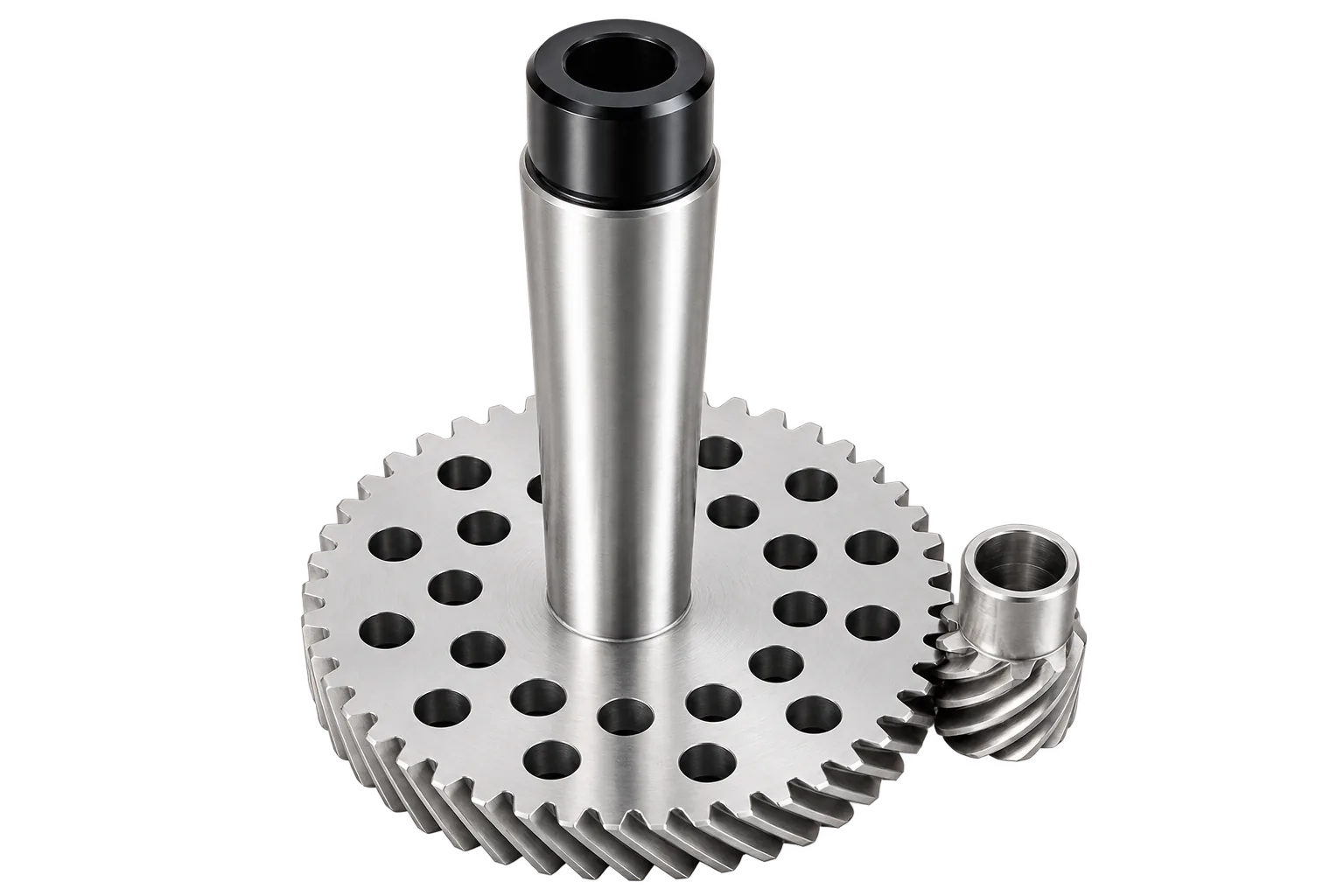
Figure: Main gear and mating pinion. Gear material has to be evaluated together with tooth geometry, shafts and bearing seats to judge the feel and service life of the whole reel.
04|Choosing a Manufacturing Method
| Method | Characteristics | Best suited to |
|---|---|---|
| Hobbing | The mainstream method for production external gears; stable accuracy; no dedicated tooling | Most production gears |
| Cold forging | Continuous grain flow along the teeth; good strength and material utilization; requires dies | Products with volume and strength demands |
| Die casting | Low cost and high efficiency; limited accuracy and strength | Entry-level zinc gears |
| CNC gear milling | Flexible, no dedicated cutters or dies; lower efficiency | Prototypes and small batches |
| Wire EDM | Good profile accuracy for spur gears; cannot cut helical gears | Spur gear prototypes and validation gears |
A few more points to consider:
- Spur or helical: helical gears have a higher contact ratio, turn more smoothly and run quieter, but generate axial thrust that must be handled by the bearings and axial positioning.
- Post-processing: deburring, cleaning and, where needed, heat treatment (for example on steel pinions). Burrs and leftover chips are common causes of noise and early wear.
- Prototype versus production: when prototypes made by CNC or wire EDM move to hobbing or cold forging in production, tooth surface condition and accuracy change, so feel must be validated again.
05|Accuracy Often Matters More Than Material
Many “rough gear” complaints are not caused by material. Tooth profile accuracy, radial and axial runout, center distance between the two shafts, shaft perpendicularity, bearing seats and shims all affect the actual mesh. A gear that passes inspection on its own can still feel gritty, tight or produce periodic noise once installed in the frame.
When diagnosing gear problems, check accuracy and assembly first, and consider changing material only after that. For a detailed analysis, see How Gears, Shafts and Bearing Seats Affect Reel Smoothness.
06|Compliance Notes on Leaded Brass
Free-cutting brass usually contains lead to improve machinability. Fishing reels are consumer products, and different markets may have different requirements, for example:
- California, USA: products may be subject to Proposition 65 warning requirements.
- European Union: lead is on the REACH Candidate List of Substances of Very High Concern (SVHC), which triggers information obligations when an article contains more than 0.1% by weight.
State your target markets in the RFQ, consider lead-free or low-lead copper alloys where needed, and ask the supplier for material certificates. Always follow the current regulations of each target market and the judgment of your own compliance team.
07|How to Validate Reel Gears
| Method | Purpose |
|---|---|
| Loaded endurance test | Run for long periods at a set load and speed; check changes in feel and noise |
| Heavy load and shock test | Simulate fights and snags; check for broken teeth, deformation and slipping |
| Tooth surface teardown | Inspect wear patterns, pitting, scuffing and metal particles in the grease |
| Comparison with a benchmark | Compare feel, noise and wear against a benchmark reel under the same conditions |
| Saltwater validation | Saltwater models must be validated together with corrosion requirements |
For corrosion design in saltwater reels, see Saltwater Fishing Reel Corrosion Protection.
08|Information to Include in Your RFQ
| Information | Why it matters |
|---|---|
| Product position and price point | Sets the direction for material and manufacturing method |
| Target species and maximum drag | Defines the load requirements for the gears |
| Gear ratio | Affects tooth count, module and pinion wear |
| Weight target | Whether lightweight materials such as aluminum are needed |
| Operating environment | Freshwater or saltwater |
| Target markets | Confirms compliance requirements such as leaded materials |
| Expected volume | Determines whether hobbing or cold forging fits, and the tooling investment |
| Benchmark samples | Used to compare feel, noise and endurance |
09|How Zhongde Can Help
- Drive train parts: main gears, mating gears, shafts and side cover bearing seats can be machined to drawing and validated together in assembly. We evaluate gear material and forming method with you based on volume, feel and cost requirements.
- Baitcasting reel OEM: MOQ of 200 units for baitcasting reels; other reel types can be considered with sufficient volume.
- Parts-only projects: side covers, spools, handle arms and gear-related parts can be machined individually.
- NDA first: check “An NDA is required first” in the RFQ form, and we will complete the NDA before reviewing your drawings.
Zhongde has worked with Japanese customers for more than 18 years, producing reel parts with demanding cosmetic and quality requirements.
Frequently Asked Questions
Is brass or aluminum better for a fishing reel main gear?
It depends on the product position. Brass balances wear resistance, machinability and cost, and suits most general-purpose models. Aluminum is lighter and suits models that prioritize low weight, but it has lower wear resistance and load capacity, so it is better for lighter-duty use. Heavy-duty or saltwater models usually consider high-strength brass, bronze or stainless steel. Decide together with the target species, maximum drag, weight target and price point.
Why do the main gear and pinion often use different materials?
First, two identical soft materials meshing together are prone to adhesive wear, while different materials or hardness levels are less likely to stick to each other. Second, the pinion has fewer teeth and turns several times faster than the main gear, so each tooth meshes more often and wears faster; a harder, more wear-resistant material is therefore common. The exact pairing should be decided based on load, lubrication and cost.
Are cold-forged gears always better than cut gears?
Not necessarily. Cold forging keeps the metal grain flow continuous along the tooth profile and offers advantages in strength and material utilization, but it requires tooling investment, suits products with meaningful volume, and usually still needs follow-up machining for accuracy. Cutting methods such as hobbing need no dedicated tooling and are more flexible for design changes. The choice depends on volume, accuracy, strength and tooling budget.
Can leaded brass gears cause compliance issues?
They can. Free-cutting brass usually contains lead. For example, products sold in California may be subject to Proposition 65 warning requirements, and lead is on the EU REACH Candidate List of Substances of Very High Concern (SVHC), which triggers information obligations when an article contains more than 0.1% by weight. State the target markets in your RFQ, consider lead-free or low-lead copper alloys where needed, and request material certificates. Always follow the current regulations of each target market and the judgment of your own compliance team.
If a gear is noisy or feels rough, is the material to blame?
Not necessarily, and often it is not. Tooth profile accuracy, gear runout, center distance, shaft perpendicularity, bearing seats and shims, burrs and lubrication all directly affect feel and noise. Switching to a more expensive material often does not solve these problems. Check accuracy and assembly first, then decide whether material or wear is the issue.