In This Article
Need fishing reel or tackle parts? Upload drawings for a quote
Direct Answer
In fishing reel OEM pre-shipment inspection, what matters most is not how many units are sampled but agreeing with the factory in advance how units are judged.
- Sampling: usually AQL sampling under ISO 2859-1 or ANSI/ASQ Z1.4, with separate criteria for critical, major and minor defects.
- Passing AQL is not the same as every unit being good: key functions should be 100% checked on the production line; the sampling inspection is a last confirmation.
- Cosmetics: use golden and boundary samples, and agree on surface classes and inspection conditions.
- Function: always check handle rotation, clutch, anti-reverse, drag, casting brake, spool free spin and level wind.
- Packaging and labels: check manuals, barcodes and the markings required by target markets as well.
Before ordering, write all of this into the purchase order or an inspection agreement.
01|The Inspection Stages Before Shipment
| Inspection | Done by | When | Focus |
|---|---|---|---|
| Incoming quality control (IQC) | Factory | When parts and purchased items arrive | Dimensions, material, cosmetics, purchased items such as bearings |
| In-process quality control (IPQC) | Factory | During machining and assembly | First article, patrol inspection, critical characteristics |
| Final / outgoing quality control (FQC/OQC) | Factory | After assembly, before and after packing | 100% function checks, cosmetics, packaging |
| Customer or third-party inspection | Brand or inspection company | Before shipment | Final confirmation under the agreed sampling plan |
Brands usually see only the last stage. But outgoing quality is determined by all the stages before it, so when choosing a factory, find out how it runs incoming, in-process and final inspection.
02|How to Read AQL Sampling
Inspection usually follows attribute sampling under ISO 2859-1 or the corresponding ANSI/ASQ Z1.4:
- The sample size is set by lot size and inspection level (general inspection level II is the most common);
- A separate AQL value is set for each defect class;
- The number of defects found in the sample is compared with the accept and reject numbers to accept or reject the whole lot.
Keep in mind:
- AQL is not a promised defect rate: it is a parameter of the sampling plan. Passing only indicates that the lot’s defect level is roughly within an acceptable range.
- Passing a sample does not mean every unit is good: items affecting safety and main functions should be 100% checked on the production line.
- Values must be agreed in advance: there are no universal inspection levels or AQL values; both parties should state them in the purchase order or inspection agreement.
03|How to Classify Defects
| Class | Definition | Fishing reel examples |
|---|---|---|
| Critical | May affect safety or violate regulatory requirements | Sharp burrs or edges, loose parts, missing warnings required by the target market |
| Major | Affects a main function or is clearly noticeable to users | Clutch does not re-engage, anti-reverse slips, drag cannot be adjusted, obvious roughness or noise, wrong or missing parts |
| Minor | Small issues that do not affect function | Light scratches on secondary surfaces, small color differences within limits, minor packaging blemishes |
Turn the classification into a product-specific list with photos or samples. The same defect may fall into a different class depending on whether it is on a primary visible surface or a hidden one.
04|Cosmetic Judgment: Golden Samples and Boundary Samples
Cosmetics are the most disputed part of any inspection. Prepare in advance:
- Golden samples: finished units approved by both parties that represent the cosmetic and feel standard.
- Boundary samples: the limit of what is acceptable, for example the largest acceptable scratch or the color range. Rejected samples can be added for contrast.
- Surface classes: divide the product into primary visible surfaces, secondary surfaces and hidden surfaces, with requirements for each.
- Inspection conditions: agree on lighting, viewing distance, angle and viewing time so that different inspectors judge the same way.
Each party keeps a sealed set of samples, and judgments are made against them. Whenever color, surface treatment or process changes, the samples must be approved again. For cosmetic control of anodized parts, see Fishing Reel Aluminum Surface Finishing.
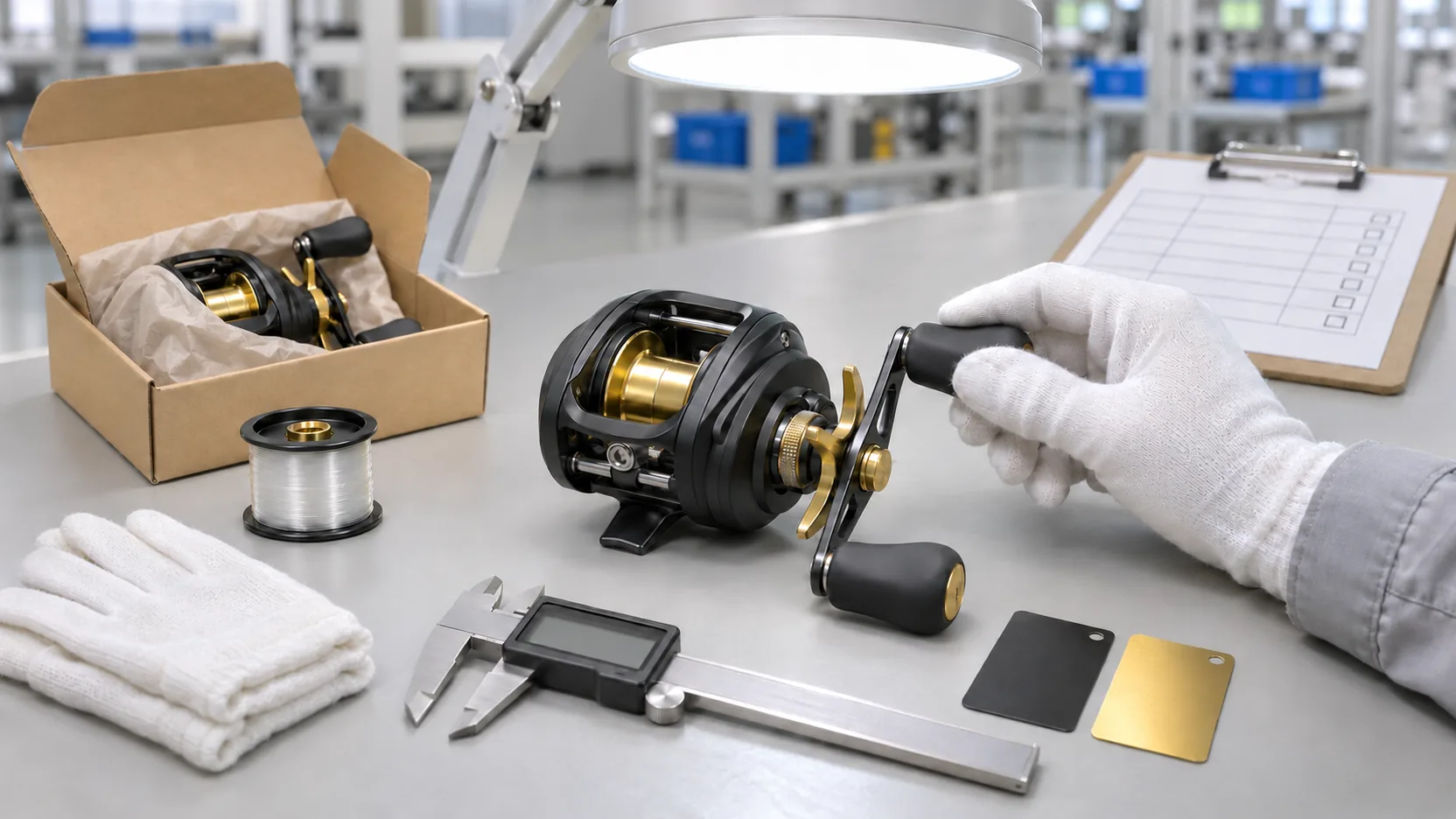
Figure: Schematic illustration. During final inspection, cosmetics and function are checked under agreed lighting, with comparison cards, golden samples and checklists used to keep judgments consistent.
05|Function Check List
| Item | What to check |
|---|---|
| Handle rotation | Smoothness; any grittiness, binding or noise |
| Clutch | Smooth engagement and release; reliable re-engagement when the handle is turned |
| Anti-reverse | The handle cannot turn backward; no obvious back-play |
| Drag | Normal adjustment range; smooth line release |
| Casting brake | Adjustment works; each setting makes a difference |
| Spool free spin | Smooth, with no noise or rubbing |
| Level wind | Smooth travel, synchronized with the spool |
| Fasteners | No loose screws or knobs |
| Feel comparison | Compare rotation feel and sound with the golden sample |
Agree on the check methods too, for example whether drag is judged by hand or measured with test equipment, and under what conditions. For drag testing methods, see Fishing Reel Drag Washer Materials and Drag Consistency.
06|Dimensions, Accessories and Interchangeability
- Key dimensions: sample-check critical characteristics against the drawing, especially those that affect assembly and interchangeability.
- Spare part interchangeability: if a spare spool or interchangeable handle is included, confirm that it fits correctly.
- Accessories: check that tools, spare washers, manuals and other accessories are complete.
- Model and color: confirm they match the order and that nothing is mixed.
07|Packaging, Labeling and Transit
| Item | What to check |
|---|---|
| Product identification | Correct model, color and barcode; barcodes scan |
| Manual | Correct language version and latest revision |
| Warnings and markings | Meet target market requirements, including country of origin |
| Retail box and insert | Printing, color and size; product held securely |
| Master carton | Shipping marks, quantity per carton, weight, carton strength |
| Moisture and shock protection | Desiccant included; adequate cushioning |
| Transit testing | Where needed, agree on drop or vibration tests to standards such as ISTA |
Warning and marking requirements differ by country; the brand should confirm them and provide them to the factory. For more on inserts, moisture and rust control and transit testing, see reel packaging and export shipping.
08|What to Do When a Lot Fails
- Quarantine: hold the failed lot and keep it separate from accepted goods.
- Sorting and rework: the factory 100% inspects the lot and reworks or replaces defective units.
- Re-inspection: sample the lot again after rework.
- Root cause and corrective action: the factory provides a root cause analysis and corrective actions, for example an 8D report, and confirms the effect in later lots.
- Traceability: use lot numbers to trace parts and processes and judge whether other lots are affected.
It is best to agree, when placing the order, on the timing of rework and re-inspection and on who pays for them.
09|What to Agree With the Factory Before Ordering
- Inspection standard: defect classification list, surface classes and inspection conditions.
- Sampling plan: sampling standard, inspection level and AQL values for each class.
- Approved samples: golden and boundary samples, with each party keeping a set.
- Function checks: check items, methods and acceptance criteria.
- Packaging specification: retail box, manual, labels, master carton and packing method.
- Inspection method: in-house or third-party inspection, when and where.
- Handling failures: rework and re-inspection arrangements and costs.
- Inspection records: which inspection records and reports the factory must provide.
The earlier these are written down, the less likely a first order is to go wrong. For the overall process from product definition to first shipment, see How to Start Your Own Fishing Reel Brand.
10|How Zhongde Can Help
- Inspection system: incoming, in-process and final inspection managed around critical characteristics, with the corresponding inspection equipment.
- Supporting inspections: we work with customers and third-party inspection companies under the agreed standard and sampling plan, and provide inspection records.
- Baitcasting reel OEM: MOQ of 200 units for baitcasting reels; other reel types can be considered with sufficient volume.
- NDA first: check “An NDA is required first” in the RFQ form, and we will complete the NDA before reviewing your drawings.
Zhongde has worked with Japanese customers for more than 18 years, producing reel parts with demanding cosmetic and quality requirements.
Frequently Asked Questions
Which sampling standard is usually used for fishing reel inspection?
The most common are ISO 2859-1 and the corresponding ANSI/ASQ Z1.4 attribute sampling standards. The sample size is set by lot size and inspection level, and separate AQL values and accept/reject numbers are set for critical, major and minor defects. There are no universal inspection levels or AQL values; the brand and the factory should agree on them in the purchase order or an inspection agreement.
If a lot passes AQL sampling, does that mean it has no defective units?
No. AQL sampling decides whether to accept a whole lot based on a sample. Passing only indicates that the defect level of the lot is roughly within an acceptable range; it does not guarantee that every unit is good. Items affecting safety and main functions should therefore be 100% checked on the production line, with the final sampling inspection as a last confirmation rather than the only safeguard.
How should disputes over cosmetic judgment be handled?
The most effective approach is to prepare golden samples and boundary samples in advance and agree on surface classes (primary visible surfaces, secondary surfaces and hidden surfaces) and inspection conditions such as lighting, viewing distance, angle and viewing time. Each party keeps a sealed set of samples, and judgments are made against the samples. Whenever color or process changes, the samples must be approved again.
Do function checks really have to be part of the inspection?
Yes. Many reel problems cannot be seen from the outside, such as a clutch that does not re-engage, a slipping anti-reverse, a drag that cannot be adjusted, or gritty, noisy rotation. Inspectors should sample functions against an agreed checklist and compare feel with the golden sample. Checking only appearance and quantity is one of the most common gaps in a first order.
What does a factory need to provide for a third-party inspection?
Usually the factory confirms the inspection date in advance, has the finished goods fully packed, provides a well-lit inspection area and the necessary tools, provides the golden samples, boundary samples and inspection standard, and assigns staff to help with opening cartons, sampling and function checks. If the lot fails, the arrangement and cost of rework and re-inspection are best agreed when the order is placed.