In This Article
Need fishing reel or tackle parts? Upload drawings for a quote
Direct Answer
Troubleshooting reel noise and feel starts with describing the symptom precisely, then isolating it:
- Clutch open, spin only the spool: checks the spool system.
- Clutch engaged, no load, turn the handle: checks the drive train.
- Add load and turn the handle: checks mesh and rigidity.
- Pull line: checks the drag.
- Remove the spool and turn the handle: separates the drive train further.
Typical links: once per turn usually points to main gear runout, tooth damage or a bent shaft; continuous grinding usually points to bearings and lubrication; only under load usually points to mesh, rigidity and center distance; spool hum when casting usually points to spool balance, spool bearings, brake contact or a pinion that has not fully disengaged.
Clean and check lubrication first, then inspect parts, then decide whether the cause lies in manufacturing or design.
01|Describe the Symptom Precisely
Descriptions such as “it feels bad” or “it makes noise” make causes hard to find. We recommend recording:
| Item | What to record |
|---|---|
| State | With or without load; clutch engaged or open |
| Position | At which handle position it occurs |
| Period | Once per turn, once every few turns, or continuous |
| Type | Grittiness, tightness, play, clicking, humming, squeaking |
| Conditions | New or used; freshwater or saltwater; temperature |
| Comparison | Differences from a benchmark reel or a good unit |
Ideally attach video and audio. The more specific the description, the easier it is to tell which stage is responsible. For evaluation methods at prototype stage, see Fishing Reel Prototype Review Checklist.
02|Isolate the Problem
| Step | System checked | If the problem appears, suspect first |
|---|---|---|
| Clutch open, flick the spool | Spool, spool bearings, casting brake | Spool balance and runout, spool bearings, brake contact, pinion not disengaged |
| Clutch engaged, turn handle without load | Drive train | Gears, main shaft, bearings, lubrication |
| Turn handle under load | Mesh and rigidity | Center distance, frame rigidity, tooth contact, bearing seats |
| Pull line off | Drag system | Drag washers, grease, washer flatness, keyway fits |
| Remove the spool, turn the handle | Drive train without the spool | Main gear, pinion, main shaft, level wind |
| Apply reverse force | Anti-reverse | One-way bearing, sleeve |
03|Symptom-to-Cause Table
| Symptom | Common causes |
|---|---|
| Grittiness or a click once per turn | Main gear runout, a burr or damage on one tooth, bent main shaft, off-square main gear |
| Continuous grinding or grittiness | Dirty, rusty or damaged bearings; aged or insufficient grease; leftover chips |
| Only under load | Gear mesh and center distance, insufficient frame rigidity, bearing seat fits; anti-reverse slip can also click |
| Spool hum or vibration when casting | Spool balance and runout, spool bearings, centrifugal blocks or magnets touching, pinion not fully disengaged |
| Clicks at level wind reversal | Worm shaft reversal points, worn pawl, lack of oil, rails not parallel |
| Handle play or back-play | Loose handle nut, large axial play, worn one-way bearing or sleeve |
| Jerky or squeaky drag | Drag washers and grease, startup stick-slip, uneven washers or pressure plate |
| Clicking or slipping under load | Incomplete pinion-to-pin engagement, one-way bearing slip |
| Heavier in cold weather | Grease thickening at low temperature |
For detailed causes by part, see Why Fishing Reel Gears Feel Smooth or Rough and How to Choose Fishing Reel Bearings.
04|Use Vibration and Frequency as a Guide
For noises that are hard to place, a vibration sensor or audio recording can be used to analyze the period and frequency:
- Synchronized with handle speed: usually the main gear or handle shaft.
- Synchronized with spool speed: usually the pinion, spool or spool bearings.
- Matching gear mesh frequency (rotation speed times tooth count): usually tooth condition and mesh.
- Irregular: usually bearing damage, foreign matter or lubrication.
The same approach works well for comparisons in production, for example comparing the spectra of good and rejected units.
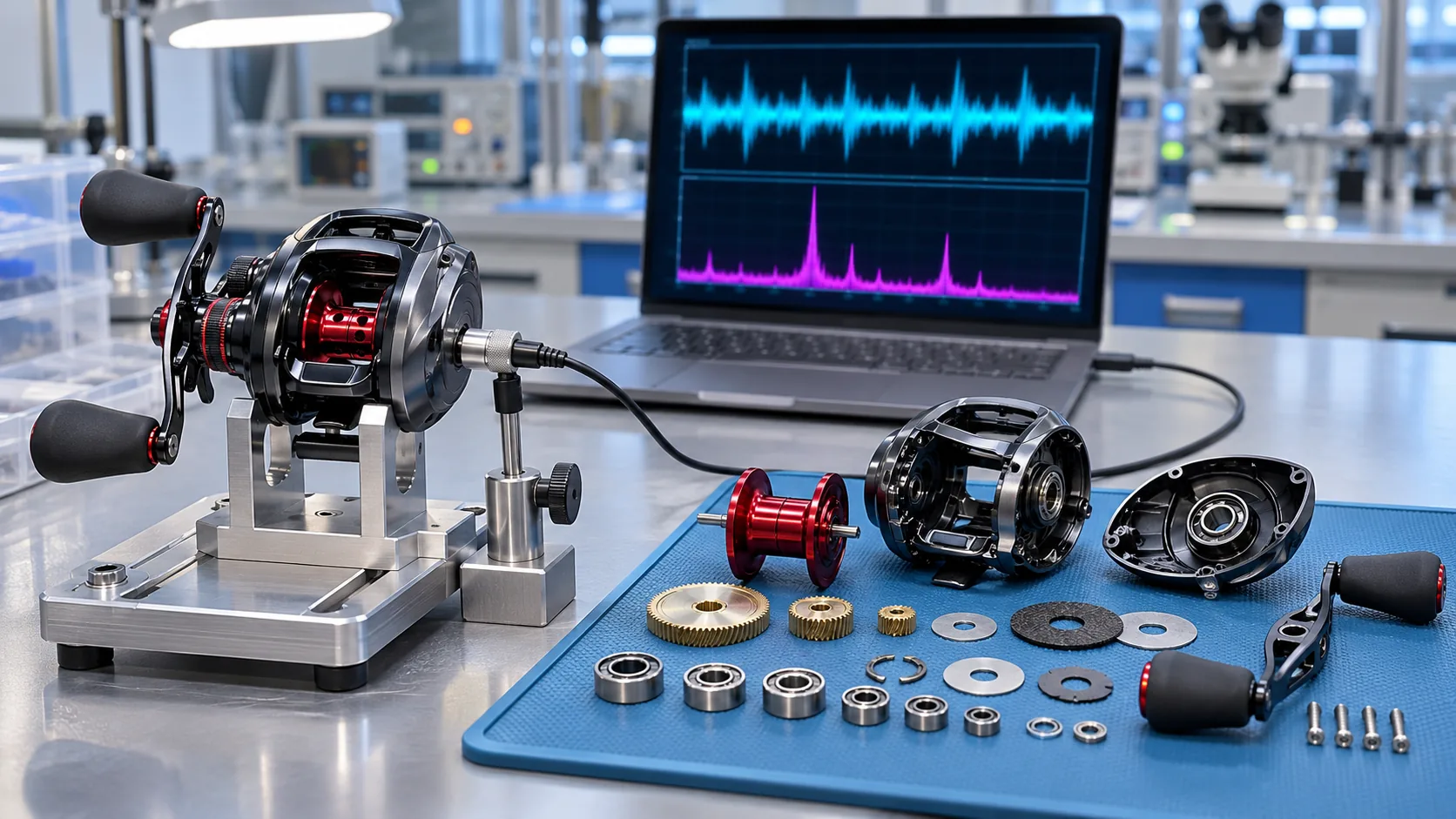
Figure: Schematic illustration. A vibration sensor captures the signal so the period and frequency of the noise can be analyzed, and together with a teardown this shows which stage is responsible.
05|Troubleshooting Order
- Clean and lubricate: remove sand, salt and old oil, lubricate as specified, and check whether the problem remains.
- Fasteners and play: check for loose screws and handle nuts, and excessive axial play.
- Isolate: follow the steps above to confirm which system is involved.
- Tear down: inspect burrs, chips, tooth contact, bearing condition, grease distribution and shims.
- Measure: measure runout, dimensions and fits of suspect parts.
- Swap to confirm: replace a suspect part with one from a good unit and check whether the problem disappears.
Do not start by replacing parts. Cleaning and lubricating alone often rules out part of the problem, while swapping parts straight away can hide the real cause. Do not oil drag washers, brake rings or one-way bearings casually; for lubrication guidance, see Fishing Reel Lubrication.
06|Telling Manufacturing Causes From Design Causes
| Type | Characteristics | Examples |
|---|---|---|
| Manufacturing | Affects some units; linked to lots or processes | Burrs, chips, runout out of tolerance, poor fits, inconsistent lubrication |
| Design | Affects most units, or always appears under certain conditions | Insufficient frame rigidity, unsuitable gear parameters, unresolved tolerance stack-up |
| Use | Linked to operating environment and care | Sand intrusion, saltwater corrosion, drop damage, casual oiling |
Manufacturing causes should be traced back to lots and processes, improved and confirmed in later lots; design causes need design changes and re-validation.
07|Recording and Feedback
- Record: model, lot number, symptom, conditions, video, teardown photos and measurements.
- Count: which symptoms are most common, and whether they cluster in particular lots or parts.
- Feed back: send the failed units to the factory for root cause analysis and countermeasures.
- Verify: after improvement, confirm the problem no longer appears in later lots.
08|How Zhongde Can Help
- Teardown analysis: we tear down failed units, measure runout, dimensions and fits, identify causes and propose countermeasures.
- Drag curves: our line-pull drag tester records drag curves to compare good and rejected units.
- Baitcasting reel OEM: MOQ of 200 units for baitcasting reels; other reel types can be considered with sufficient volume.
- NDA first: check “An NDA is required first” in the RFQ form, and we will complete the NDA before reviewing your drawings.
Zhongde has worked with Japanese customers for more than 18 years, producing reel parts with demanding cosmetic and quality requirements.
Frequently Asked Questions
Where should I look first when a reel feels gritty?
First establish whether it happens with or without load, and whether it is periodic or continuous. For continuous grinding or grittiness, check bearings and lubrication first; for once-per-turn grittiness, check the main gear and main shaft first; for problems only under load, check gear mesh, center distance and frame rigidity. Clean and lubricate as specified before tearing down parts, rather than replacing parts straight away.
What does a noise once per handle turn mean?
A noise synchronized with the handle and occurring once per turn is usually linked to the main gear or handle shaft, such as excessive main gear runout, a burr or damage on one tooth, a bent main shaft or a main gear mounted off-square. If the period matches spool rotation instead, the pinion or spool system is more likely. The relationship between period and rotation speed shows which stage is responsible.
Why does the spool hum during a cast?
Common causes are poor spool balance or excessive runout; dirty, damaged or dry spool bearings; centrifugal brake blocks or magnets touching the spool; and a pinion that has not fully disengaged with the clutch open. Start by flicking the spool with the clutch open and listening to the sound and spin duration, then check each item.
Can a new reel make noise?
Yes. Noise in a new reel usually comes from manufacturing and assembly, such as leftover burrs and chips, the wrong grease type or amount, fits that are too tight or too loose, poor shim adjustment, or excessive gear runout. These problems should be caught by function checks at outgoing inspection and fed back to machining and assembly for improvement.
Will adding oil fix reel noise?
Sometimes it helps temporarily, but it does not necessarily fix the root cause. If the noise comes from a lack of lubricant or aged grease, cleaning and lubricating as specified will help; if it comes from gear runout, bearing damage, poor fits or frame deformation, oil only masks the symptom. Do not oil drag washers, brake rings or one-way bearings casually, as that creates new problems.