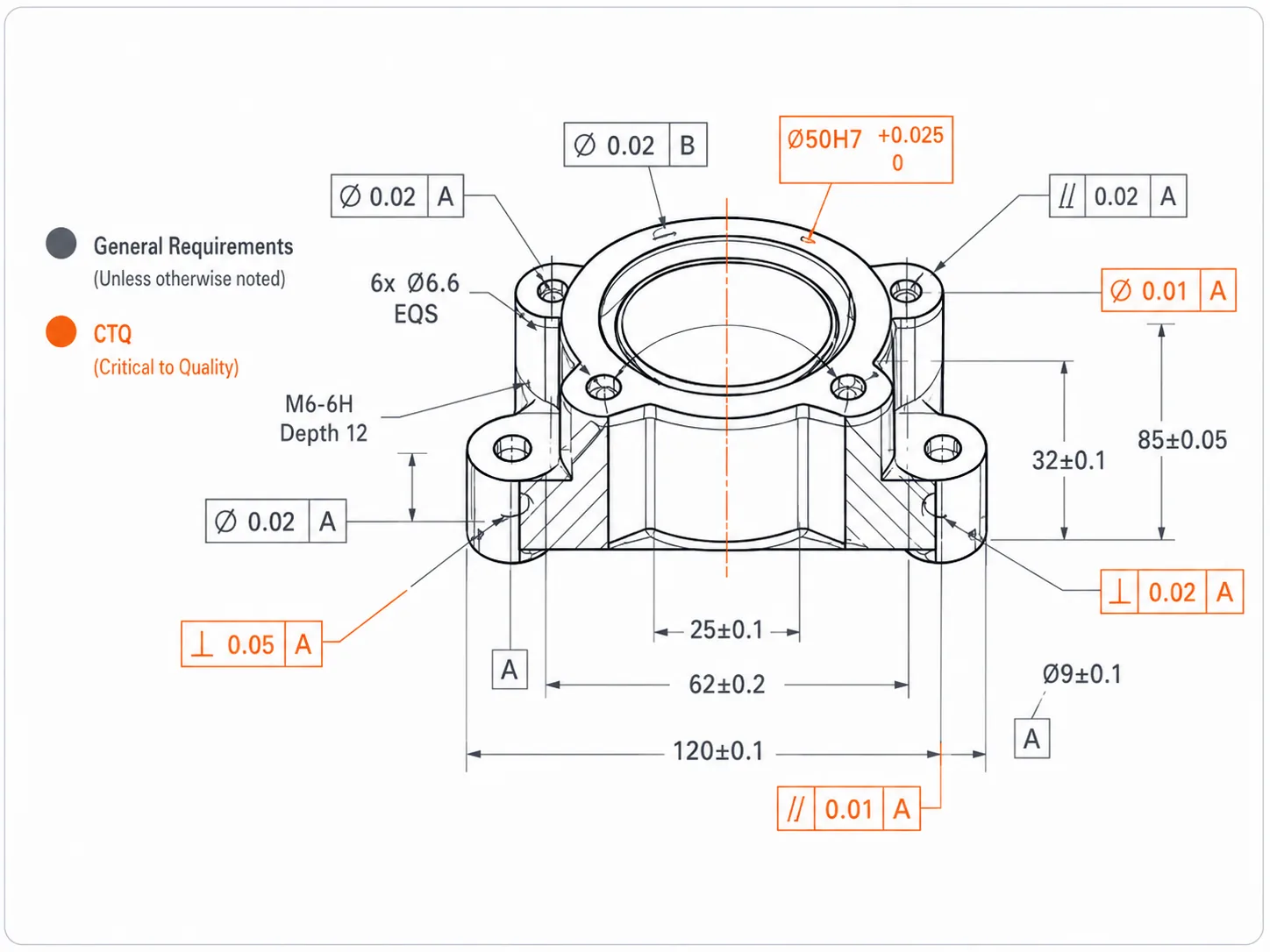
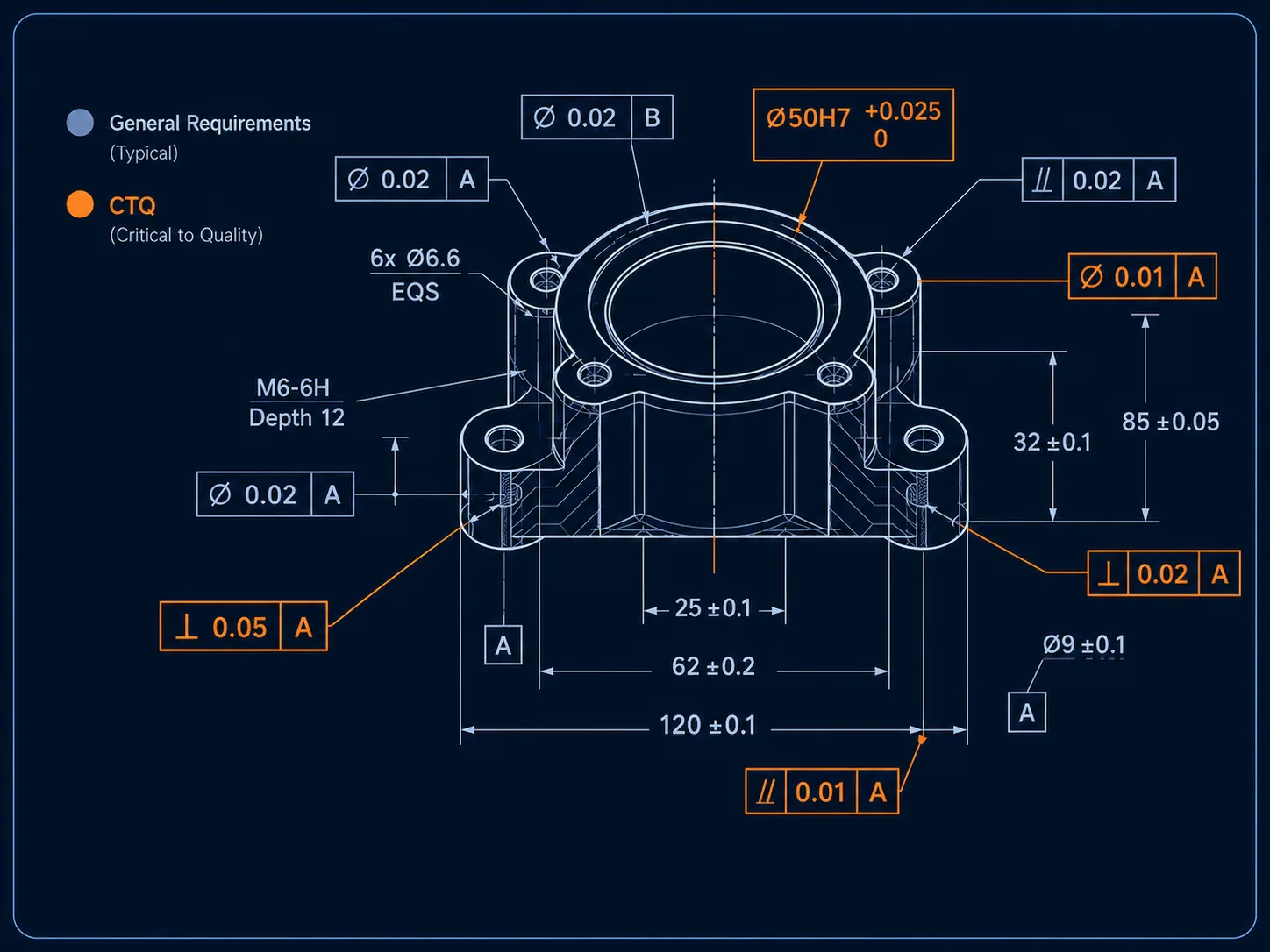
A Drawing May Contain 100+ Requirements
Every requirement must still be met, while only a limited number directly determine function, assembly and reliability.
CTQ QUALITY MANAGEMENT
Conventional inspection determines whether a finished part is acceptable. CTQ management begins with product function, assembly relationships and failure risks to identify the characteristics that truly determine performance and reliability. Zhongde’s integrated manufacturing system carries the same CTQ through material, forming, precision machining, surface finishing, assembly and final validation.
Function-Based
Defined from product performance, assembly and failure risk
Risk Prevention
Critical characteristics defined before manufacturing
Process Control
CTQs deployed to related manufacturing and inspection steps
Traceable Records
Revisions, process results and production lots remain linked
WHAT IS CTQ
A drawing may contain more than one hundred dimensions, tolerances and technical requirements, but they do not affect product function equally. CTQs are the limited number of characteristics that directly influence assembly, performance, reliability or special customer requirements.
Every requirement must still be met, while only a limited number directly determine function, assembly and reliability.
Clarify the part’s role, mating interfaces, loading conditions and operating relationships.
Assess how deviations affect assembly, performance and reliability against process capability.
Specify critical dimensions, geometry, surfaces, materials or functional acceptance criteria.
Assign process controls, measurement methods, inspection frequency and traceable records.
Diameter, position, flatness, concentricity and mating dimensions
Roughness, coating thickness, cleanliness, hardness and heat-treatment condition
Torque, press-fit depth, leak rate, rotational condition and functional testing
Critical risks remain visible and functional failure risk is reduced.
Risks are identified and corrected before they become batch defects.
Inspection and control resources are concentrated on critical items.
Shorter inspection time and faster release improve overall efficiency.
Control investment is placed where it generates the greatest value.
CTQ management does not reduce control of other requirements. All requirements remain compliant with the drawing, while the limited characteristics that determine function and reliability receive a higher level of control.
CTQ VS GENERAL QUALITY CONTROL
Conventional final inspection focuses on whether the finished product is acceptable. CTQ management starts from product function, assembly relationships and failure risks to identify the characteristics that truly determine performance and reliability.
Post-Process Judgment
Manufacture to Drawing
Final Inspection
Pass / Fail
Rework / Late Risk Exposure
Early Identification · Focused Control
Product Function
Failure Risk
Identify CTQs
Process Control & Records
Conventional inspection answers “Is the product acceptable?” CTQ management answers “Which characteristics determine whether the product works properly, and how can loss of control be prevented?”
Earlier Risk Detection
Less Batch Rework
Lower Functional Failure Risk
More Rational Quality Cost Allocation
WHY ZHONGDE IS DIFFERENT
A single CTQ is often influenced by several upstream and downstream operations. Zhongde maintains consistent drawings, datums, compensation relationships, process data and feedback within one factory, carrying the CTQ from engineering review through final validation.
Control blank deformation, machining allowance and datum stability
Control bore size, roundness, concentricity and position
Manage coating allowance, masking and treatment deformation
Confirm press force, insertion depth and fit condition
Verify rotational resistance, runout and operating condition
Control blank deformation, machining allowance and datum stability
Control bore size, roundness, concentricity and position
Manage coating allowance, masking and treatment deformation
Confirm press force, insertion depth and fit condition
Verify rotational resistance, runout and operating condition
Upload your drawings. Our engineering team will provide a manufacturing review and quotation within 24 hours.