In This Article
Direct answer
6061, 6063, and 7075 are not simply low-, medium-, and high-strength versions of the same material. Their engineering value comes from the combination of alloy, temper, stock form, and manufacturing route.
| Material | Practical starting point | Main manufacturing concerns |
|---|---|---|
| 6061 | General CNC structures, housings, mounts, and cooling parts | Temper, residual stress, thin-wall distortion, anodizing allowance |
| 6063 | Extrusions, heat-sink fins, long constant sections, cosmetic parts | Straightness, twist, wall thickness, surface quality, local secondary machining |
| 7075 | Highly loaded, weight-sensitive, section-limited structures | Material direction, stress release, corrosion protection, anodized appearance, total cost |
A sound selection sequence is:
Part function and failure mode
→ Priority of strength, corrosion, appearance, heat transfer, and manufacturability
→ Wrought or cast material
→ Plate, bar, tube, extrusion, or forging
→ T5, T6, T651, T73, or another temper
→ CNC, extrusion, joining, and finishing route
→ Prototype validation and production control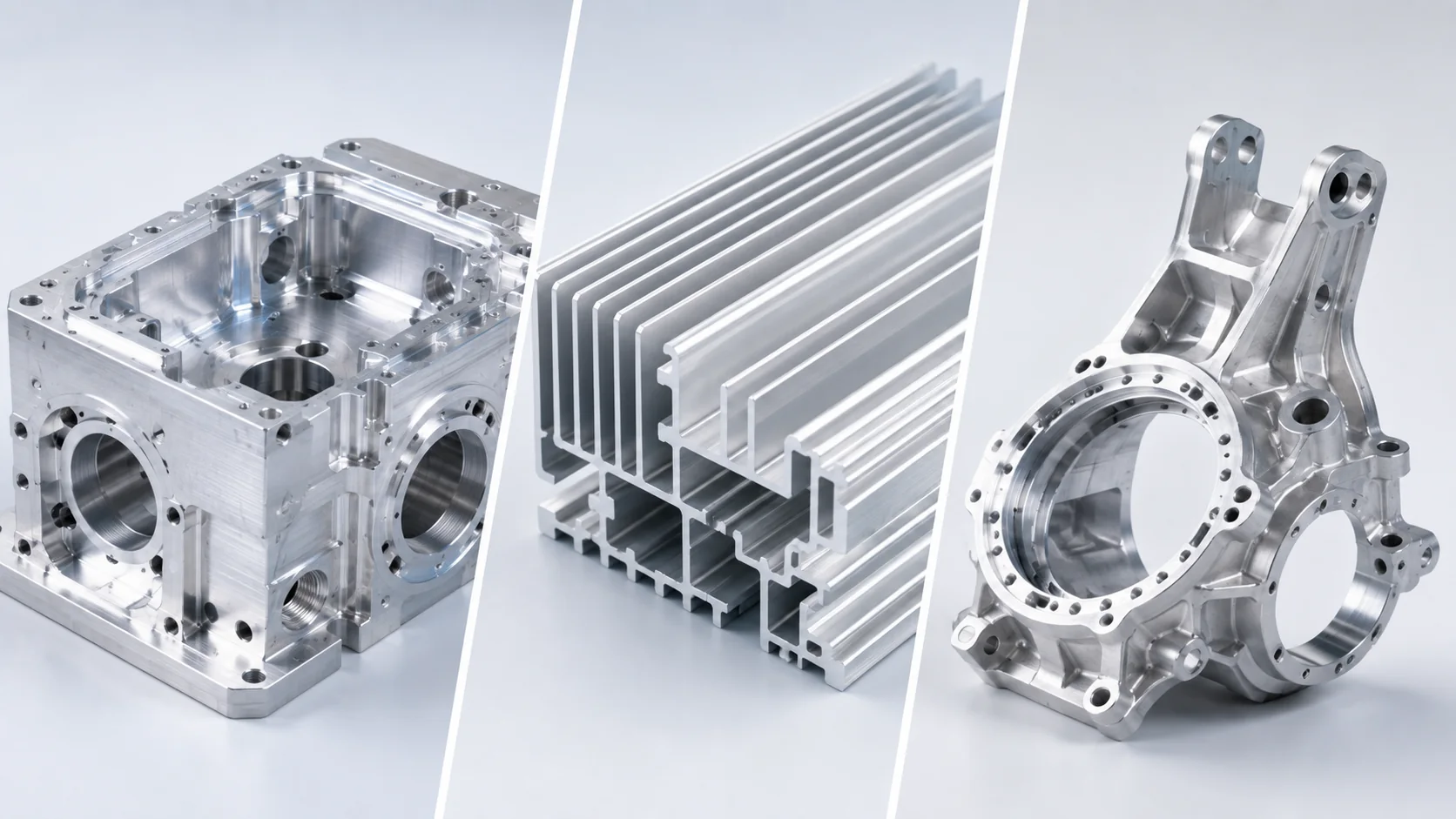
The practical differences among 6061, 6063, and 7075 also depend on stock form, manufacturing route, and part function.
1. Set the property priorities before selecting a grade
The main difficulty in aluminum selection is not a shortage of grades. It is the conflict between engineering objectives. Higher strength may bring higher material cost, more demanding corrosion protection, or tighter process control. Better extrudability and cosmetic quality do not automatically provide the highest load capacity. Higher thermal conductivity does not by itself solve interface resistance, flow-channel limitations, or air-side heat transfer.
The DFM review should rank at least these requirements:
- Load, stiffness, fatigue, and impact;
- Corrosion resistance, coolant compatibility, and environmental exposure;
- Heat conduction, spreading, and interface contact;
- Appearance, color consistency, gloss, and finishing;
- Suitability for CNC machining, extrusion, welding, brazing, or other joining;
- Dimensional stability and production capability;
- Material availability, tooling investment, piece cost, and life-cycle cost.
A single alloy does not need to maximize every property. A more useful approach is to separate:
- Non-negotiable CTQs, such as a bearing bore, sealing face, load path, or corrosion requirement;
- Negotiable attributes, such as appearance on nonfunctional faces or noncritical strength margin;
- Attributes requiring prototype validation, such as anodized color, thin-wall springback, post-weld distortion, or thermal contact performance.
2. Distinguish wrought material, cast material, and stock form first
6061, 6063, and 7075 are commonly used as wrought aluminum alloys. They can be rolled, extruded, drawn, or forged into plate, bar, tube, profiles, and forgings. Wrought materials and cast alloys have different compositions, microstructures, defect modes, and machining boundaries.
| Stock route | Main benefit | Main risk | Typical use |
|---|---|---|---|
| Plate | Efficient for flat parts, cold plates, housings, and mounting plates | One-sided heavy removal can cause bowing | Cold plates, base plates, thin-wall housings |
| Bar | Suitable for shafts, flanges, sleeves, and compact block parts | Low material utilization for large-diameter parts | Flanges, fittings, bearing seats |
| Tube | Reduces internal removal for hollow components | ID, OD, wall thickness, and straightness depend on available sizes | Sleeves, cylinders, structural tubes |
| Extrusion | Near-net constant profile reduces CNC removal | Requires a die and a mostly constant cross-section | Heat sinks, rails, long housings |
| Forging | Can improve load-path efficiency and material flow | Higher tooling investment and volume threshold | Highly loaded brackets and compact structures |
| Die casting | Near-net complex shape for large volumes | Porosity, shrinkage, local density, and datum strategy require validation | High-volume complex housings |
The question is therefore not only 6061 versus 7075. A 6063 extrusion with local CNC work, a fully machined 6061 billet, and a finish-machined 7075 forging are three very different cost and risk models.
3. 6061: a common balanced starting point
6061 is a heat-treatable 6xxx alloy. It is rarely the maximum performer in a single category, but it offers a practical balance of strength, corrosion resistance, machining, finishing, availability, and total cost. This makes it a frequent starting point for precision parts.
Where 6061 is often appropriate
- CNC housings, mounts, flanges, and connecting structures;
- Cold-plate bodies, manifolds, and general cooling components;
- Optical-module housings, heat-spreader bases, and precision structures;
- General robot joint housings, motor covers, and gearbox mounts;
- Parts requiring anodizing, selective masking, and downstream assembly;
- Prototype to medium-volume parts that require fast design changes.
Good machinability does not mean immunity from distortion. The following designs still require close review:
- Large one-sided pockets;
- Deep cavities combined with thin walls;
- Large plates with tight flatness;
- Open housings and asymmetric sections;
- Bores and pilots that must remain precise before and after anodizing.
For plate parts with high material removal, temper, rough-finish separation, symmetric removal, clamping force, and in-process inspection can matter more than changing to a higher-strength alloy.
4. 6063: value created by the extrusion route and surface quality
6063 is also a 6xxx alloy, but its manufacturing role differs from 6061. Its strongest value is normally not a fully machined high-load billet part. It is the ability to extrude fins, rails, walls, grooves, and long profiles close to the final cross-section.
Structures suited to 6063
- Long heat sinks and regular fins;
- Extruded housings for optical and electronic equipment;
- Rails, frames, and constant-section supports;
- Profiles with demanding cosmetic anodized surfaces;
- Parts that need only cutting, drilling, tapping, slotting, and local finish machining after extrusion.
Extrusions still require CNC and quality control
Extrusion is not final precision machining. Production control still needs to cover:
- Profile wall and fin thickness;
- Straightness, twist, and bow along the length;
- Section drift as the die wears;
- Cut length and end-face quality;
- Secondary machining of mounting faces, holes, threads, and thermal interfaces;
- Extrusion lines and surface defects before anodizing;
- Cosmetic consistency across extrusion lots.
If the cross-section changes significantly along the part, contains multidirectional cavities, or the volume is too low to amortize die cost, a 6063 extrusion may not be more economical than a 6061 machined part.
5. 7075: high-load lightweight structures, not a default upgrade
7075 is a high-strength 7xxx alloy. When space is limited, weight is critical, and the part carries substantial load, it can provide greater load capacity within a compact section. This is why it is considered for robot joints, highly loaded brackets, output interfaces, and other compact structures.
Conditions that justify 7075
- Strength or fatigue is a real design bottleneck;
- A thinner section can still meet stiffness and local stability requirements;
- The part does not rely on a welded heat-affected zone retaining base-material strength;
- Corrosion protection and finishing are already defined;
- Product value can absorb the material cost and tighter process control.
Production risks of 7075
- Heavy material removal can release residual stress;
- Thin, open, and asymmetric structures can spring after unclamping;
- General corrosion behavior should not be assumed to match 6061;
- Anodized color and cosmetic uniformity require prototype confirmation;
- Precision bores, threads, and fits need clear masking or dimensional allowance;
- Rework, scrap, and material substitution usually carry a higher cost.
7075 should therefore not be treated as a direct upgrade from 6061. If a general bracket, heat-transfer part, or moderate-load structure already meets its functional requirement in 6061, switching to 7075 may add cost and manufacturing risk without useful value.
6. Temper can affect dimensional stability more than the grade comparison
A drawing that states only AL6061 or AL7075 is usually incomplete. The material definition should also include temper and stock form.
| Temper | Practical meaning | Typical concern |
|---|---|---|
| T5 | Common for extrusions after cooling from the extrusion process and artificial aging | Balance of profile, straightness, strength, and appearance |
| T6 | Solution heat treated and artificially aged | High strength does not automatically mean low residual stress |
| T651 | T6 condition with additional stress relief by stretching | Often better for dimensional stability in heavily machined plate |
| T73 | Used for some 7xxx materials to improve stress-corrosion resistance | Trade-off among strength, corrosion resistance, and environment |
The temper designation is only the starting point. Engineering and purchasing should also confirm:
- Material product standard and supplied condition;
- Plate thickness, bar diameter, or extrusion section;
- Rolling, extrusion, or stretching direction;
- Straightening and stress-relief process;
- Material certificate and heat or lot traceability;
- Whether substitute grade or temper requires customer approval.
Even with T651, thin walls, large surfaces, and high-removal parts still require suitable fixturing, rough-finish separation, and intermediate stability checks.
7. Machinability means more than easy cutting
CNC machinability should be evaluated through several dimensions:
Chip formation
+ Tool load and life
+ Burrs and built-up edge
+ Surface finish
+ High-removal efficiency
+ Heat and coolant control
+ Thin-wall springback
+ Post-unclamping stability
+ Production offset frequency| Area | 6061 | 6063 | 7075 |
|---|---|---|---|
| Common machining role | General CNC from plate, bar, and block | Cutting and local secondary work after extrusion | Precision machining of highly loaded structures |
| Cutting focus | Balance productivity, finish, and distortion | Control soft thin walls, burrs, and local vibration | Control tool load, heat, and residual-stress release |
| Fixturing focus | Symmetric support and controlled clamping | Long-part location, twist, and profile distortion | Rigid support, staged removal, and unclamped recheck |
| Production risk | Stock-lot variation and thin-wall distortion | Extrusion lot, die wear, and straightness | Material cost, distortion, corrosion, and appearance consistency |
A part that measures correctly while clamped can move after release. Thin-wall housings and long extrusions should include unclamped remeasurement, in-process rest periods when needed, and final inspection from functional datums.
8. Anodizing belongs in the material-selection stage
Anodizing is not an isolated decorative step after machining. Alloy chemistry, material structure, stock surface, and pretreatment affect coating growth, color, gloss, and batch consistency.
6061
6061 can generally support stable functional or hard anodizing for precision components. Material lot, machined surface, blast parameters, and coating thickness can still change appearance.
6063
6063 is widely associated with profiles that require good surface quality and cosmetic anodizing. Extrusion lines, die marks, straightening marks, and the contrast between as-extruded and locally machined surfaces must be controlled.
7075
7075 can be anodized, but color and cosmetic uniformity are usually more demanding. Cosmetic surfaces should be approved with limit samples made from the actual temper, pretreatment, and target coating thickness.
Interfaces to define for every grade
- Bearing bores, dowel holes, and precision pilots;
- Sealing faces, thermal interfaces, and electrical contact areas;
- Threads, small holes, and blind holes;
- Grounding points and conductivity requirements;
- Masking boundaries, rack points, and fixture contact marks;
- Coating-thickness effects on fit and roughness.
When a drawing asks for uniform appearance, full coating coverage, and micron-level fits at the same time, these goals may conflict. The DFM review must establish priorities before production.
9. Typical selection logic in the three target industries
9.1 AI server liquid-cooling parts
Cold plates, manifolds, and fittings require a balance of heat transfer, sealing, corrosion resistance, joining route, internal cleanliness, and dimensional stability. 6061 is often a practical CNC starting point, but the final choice must match brazing, friction-stir welding, sealing design, and coolant system. 7075 should not be selected for a fluid boundary only because it is stronger. 6063 is better suited to extruded channels or long thermal profiles than to every complex cold plate.
9.2 Humanoid robot joint parts
General housings, covers, and mounts often favor the balanced machining and datum capability of 6061. Highly loaded, weight-sensitive brackets, output interfaces, or compact housings may justify 7075, provided that thin-wall distortion, bearing press fits, anodizing allowance, and corrosion protection are CTQs. 6063 is more relevant to long profile members, rails, or secondary covers than to the primary high-load joint interface.
9.3 Optical-transceiver precision structures
6063 extrusions suit long housings, regular fins, and volume heat sinks. 6061 CNC parts suit complex cavities, multidirectional datums, prototypes, and medium volumes. 7075 should be considered only when structural load and weight exceed the practical capability of 6061. Thermal selection must consider TIM, contact surface, fins, and system airflow together with the alloy.
10. Prototype stock is not automatically the production route
Prototype parts are often machined from standard plate or bar because no die is required, design changes are easy, and lead time is predictable. Before production, the team should reassess:
- Whether extrusion, tube, forging, or die-cast stock is appropriate;
- Whether volume can amortize tooling cost;
- Whether near-net stock reduces machining time and material waste;
- Whether the new route introduces straightness, porosity, die wear, or lot variation;
- How 100 percent prototype inspection becomes first-piece, in-process, and SPC control;
- Whether anodized color, coating thickness, and material lot require production limit samples;
- How substitute material and a second source will be approved.
A successful billet-machined prototype proves that the geometry can be manufactured. It does not prove that billet machining is the most economical production route. Conversely, a future extrusion or casting plan does not mean tooling must be committed at the first prototype stage.
11. How to define aluminum material in an RFQ
| RFQ input | Engineering purpose |
|---|---|
| Alloy grade | Defines the base alloy system |
| Temper | Supports strength, residual-stress, and stability assessment |
| Stock form | Determines tooling, machining allowance, and process route |
| Material standard and certificate | Establishes composition, mechanical properties, and lot traceability |
| CTQs and assembly relationship | Defines functional datums, fixturing, and inspection |
| Service environment | Supports corrosion, temperature, fluid, and protection decisions |
| Surface treatment | Defines coating thickness, color, masking, and dimensional allowance |
| Annual volume and lot size | Compares billet CNC, extrusion, forging, and die casting economics |
| Prototype and production plan | Supports validation, tooling, and process-capability planning |
| Substitution rule | Prevents unapproved changes to grade, temper, or source |
When the material is not yet fixed, an RFQ can state functional requirements and the permitted substitution range so that alternative manufacturing routes can be compared. A note such as aluminum, supplier choice leaves load, corrosion, appearance, and production risk unresolved until late in the project.
12. Quick selection checklist
Before releasing a drawing, confirm:
- Is the real failure mode strength, stiffness, fatigue, corrosion, heat transfer, or appearance?
- Can the part use a constant cross-section and a 6063 extrusion?
- Does 6061 already meet the load, or is 7075 strength genuinely required?
- Does the drawing define T5, T6, T651, T73, or another temper?
- Should the stock be plate, bar, tube, extrusion, forging, or casting?
- Do heavy removal and thin walls require staged machining and unclamped inspection?
- Are anodized, masked, thermal-contact, and precision-fit surfaces defined?
- Have prototype and production routes been evaluated separately?
- Are material certificates, lot traceability, and substitution approval defined?
FAQ
Which of 6061, 6063, and 7075 is best for precision CNC parts?
No single grade is best for every precision part. 6061 is often the balanced starting point for machining, finishing, availability, and general structural performance. 6063 is more suitable when the design is driven by an extruded profile and only local CNC features are required. 7075 is appropriate for weight-sensitive, highly loaded parts, but it requires tighter control of temper, residual stress, corrosion protection, and anodized appearance.
Why is 6063 commonly used for aluminum extrusions and heat sinks?
6063 combines good extrudability with a clean surface and is well suited to continuous profiles that integrate fins, rails, walls, or long uniform sections. The profile can then be cut, drilled, tapped, and finish-machined at local interfaces. Its main value comes from the combination of alloy and extrusion route, not from strength alone.
If 7075 is stronger, why can it not replace every 6061 part?
Higher strength addresses only part of the design requirement. 7075 usually has a higher material cost, lower general corrosion resistance, more demanding anodizing and appearance control, and stricter distortion management for thin-wall or high-removal machining. For general brackets, heat-transfer parts, and moderate-load structures, 6061 often meets the requirement with lower total manufacturing risk.
What material information should be included in an aluminum part RFQ besides the alloy grade?
The RFQ should state the temper, stock form, applicable material specification, critical dimensions and CTQs, surface treatment, service environment, assembly relationship, annual volume, and lot size. Thin-wall, high-removal, high-flatness, or cosmetic anodized parts should also define material direction, color expectations, masking areas, and batch consistency requirements.