
In This Article
Direct answer
There is no universal winner between aluminum and copper. The correct choice depends on heat load, weight, cost and manufacturing conditions.
| Project condition | First option to evaluate |
|---|---|
| Large area, weight-sensitive, cost-sensitive, volume production | Aluminum cold plate |
| High heat flux, concentrated hot spots, limited package space | Copper cold plate |
| Need local performance without full-copper weight and cost | Hybrid structure |
| Comparison item | Aluminum | Copper |
|---|---|---|
| Thermal conductivity | About 205 W/(m·K) | About 385 W/(m·K) |
| Density | About 2.7 g/cm³ | About 8.96 g/cm³ |
| Weight | Light | About 3.3× aluminum |
| Machinability | Better for scalable machining | Higher machining load and cost |
| Main advantage | Balanced weight, cost and production efficiency | Stronger heat spreading |
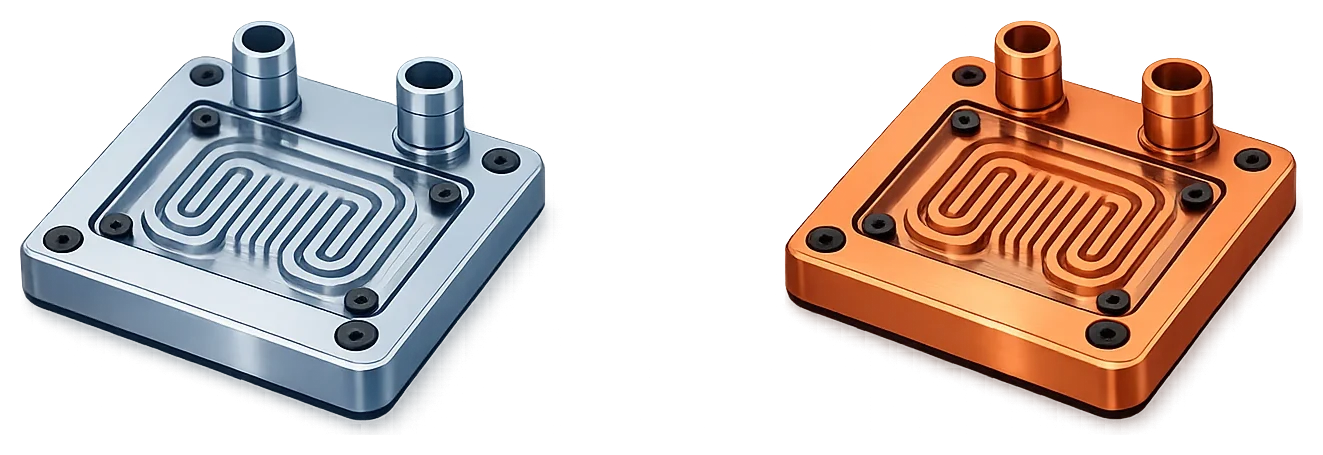
1. Liquid-cooling performance is not determined by conductivity alone
Copper conducts heat at nearly twice the rate of aluminum, but cold-plate performance also depends on channel geometry, coolant flow, pressure drop and contact-surface quality. If the channel design is poor or coolant flow is insufficient, switching to copper may deliver limited improvement.
The practical question is whether local heat spreading is the real bottleneck. For many mainstream liquid-cooling projects, a properly designed aluminum plate is sufficient. Copper becomes more valuable when the heat source is highly concentrated or the available cold-plate area is limited.
2. When aluminum is the better first choice
Aluminum is light, economical and efficient to machine. It is well suited to large-area cold plates and stable volume production, which is why it is widely used in AI servers, communications equipment and power electronics.
Aluminum is usually preferred when:
- total system weight matters;
- the cold plate is relatively large;
- cost and machining takt time matter;
- heat flux is moderate and the design may still change.
Its main limitation is weaker lateral heat spreading. Very small, high-power heat sources can create a larger temperature gradient through the base.
3. When copper is worth the added cost
Copper is more suitable for high heat flux, concentrated hot spots and tight package limits. It spreads heat more effectively from a small source area and is therefore attractive for high-power GPUs, ASICs and power modules.
The trade-offs are clear: copper is heavier, more expensive and usually slower to machine. Coolant compatibility, surface treatment and galvanic-corrosion risk must also be reviewed when copper is combined with other wetted metals.
Copper can be valuable in microchannel designs, but channel quality, cleanliness and pressure-drop control still determine the final result.
4. When a hybrid structure is more practical
Many projects do not need a full-copper plate. A copper base or insert can be placed directly below the heat source while the main body remains aluminum. This improves local spreading without carrying the full weight and cost of copper.
Hybrid structures are useful when heat load is high but a full-copper design is excessive. Their main challenges are dissimilar-material joining, interface flatness, galvanic corrosion and repeatability in production.
5. Final selection guide
| Project priority | Recommended route |
|---|---|
| Weight and cost | Aluminum |
| Hot-spot spreading and high heat flux | Copper |
| Local thermal upgrade with lower overall weight | Hybrid |
| Conventional channels already meet the target | Do not change to copper only for conductivity |
| Microchannel or extreme-performance project | Evaluate material, channel geometry, pressure drop and process capability together |
Before RFQ, provide heat load, contact area, coolant, target flow rate, allowable pressure drop, working pressure, expected volume and weight limit. Material and channel design should be reviewed together.
FAQs
Is a copper cold plate always better than an aluminum cold plate?
No. Copper has higher thermal conductivity, but actual performance also depends on channel design, coolant flow, pressure drop, contact flatness and system conditions.
Can aluminum cold plates use microchannels?
Yes, but channel dimensions, process capability, cleanliness, pressure drop and corrosion requirements must be evaluated together.
Why use a hybrid aluminum-copper structure?
It keeps copper in the hot-spot region while using aluminum to reduce total weight and cost.
What is most often overlooked in material selection?
Coolant compatibility, galvanic corrosion, joining reliability, machining tolerance and production cost are often overlooked when the focus is only on thermal conductivity.