In This Article
Parcel sorting is becoming an early real-world use case for dual-arm embodied robots. A fixed workstation removes the need for walking and balance control, allowing the machine to focus on vision, coordinated arm motion, grasping, parcel reorientation, feeding and exception handling. For the manufacturing supply chain, the key question is whether shoulder, elbow and wrist joints and lightweight arm structures can move from prototype designs into standardized, repeatable production.
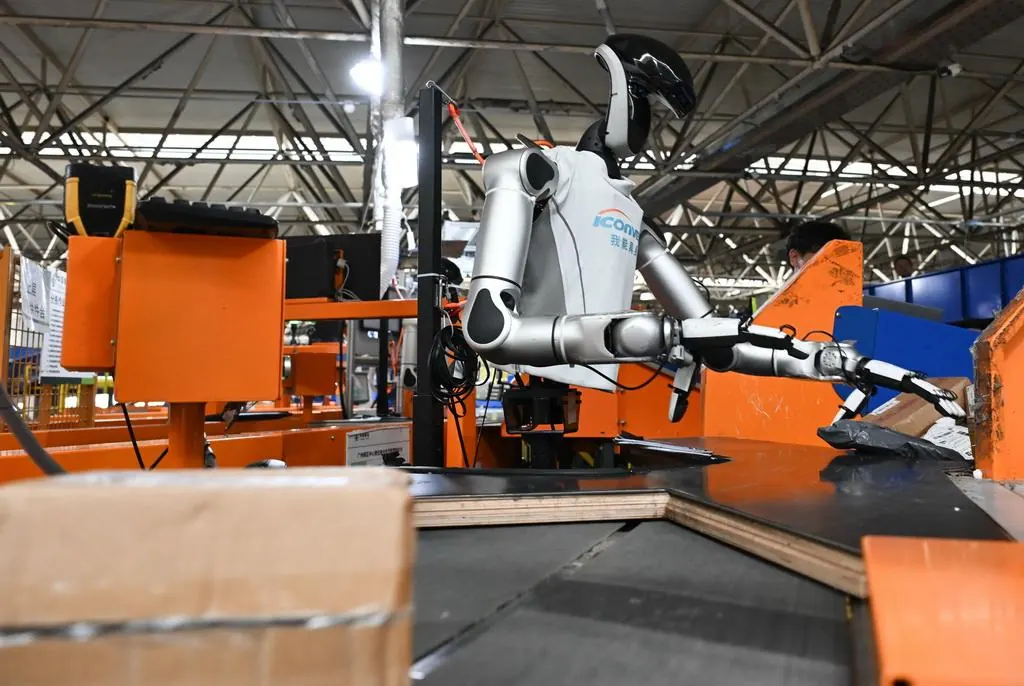
Dual-arm embodied parcel sorting robot in a logistics workstation. A fixed base concentrates mechanical complexity on manipulation, vision and sorting rather than locomotion.
Why the Guangzhou postal deployment matters
In June 2026, the Guangdong Postal Administration reported that Guangzhou Postal District Center had introduced embodied sorting robots for parcel feeding, sorting and exception identification. The published maximum feeding rate was about 1,200 parcels per hour. The center handles roughly 6.5 million mail items per day and more than 10 million at peak, so this is a real logistics hub rather than a laboratory demonstration. Guangdong Postal Administration
A separate Xinhua report on embodied logistics robots operating at the same Guangzhou postal center described handling of soft bags and rigid boxes, including grasping, turning packages so labels face upward and feeding them into downstream automation. This illustrates the broader shift from high-speed automation of standardized objects toward flexible manipulation of irregular parcel flows. Xinhua
The important point is not whether the robot looks human. The value lies in converting an unstructured incoming parcel stream into a structured flow that conventional conveyors and sorters can process reliably.
What does a dual-arm parcel sorting robot actually do?
The typical task is not warehouse walking. It is a fixed-workstation manipulation cycle:
Parcel arrival -> vision localization -> grasp-point selection -> grasping -> reorientation or turning -> destination decision -> placement on the correct conveyor -> downstream automation
The hardest part is not the final placement. It is dealing with uncertainty before placement.
| Incoming condition | Practical problem | Required capability |
|---|---|---|
| Standard carton | Clear grasp surfaces | High cycle rate and repeatability |
| Poly mailer | Shape changes under load | Adaptive grasping and force control |
| Flat parcel | May adhere to the belt | End-effector adaptation |
| Long package | Offset center of gravity | Pose estimation and two-arm support |
| Overlapping parcels | Target is partially blocked | Segmentation and pick sequencing |
| Label facing down | Orientation must change | Regrasping and turning |
| Exception parcel | Cannot follow normal flow | Identification and recovery logic |
For this application, payload alone is not a sufficient robot specification. First-attempt success rate, recovery time, stable cycle time, exception handling and system availability matter just as much.
Why use two arms instead of one?
For a fixed carton at a known location, a conventional single robot arm may be faster and cheaper.
Two arms become useful when parcel state is uncertain. One arm can stabilize a flexible bag while the other changes the grasp and turns it. For a larger carton, the two arms can support both sides and reduce the risk of slip or uncontrolled rotation.
The core capability is therefore bimanual manipulation, not simply a human-like appearance.
| Task | Single arm | Dual arm |
|---|---|---|
| Standard carton pick and place | Excellent | Excellent |
| Flexible mailer handling | Moderate | More adaptable |
| Package reorientation | Requires regrasping or special tooling | More natural coordinated motion |
| Large carton | Limited by payload and grasp point | Two-sided support |
| Unstable center of gravity | Higher risk | Additional support points |
| Complex exception handling | More limited | Higher manipulation freedom |
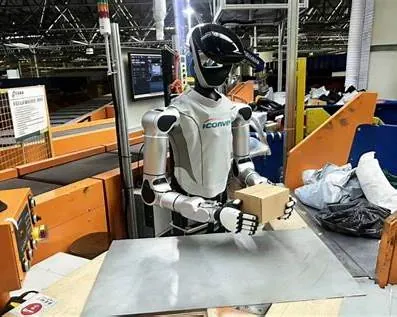
At close range, the engineering problem is the coordination of shoulder, elbow, wrist, hand and vision systems, not whether the machine has a complete humanoid lower body.
Why a fixed workstation may commercialize faster
Parcel centers already contain conveyors, scanners, diverters and safety systems. If the robot only needs to pick, orient and feed parcels within a fixed envelope, legs add cost without necessarily increasing workstation output.
Removing locomotion can eliminate or reduce:
- high-power hip, knee and ankle joints;
- dynamic balance control and fall risk;
- mobile battery requirements;
- additional energy consumption;
- safety issues created by a walking machine;
- lower-body maintenance and spare-part complexity.
The mechanical budget can then be concentrated on shoulder, elbow, wrist and waist joints, end effectors and vision.
From an engineering perspective, this is not a reduced humanoid. It is a task-optimized dual-arm manipulation platform.
What does 1,200 parcels per hour really test?
A rate of 1,200 items per hour corresponds to an average system takt of roughly three seconds per fed item. That does not mean every complex manipulation is independently completed in exactly three seconds. Conveyors, buffers, overlapping motions and parallel operations contribute to overall throughput.
The more important shift is from asking whether the robot can grasp a parcel to asking whether it can do so reliably for an industrial shift.
| Industrial metric | Question to answer |
|---|---|
| Throughput | How many items can be handled consistently per hour? |
| First-attempt success | How often does the first grasp succeed? |
| Recovery time | How quickly does the system recover from a failed grasp? |
| Availability | What percentage of scheduled time is productive? |
| Mis-sort rate | How often is a parcel sent to the wrong route? |
| Joint life | How do joints perform under millions of cycles? |
| Maintenance | How quickly can a joint or end effector be serviced? |
| Cost per parcel | What is the total handling cost per item? |
For logistics operators, the decisive metric is ultimately cost per parcel, not the visual appeal of a robot demonstration.
Which mechanical parts matter to precision manufacturing suppliers?
Even without a humanoid lower body, a dual-arm robot contains many high-cycle rotary joints and precision interfaces.
| Module | Typical precision parts | Manufacturing focus |
|---|---|---|
| Shoulder | Joint housing, bearing seat, output flange | Stiffness, concentricity, bearing fit |
| Upper arm | Lightweight arm body, connector brackets | Low inertia, bending stiffness, distortion |
| Elbow | Housing, bearing bores, connection flange | Concentricity, assembly stack-up |
| Forearm | Lightweight structure | Mass, inertia, rigidity |
| Wrist | Compact joint housing, flange | Miniaturization, repeatability, cable routing |
| Hand/end effector | Palm frame, mounting interfaces | Multi-axis assembly, impact resistance |
| Waist | Rotary housing, bearing seat | Torque capacity, stiffness |
| Fixed base | Mounting base, adapters | Machine datum, vibration resistance |
| Vision | Camera and sensor mounts | Calibration stability |
A common mistake is to focus on isolated dimensions. A good bearing bore does not guarantee a good robot joint. Bearing seats, reducer interfaces, motor interfaces, encoders and output flanges form one assembly stack, and datum drift at any interface can be amplified at the end effector.
What are the real CTQs for parcel-sorting robot joints?
For high-cycle sorting, CTQs must be tied to failure modes rather than described simply as high precision.
| CTQ | Possible failure when uncontrolled | Manufacturing approach |
|---|---|---|
| Bearing-seat concentricity | Uneven loading, heat, reduced life | Common datums and finish machining |
| Bearing-bore roundness | Variable fit and rotational resistance | Precision boring/turning and measurement |
| Output-flange runout | Reduced end-point repeatability | Axial and radial datum control |
| Motor/reducer alignment | Noise, wear, efficiency loss | Assembly stack-up review |
| Encoder mounting datum | Zero-position drift | Stable face and locating features |
| Housing stiffness | End-point deflection under load | Thin-wall and stiffness validation |
| Arm mass | Higher inertia and slower cycle time | Material and topology optimization |
| Edge quality | Cable damage or assembly interference | Deburring and edge control |
Prototype robots can appear successful as long as they move. After tens of thousands of cycles per day, heat, wear, loosening, repeatability drift and service time become real operating costs.
Lightweight does not mean as light as possible
Parcel robots benefit from lower distal arm mass because the joints repeatedly accelerate and decelerate. Reducing forearm and wrist mass can directly reduce inertia.
However, excessive wall thinning reduces stiffness.
| Location | First priority | Typical manufacturing logic |
|---|---|---|
| Shoulder housing | Stiffness and load capacity | Rigid aluminum housing with precision bearing features |
| Upper arm | Low mass and bending stiffness | Thin-wall ribs, extrusion or formed structure plus CNC |
| Elbow joint | Balance of stiffness and precision | Precision bearing and reducer interfaces |
| Forearm | Low inertia | Weight-relieved light-alloy structure |
| Wrist | Very low mass | Compact integrated housing |
| Fixed base | High stiffness | Stable mounting datums, little need for extreme lightweighting |
This is also why the manufacturing route often changes during scale-up. Machining from solid is useful for low-volume prototypes, while higher production may justify forging, die casting, extrusion or other near-net-shape processes followed by CNC finishing of CTQ interfaces.
The real volume opportunity is joint platformization
If every shoulder, elbow and wrist axis uses a unique joint, the supply chain remains a high-mix, low-volume business.
The stronger manufacturing signal is the emergence of a few standardized actuator sizes or torque classes reused across different axes and robot models.
That changes the production logic from:
many drawings x a few prototypes
to:
a small number of joint platforms x thousands of robots x multiple joints per robot
At that point, dedicated fixtures, automated loading, tool-life management, SPC and batch traceability become economically justified.
What should an RFQ define before production planning?
| RFQ input | Why it matters |
|---|---|
| Annual volume and ramp schedule | Determines solid CNC versus near-net shape plus CNC |
| Number of repeated joints per robot | Indicates platform-scale production potential |
| Bearing model and fit | Drives bore tolerances and surface requirements |
| Motor and reducer interfaces | Defines alignment and stack-up requirements |
| Encoder datums | Affects zero position and repeatability |
| Mass and inertia target | Influences material and weight-relief design |
| Continuous cycle requirements | Drives fatigue, thermal and life expectations |
| Surface treatment | Requires allowance for dimensional change |
| Inspection plan | Defines CMM, runout, roundness and reporting needs |
| Assembly scope | Clarifies part, subassembly or joint-module delivery |
For a precision machining supplier, the value is not simply producing one robot housing. It is helping stabilize joint datums, assembly stack-ups and repeatable production processes before volume increases.
Conclusion
The Guangzhou postal deployment shows why parcel logistics is a strong early application for dual-arm embodied robots: the workstation is fixed and repetitive, while the incoming parcels remain variable in size, material and orientation.
Commercial products do not need to reproduce a complete human body. They may become more specialized over time: fixed bases, faster arms, more durable joints and end effectors optimized for cartons, mailers and exception items.
For the manufacturing supply chain, three signals matter most:
- whether shoulder, elbow and wrist joints become platformized;
- whether machined-from-solid prototypes move toward near-net-shape plus CNC production;
- whether individual joint parts reach thousands or tens of thousands of repeat units.
When those three signals appear together, parcel-sorting embodied robots become more than a popular AI topic. They become a repeatable precision manufacturing opportunity.
FAQ
How is a dual-arm parcel sorting robot different from a conventional industrial robot arm?
A conventional industrial robot arm is best suited to repetitive tasks with highly controlled object positions and trajectories. A dual-arm parcel sorting robot must handle packages that vary in size, material and orientation, so it depends more heavily on machine vision, grasp planning, coordinated two-arm manipulation, exception handling and stable continuous operation.
Why can a parcel sorting robot use a fixed workstation instead of legs?
When the main job is to pick, reorient, feed and divert parcels between conveyors, a fixed workstation avoids the weight and control complexity of walking and balancing. More of the system budget can be allocated to the arms, wrists, end effectors, vision system and durable joints.
What throughput has been reported for the embodied sorting robot at Guangzhou Postal District Center?
The Guangdong Postal Administration reported that the embodied sorting robot introduced at Guangzhou Postal District Center can reach a maximum parcel feeding rate of about 1,200 items per hour while performing parcel feeding, sorting and exception identification tasks.
Which mechanical parts matter most in a dual-arm sorting robot?
From a precision manufacturing perspective, shoulder, elbow and wrist housings, bearing seats, output flanges, hollow shafts, lightweight arm structures, waist rotation parts, end-effector interfaces and vision sensor mounts are especially important because they influence stiffness, repeatability, inertia, service life and assembly consistency.