In This Article
A useful way to understand embodied AI is not as “another type of robot,” but as a different relationship between intelligence and hardware:
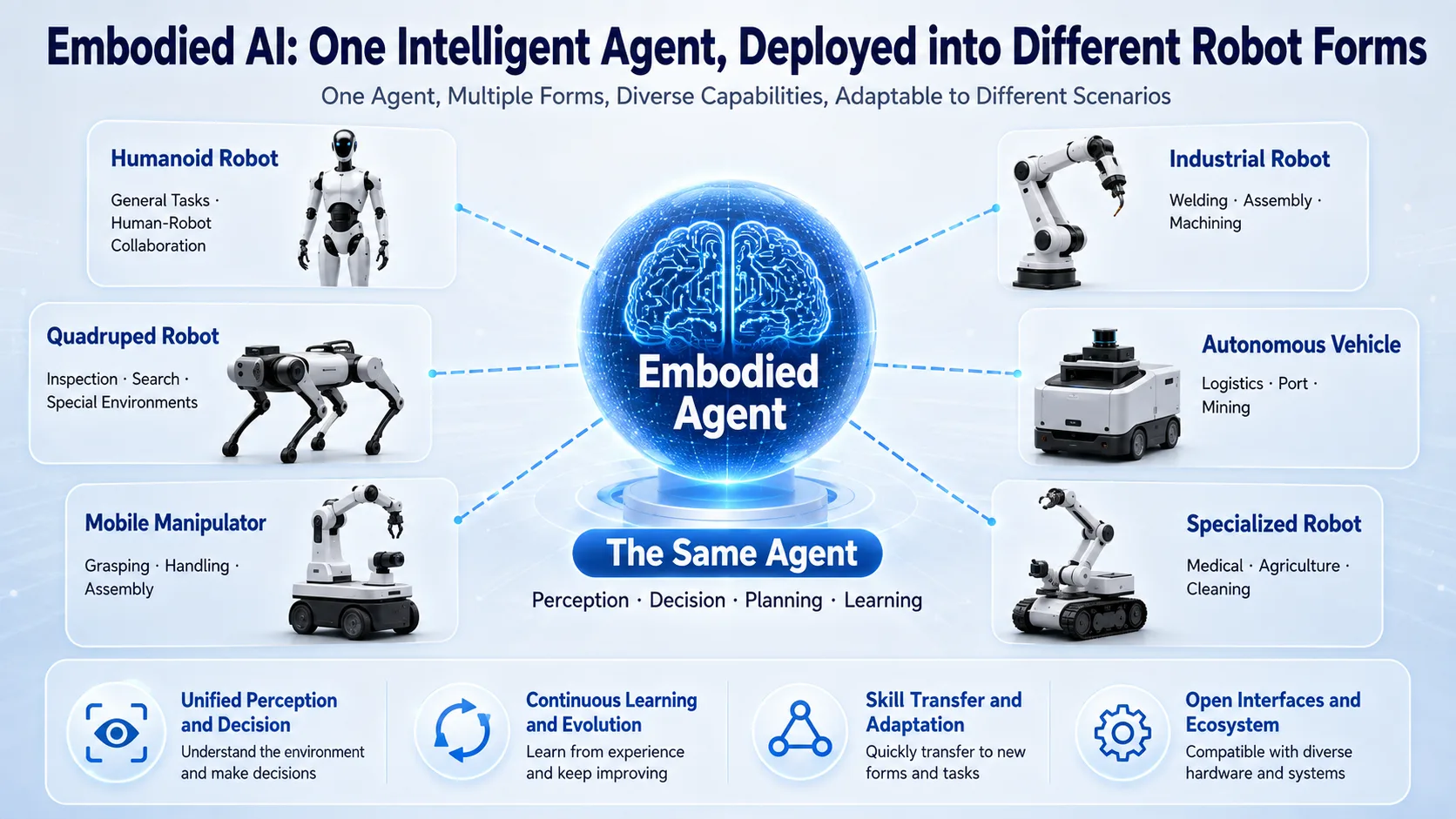
The same intelligent agent can be adapted to different physical robot forms.
The agent provides perception, environmental understanding, decision-making, planning and learning. The physical robot provides cameras, joints, wheels, legs, arms, grippers and other mechanisms that allow the same intelligence to work in different environments.
This creates a potentially important shift from traditional automation.
A conventional machine is usually designed around one body, one program and one task. A more general embodied AI architecture may gradually move toward:
One Agent → Multiple Robot Forms → Multiple Physical Tasks.
That does not mean the same AI model can simply be copied into every robot without engineering work. Cross-embodiment deployment still requires sensor mapping, kinematic and dynamic adaptation, control interfaces, safety constraints and often additional training.
One Agent Can Have Different Bodies
An intelligent agent with general perception, decision, planning and learning capabilities may operate through very different robot bodies.
| Robot Form | Physical Characteristics | Typical Applications |
|---|---|---|
| Humanoid robot | Legs, arms, many degrees of freedom | General tasks, human-robot collaboration |
| Quadruped robot | Four legs, terrain adaptability | Inspection, search, special environments |
| Mobile manipulator | Wheeled base + robot arm | Grasping, handling, assembly |
| Industrial robot | Fixed base + multi-axis arm | Welding, assembly, machining |
| Autonomous equipment | Mobile wheeled platform | Logistics, ports, mining |
| Specialized robot | Application-specific body | Medical, agriculture, cleaning |
From a software perspective, these systems may share parts of the same perception, task-planning and skill knowledge.
From a physical perspective, however, they can have completely different degrees of freedom, payloads, sensors, end effectors, speeds and safety limits.
This is why one of the most valuable ideas in embodied AI is not merely that “AI can think,” but that:
The same intelligence can transfer across different physical forms and be adapted to different real-world tasks.
What Does the Agent Do, and What Does the Robot Body Do?
A simplified embodied system can be separated into two layers.
| Layer | Primary Responsibility | Typical Elements |
|---|---|---|
| Intelligent agent | Perception, reasoning, planning, learning | VLM, VLA, policy models, task planning |
| Robot body | Sensor input and physical execution | Cameras, encoders, motors, reducers, joints, mobile base |
The agent may create a high-level instruction such as:
“Move to the shelf, pick up the blue component, and place it in the bin on the left.”
A humanoid robot may walk there and use two arms and hands.
A mobile manipulator may drive on wheels and use one arm and a gripper.
The task can be similar, but the low-level motion is completely different.
This requires a conversion chain:
Task Intent → Robot Capability → Motion Planning → Joint Control → Physical Action
Why “The Same Agent” Is Not Simply a Model Download
The idea of one agent entering different robot forms is a useful mental model, but real engineering requires an embodiment adaptation layer.
| Difference | Why Adaptation Is Required |
|---|---|
| Degrees of freedom | Humanoids and robot arms have different joints |
| Kinematics | The same target position requires different joint solutions |
| Dynamics | Mass, inertia and payload differ |
| Sensors | Vision, force and tactile configurations differ |
| Actuators | Motors, reducers and joint structures differ |
| Control frequency | Real-time control requirements differ |
| Safety limits | Maximum speed, torque and collision constraints differ |
A more accurate statement is therefore:
Cognitive and skill capabilities can be transferred, but they must pass through an embodiment adaptation layer before becoming physical motion on a specific robot.
This adaptation layer may become a major part of future embodied AI platforms.
From Digital Intelligence to Physical Intelligence
Generative AI mainly produces outputs in digital space.
Embodied AI must operate under real physical constraints.
| Physical Factor | Effect on the Robot |
|---|---|
| Gravity | Continuous joint load |
| Inertia | Dynamic load during acceleration and deceleration |
| Friction | Efficiency and control response |
| Clearance | Position and reversal error |
| Stiffness | Deflection under load |
| Temperature | Dimensional and fit changes |
| Impact | Transient high loads |
| Manufacturing variation | Changes actual motion geometry |
The challenge is therefore not only:
Can AI understand the physical world?
It is also:
Can the robot body act on the physical world accurately and repeatedly?
How Does an AI Command Become Physical Motion?
Once the agent decides on an action, a robot may execute it through a chain like this:
AI Agent
↓
Motion Planning
↓
Controller
↓
Motor
↓
Reducer
↓
Bearing
↓
Output Shaft / Flange
↓
Robot Link
This is an important boundary.
The upper part remains largely digital. Starting from the motor and actuator, calculated commands enter the mechanical world.
At that point, theoretical control accuracy encounters backlash, clearance, runout, deformation, temperature and assembly variation.
Why Can an Accurate AI Command Still Produce Inaccurate Motion?
Even when the agent correctly determines the desired motion, actual output depends on the whole electromechanical system.
| Error Source | Typical Effect |
|---|---|
| Reducer backlash | Reversal error |
| Bearing clearance | Output movement or tilt |
| Misaligned bearing bores | Increased friction and vibration |
| Output-shaft runout | End-point trajectory error |
| Encoder eccentricity | Periodic feedback error |
| Housing deformation | Axis displacement |
| Thermal expansion | Accuracy drift over time |
| Assembly stack-up | Robot-to-robot variation |
This reveals an important engineering principle:
Robot motion accuracy is a system capability, not the capability of a single algorithm or a single part.
Joint Actuators Connect the Agent to the Physical World
For humanoid robots and articulated manipulators, the joint actuator is one of the most important interfaces between digital control and real motion.
| Component | Function | Typical Mechanical CTQ |
|---|---|---|
| Motor | Generate power | Rotor axis, stator location |
| Reducer | Reduce speed and increase torque | Input/output axis, locating datum |
| Bearing | Support rotation | Bore size, roundness, coaxiality |
| Encoder | Position feedback | Eccentricity, mounting datum |
| Housing | Support and establish references | Coaxiality, perpendicularity, position |
| Output Shaft | Transmit motion | Runout, coaxiality |
| Output Flange | Connect robot link | Flatness, face runout, position |
These components serve different functions but often share one mechanical coordinate system.
Why the Joint Housing Is More Than an Enclosure
A compact actuator can contain several related functional axes:
Motor Axis → Reducer Axis → Bearing Axis → Encoder Axis → Output Axis
The housing often establishes the actual physical relationship among those axes.
It is therefore not simply a protective shell. It acts as:
A mechanical reference carrier for the entire actuator.
That is why bearing seats, locating diameters, mounting faces, encoder interfaces and output features must be considered as one functional system.
From Individual Tolerances to Tolerance Stack-Up
A robot joint is a multi-part assembly.
Output position may depend on:
Housing Datum + Bearing Position + Reducer Stack Height + Shaft Dimension + Assembly Clearance
During prototype development, engineers may solve variation using shims, selective fitting or manual adjustment.
At production scale, the system must evolve toward:
Functional Requirement → Datum Strategy → Part CTQ → Process Capability → Assembly Capability → Robot Performance
As robots move from “it works” to stable production, tolerance stack-up becomes increasingly important.
Does Manufacturing Become Less Important When One Agent Can Use Different Bodies?
No. In many cases it becomes even more important.
If cognitive and skill capabilities become more portable across robot platforms, software may become increasingly platformized.
But every physical body must still execute real motion.
Different embodiments create different mechanical CTQs.
| Embodiment | Typical Manufacturing Focus |
|---|---|
| Humanoid robot | Joint coaxiality, lightweighting, output accuracy |
| Quadruped robot | Impact load, joint stiffness, sealing |
| Mobile manipulator | Chassis references, arm interface, repeatability |
| Industrial robot | Stiffness, lifetime, reducer and bearing-seat accuracy |
| Specialized robot | Application-specific materials, sealing, corrosion or cleanliness |
So embodied AI does not make mechanical engineering less important.
Instead:
The more general the intelligence becomes, the more clearly the body’s performance limits must be defined and manufactured consistently.
From Demo to Mass Production
| Stage | Main Question |
|---|---|
| Concept | Is the architecture feasible? |
| Prototype | Can the component be manufactured? |
| Engineering Sample | Can the robot complete the task? |
| Pilot Production | Are multiple robots consistent? |
| Mass Production | Can production remain stable and economical? |
A demonstration asks:
Can this robot perform the movement?
Production asks:
Will robot No. 1 and robot No. 10,000 perform closely enough?
Quality control therefore moves beyond final inspection toward:
CTQ Definition → Datum Strategy → Process Control → SPC → Cp/Cpk → Traceability
Prototype Process Is Not the Same as Mass-Production Process
Billet CNC machining is often ideal during early robot development because it enables fast design changes without tooling.
As volume increases, the process route should be reevaluated.
| Stage | Possible Manufacturing Route |
|---|---|
| Prototype | Billet CNC |
| Low volume | CNC + dedicated fixtures |
| Medium volume | Extrusion / forging + CNC |
| High volume | Die casting / forging / near-net-shape + CNC |
A mature manufacturing supplier should answer more than:
Can we machine this component?
The more useful question is:
Which manufacturing route is appropriate for the required CTQs and expected volume?
What Information Should a Robot Component RFQ Include?
| RFQ Information | Engineering Purpose |
|---|---|
| 3D Model | Understand geometry and accessibility |
| 2D Drawing | Define dimensions and tolerances |
| Material | Evaluate machining and deformation risk |
| Datum System | Establish machining and inspection references |
| CTQ | Identify critical controls |
| Assembly Interface | Understand tolerance chains |
| Surface Treatment | Evaluate post-process dimensional change |
| Prototype Quantity | Plan prototype process |
| Annual Volume | Plan production process |
| Inspection Requirement | Define CMM or dedicated gauging |
A high-quality RFQ should help the manufacturing engineer understand:
What function does this component perform inside the robot body?
Conclusion: One Agent, Different Bodies
Embodied AI may increasingly develop toward a platform model:
The same intelligent agent can be connected to different robot forms through different embodiment adaptation layers.
The agent decides:
What it sees, what should be done, and what action should come next.
The control system decides:
How the intended action should be converted into motion commands.
The mechanical system finally determines:
Whether that action can be executed accurately, reliably and repeatedly.
Embodied AI is therefore not only about AI models.
When it enters factories, logistics, agriculture, healthcare and service environments, intelligence must work together with actuators, joints, structures, sensors, tolerance stack-ups, CTQs and scalable manufacturing.
The same agent may enter different bodies, but every body still depends on a real, reliable and manufacturable mechanical system.
FAQ
What is embodied AI?
Embodied AI enables artificial intelligence to interact with the real world through a physical body in a continuous loop of perception, decision, action and feedback. One useful way to understand it is the same intelligent agent being adapted to different robot forms.
Can the same intelligent agent really be deployed into different robot forms?
In principle yes, but it is not as simple as copying one model onto another robot. Cognition, planning and skill knowledge can be shared, while each robot still needs sensor mapping, kinematic and dynamic adaptation, control-interface translation, safety constraints and often additional skill training.
Is embodied AI the same as a humanoid robot?
No. A humanoid robot is one important embodiment, but embodied AI can also be deployed in quadruped robots, mobile manipulators, industrial robots, autonomous equipment and other specialized robots.
Why does embodied AI increase mechanical precision requirements?
AI-generated actions must ultimately be executed by real mechanisms. Reducer backlash, bearing clearance, shaft misalignment, housing deformation, encoder mounting error and thermal expansion can all cause actual motion to deviate from commanded motion.
How do manufacturing priorities change from prototype to mass production?
Prototype development focuses on achieving function, while mass production must control consistency, interchangeability, cycle time, cost and reliability. Quality management therefore expands into CTQ control, tolerance stack-up, SPC, Cp/Cpk and traceability.