In This Article
Direct answer
The AI optical-interconnect supply chain is not defined by one question such as who manufactures the transceiver. The important questions are who generates, modulates and receives the optical signal; who processes the high-speed electrical signal; who integrates the optical engine and module; who places the optical link into the switch system; and who can stabilize thermal, structural, assembly and production risks.
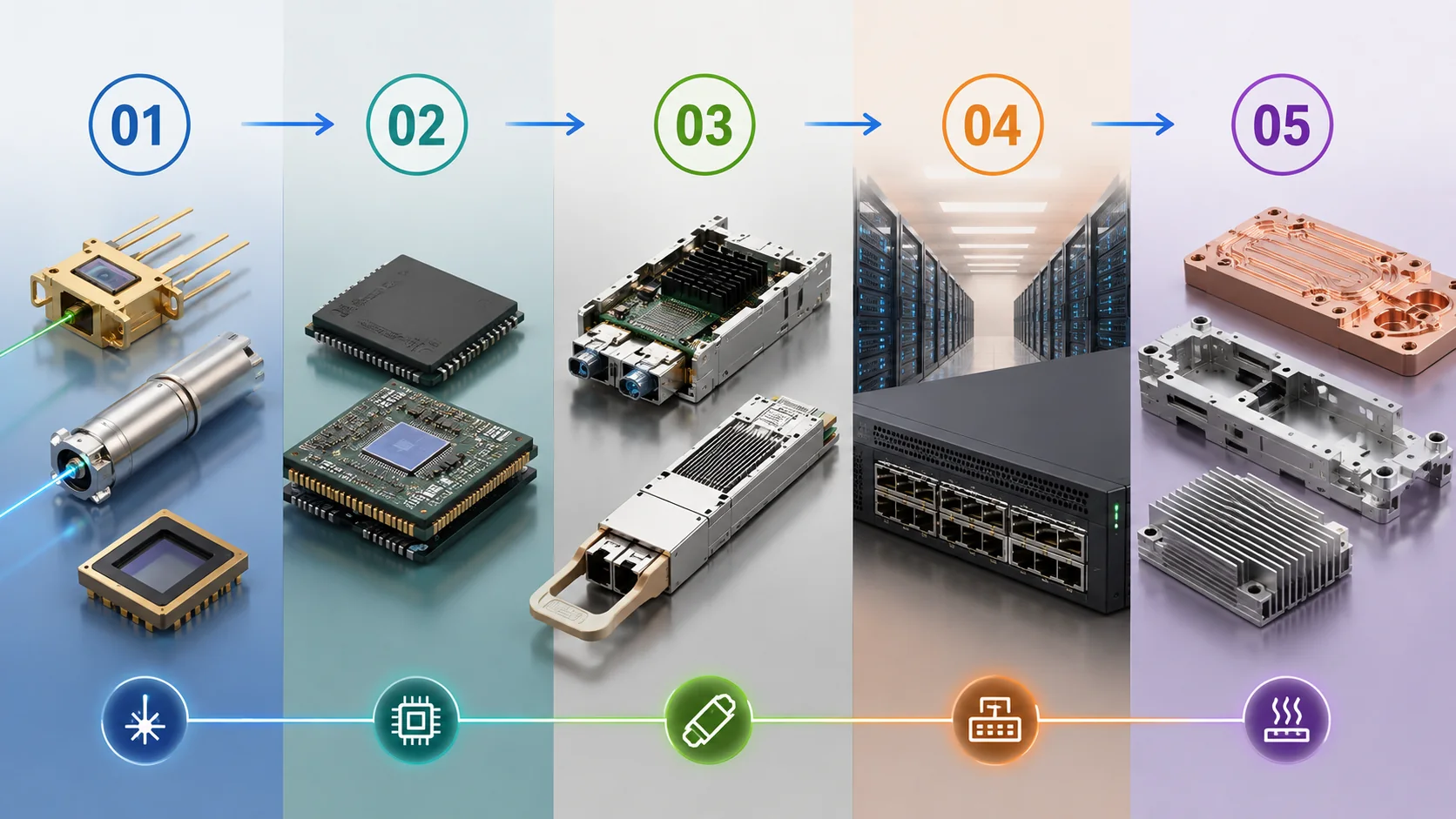
A manufacturing-focused map has six overlapping layers:
| Layer | Primary function | Representative public positioning | Precision-manufacturing impact |
|---|---|---|---|
| Lasers and photonic devices | Generate, modulate and receive light | Coherent, Lumentum and others | Device carriers, local cooling and package-adjacent structures |
| DSPs, drivers and TIAs | Equalize, drive, receive and diagnose high-speed electrical signals | Marvell and others | Power and hotspot locations shape the module thermal structure |
| Silicon photonics and optical engines | Integrate modulation, coupling and receiver functions | Coherent and vertically integrated suppliers | Optical-engine bases, locating structures and heat spreaders |
| Transceiver design, assembly and test | Integrate optical, electrical, thermal and mechanical functions into a module | InnoLight, Eoptolink, Coherent, Lumentum and others | Housings, lids, heatsinks, pull tabs, assembly and gauges |
| Switching silicon and AI-network systems | Provide high-speed switching and define port and cooling architecture | Broadcom, NVIDIA and others | Cages, cold plates, fiber interfaces and system-level assembly datums |
| Precision structures and manufacturing | Convert functional requirements into repeatable production processes | Material, forming, machining, finishing and inspection suppliers | CTQs, tolerance chains, cleanliness, traceability and change control |
These are not rigid upstream and downstream boxes. One company may supply lasers, optical engines and complete modules, while another supplies only the DSP or switch ASIC. A useful supply-chain analysis starts with public products and system boundaries rather than a generic label.
Information boundary: This article is based on public product pages, product briefs and technical announcements available through August 2026. A demonstration, customer sample, publicly listed product and high-volume production are different states. The article does not rank market share, provide investment analysis or imply that Zhongde supplies any company named here.
1. Why are AI data centers reshaping the optical-transceiver supply chain?
Conventional data centers also rely on optics, but AI training and inference clusters create much heavier east-west traffic. Large groups of GPUs continuously exchange parameters, gradients and intermediate data, increasing port density and sustained network utilization. The move from 400G to 800G and 1.6T changes more than aggregate bandwidth:
- electrical and optical lanes move from 100G per lane toward 200G per lane;
- DSPs, drivers, lasers and receivers face tighter signal and optical requirements;
- module power and local heat flux rise;
- fiber count, port density and system airflow must be rebalanced;
- pluggable, low-power pluggable, board-mounted and CPO architectures compete at different system boundaries.
IEEE 802.3df-2024 covers relevant MAC and physical-layer specifications for 800 Gb/s Ethernet. At the article update date, IEEE P802.3dj remained an active project for 200 Gb/s, 400 Gb/s, 800 Gb/s and 1.6 Tb/s Ethernet. Public 1.6T products, demonstrations and customer validation programs may therefore use different MSAs, interfaces and implementation choices. A supplier roadmap should not be treated as a fully frozen industry-wide design.
2. Why is the upstream, midstream and downstream model insufficient?
The three-stage model is useful for an introduction, but it hides three engineering realities.
2.1 Value is distributed across several functional loops
A 1.6T module is not determined by the laser alone. DSP power and signal processing, optical-engine coupling, PCB routing, connectors, module envelope, thermal contact surfaces, firmware and host airflow all affect the result. One failed loop can produce a module with conforming component data but inadequate system performance.
2.2 Vertical integration changes company positions
Coherent and Lumentum supply upstream lasers and detectors and also present or offer high-speed module solutions. InnoLight and Eoptolink are strongly identified with module products but also develop optical-engine, silicon-photonics and other core platforms. A company cannot be assigned permanently to one location in the chain.
2.3 CPO changes the module boundary
Traditional pluggable architectures locate optical conversion at the front panel. CPO places optical engines around the switch ASIC. Some value associated with the traditional module housing decreases, while value grows in optical-engine carriers, cooling structures, external laser sources, fiber interfaces and precision system assembly.
3. What does the laser and photonic-device layer control?
This layer includes EMLs, DMLs, VCSELs, continuous-wave lasers, modulators, photodiodes and receiver devices. It influences optical power, modulation bandwidth, wavelength stability, reach, temperature behavior and cost structure.
Lumentum’s 200G PAM4 EML is positioned for scalable 1.6T pluggable modules using eight 200G lanes. Its data-center portfolio also includes DMLs and continuous-wave lasers. Coherent’s public 1.6T demonstrations in 2026 covered silicon photonics, high-power InP CW lasers, 200G InP EMLs and 200G GaAs VCSELs. This shows that 1.6T is a bandwidth class, not one optical technology.
The opportunity for a structural supplier is not laser-chip fabrication. It is understanding the thermal and assembly boundary around the device:
- local heat spreading and temperature uniformity around a laser or optical engine;
- particle and impact protection near optical interfaces;
- flatness and location of miniature carriers;
- integration of copper, aluminum or hybrid spreaders into the module structure.
4. Why are DSPs, drivers and TIAs critical supply-chain nodes?
A PAM4 DSP supports equalization, diagnostics and signal-quality management. Drivers and TIAs connect the transmit and receive paths. As lane rates increase, the DSP is both a performance-critical device and one of the main heat sources inside a pluggable module.
Marvell’s PAM4 DSP portfolio covers rates from 100G to 1.6T. Its Ara 3nm 1.6T platform supports eight 200G electrical and optical lanes. A DSP vendor does not manufacture the module housing, but device size, power, driver capability and lane count directly influence:
- PCB layout and internal volume;
- the number and height of thermal contact pads;
- hotspot distribution in the lid or heat spreader;
- module stack height and host-cooling load;
- production test and diagnostic requirements.
LPO, LRO and TRO architectures redistribute part of the DSP function or retiming boundary. They do not merely remove one chip; they shift link-budget, interoperability, tuning and production-validation pressure to other parts of the system.
5. Where are InnoLight, Eoptolink, Coherent and Lumentum positioned?
The table describes public product positioning, not market rank or the full business scope of each company.
| Company | Public product and technology emphasis | Typical supply-chain position | Manufacturing implication |
|---|---|---|---|
| InnoLight | 100G through 1.6T data-center modules and silicon-photonics platforms | High-speed module and optical-engine integration | OSFP-class housings, thermal structures, ports and production assembly |
| Eoptolink | 800G and 1.6T OSFP plus LRO and related architectures | High-speed pluggables, optical engines and low-power solutions | Different thermal, housing and test boundaries by architecture |
| Coherent | Lasers, detectors, VCSELs, silicon photonics and multiple 1.6T modules | Multi-layer vertical coverage from devices to modules | Different heat maps, interfaces and material combinations by optical route |
| Lumentum | EMLs, DMLs, CW lasers and 1.6T module solutions | Upstream photonic devices extending into modules | Laser cooling, optical-engine carriers and module thermal management |
5.1 InnoLight: high-speed pluggables are the clearest public product line
InnoLight’s data-center portfolio covers 100G, 200G, 400G, 800G and 1.6T. Its 1.6T OSFP224 page describes eight 200G PAM4 electrical and optical lanes. For manufacturing, the key issue is not repeating the bandwidth number but understanding power, thermal contact area, port density, structural strength and assembly repeatability.
5.2 Eoptolink: moving from 800G into 1.6T and lower-power architectures
Eoptolink’s public product solutions include 800G QSFP-DD800 and OSFP modules as well as 1.6T OSFP DR8 and 2xFR4 products. Its public 1.6T DR4 demonstration in 2026 used an eight-by-200G electrical interface and four-by-400G optical interface. A lower fiber count and higher optical-lane rate change the front-panel ports, internal fiber space and heat layout.
5.3 Coherent: components, silicon photonics, VCSELs and modules in parallel
Coherent’s 1.6T DR8 product uses eight 200G PAM4 lanes, while its public portfolio includes silicon-photonics and VCSEL implementations with different DSP combinations. Similar external form factors can therefore contain very different optical engines, hotspot positions, thermal steps and assembly sequences.
5.4 Lumentum: upstream laser capability extending into 1.6T modules
Lumentum’s data-center connectivity portfolio includes EMLs, DMLs, continuous-wave lasers and high-speed module solutions. Its strongest public identity begins at the light-source and component layer, but its product scope also extends into 1.6T modules. A manufacturing review should distinguish a component supplier’s demonstration or module solution from the final customer’s released production architecture.
6. Why should Broadcom and NVIDIA not be listed as ordinary module vendors?
Broadcom and NVIDIA approach the problem from switching silicon and complete systems rather than from one pluggable module.
The Broadcom BCM78919 is a 102.4-Tb/s CPO switching device supporting up to 64 by 1.6TbE or 128 by 800GbE. It moves the switch ASIC and optical engines into one system-level packaging boundary, requiring coordinated ASIC cooling, optical-engine temperature control, fiber routing and dense assembly.
NVIDIA Spectrum-X Ethernet Photonics integrates CPO around the switch ASIC and was announced for availability in the second half of 2026. NVIDIA’s public announcement also describes CPO developing alongside pluggable-transceiver technologies, reinforcing that the market is not switching to one architecture at one instant.
A more useful distinction is:
Module vendor: integrates optical, electrical, thermal and mechanical functions into a pluggable form
Switch-silicon vendor: defines port rate, switch capacity and the CPO package boundary
System vendor: defines network architecture, cooling, service and deployment
Precision manufacturer: converts structural and thermal interfaces into repeatable parts and assemblies
7. How will pluggable, LPO, LRO, NPO and CPO coexist?
These architectures solve problems at different system boundaries and should not be viewed only as a replacement sequence.
| Architecture | Optical location and signal processing | Main advantage | Manufacturing and service challenge |
|---|---|---|---|
| Conventional pluggable | Optics and DSP in the front-panel module | Mature ecosystem, replaceable and serviceable | Higher power and electrical-channel pressure at higher speeds |
| LPO, LRO and TRO | Adjust or reduce parts of the DSP and retiming boundary | Lower power while retaining a pluggable boundary | More difficult link budget, interoperability, tuning and test |
| NPO | Optical engine close to the ASIC with some modularity retained | Shorter electrical path with partial serviceability | Complex packaging, board connection and cooling boundary |
| CPO | Optical engines co-packaged or tightly integrated with the switch ASIC | Potential for high bandwidth density and lower electrical loss | Difficult cooling, fiber attachment, yield, repair and system validation |
Actual deployment depends on reach, port capacity, power, failure service and cost. A manufacturing supplier should not bet on one acronym; it should track where the structural value moves.
8. What precision structural parts are created by the upgrade cycle?
8.1 Pluggable optical transceivers
Typical opportunities include:
- upper and lower housings and precision bases;
- thermal lids and copper or aluminum heat spreaders;
- extruded or CNC-machined external heatsinks;
- front panels and structures around optical ports and connectors;
- pull tabs, pivots, latches and release parts;
- assembly, insertion and dimensional inspection fixtures.
8.2 Optical engines and board-mounted optics
The structure moves closer to the photonic core and becomes smaller:
- optical-engine mounting bases and miniature carriers;
- local spreaders and miniature heatsinks;
- fiber-array supports and strain-relief parts;
- alignment datums between the PCB and optical engine;
- cleanliness, dust protection and protective packaging structures.
8.3 CPO systems
CPO reduces some traditional module-housing demand but creates system-level opportunities:
- optical-engine carriers and mounting frames;
- cooling bases around the ASIC and optical engines;
- cold-plate and liquid-connection interfaces;
- metal housings for external laser sources;
- high-density fiber-connection supports;
- assembly datums, fixtures and inspection methods for large multi-part systems.
The main challenge is not minimizing every individual tolerance. It is maintaining the tolerance chain among heat paths, optical and electrical interfaces, mechanical datums and final assembly state.
9. Where can Zhongde participate, and where is the boundary?
9.1 Suitable manufacturing scope
Zhongde is positioned more naturally for:
- aluminum, copper and other metal housings, bases and thermal structures;
- precision machining after die casting, extrusion or another near-net blank route;
- thermal lids, spreaders, optical-engine bases and cold-plate connection parts;
- anodizing, electroless nickel, coating and local masking;
- deburring, cleaning, protective packaging and traceability;
- component assembly, CMM inspection and tolerance-chain verification;
- transition from all-CNC engineering prototypes to near-net blanks plus critical-surface machining.
9.2 Scope that should not be claimed
Zhongde should not claim responsibility for:
- EML, VCSEL, photodiode or silicon-photonics chip design and fabrication;
- PAM4 DSP, driver, TIA or switch-ASIC design;
- active optical alignment and core optical packaging;
- high-speed electrical and firmware design;
- complete transceiver performance certification;
- IEEE, OIF or MSA certification;
- an existing supply relationship with any company named in this article.
A clear boundary helps a customer identify when structural and manufacturing support is useful without creating a misleading impression of capability.
10. How can procurement identify a company’s actual supply-chain position?
A sourcing or supply-chain team can start with the following questions:
| Question | What it reveals |
|---|---|
| Does the company manufacture lasers, detectors or silicon-photonics chips? | Control of upstream device and process platforms |
| Does it develop optical engines and perform optical packaging? | Optical-electrical integration capability |
| Which DSP is used, and is the architecture LPO, LRO or TRO? | Power, signal-processing and interoperability approach |
| Is the product 800G, 1.6T or a CPO optical engine? | Product generation and system boundary |
| Does the company perform module assembly, burn-in and high-speed test? | Complete module-delivery capability |
| Are the housing and thermal structures machined, cast or extruded? | Production economics, tooling and structural supply chain |
| Is acceptance in the free state or final system assembly? | CTQ and inspection boundary |
A 1.6T label on a website does not answer all of these questions. Procurement still needs to confirm product state, interface, reach, optical route, DSP, power, sampling stage and production plan.
11. What does this mean for precision manufacturers?
Growth in AI optics does not automatically create orders for every machine shop. A structural supplier must demonstrate that it can:
- derive real CTQs from thermal, optical, electrical and mechanical functions;
- build the tolerance chain among the connector, optical port, PCB, thermal surface and module envelope;
- select an all-CNC, cast, extruded or hybrid route according to prototype quantity and annual volume;
- control thin-wall distortion, blank variation, tool wear, coating thickness and masking boundaries;
- define different acceptance methods for free state, post-finishing state and assembled state;
- maintain batch consistency through first-article inspection, in-process measurement, traceability and change control.
This is the practical position of Zhongde’s optical-transceiver business: not competing with chip or optical-packaging companies, but supporting the stage where their design becomes a manufacturable, measurable and traceable structural product.
Frequently asked questions
What are the main layers of the global AI optical-transceiver supply chain?
A practical functional map has six overlapping layers: lasers and photonic devices; high-speed electrical ICs such as DSPs, drivers and TIAs; silicon-photonics chips and optical engines; transceiver design, assembly and test; switching silicon and AI-network systems; and the precision-structure, thermal-management and manufacturing supply chain. Some companies span several layers, so each company should not be assigned to one fixed box.
How do InnoLight, Eoptolink, Coherent and Lumentum differ in the supply chain?
Based on public product information available through August 2026, InnoLight and Eoptolink are focused strongly on high-speed pluggable modules such as 800G and 1.6T and related low-power architectures. Coherent spans lasers, detectors, silicon photonics, VCSELs and multiple 1.6T module implementations. Lumentum builds on upstream EML, DML and continuous-wave laser products while also presenting module solutions for 1.6T applications. Their businesses overlap and should not be treated as four mutually exclusive company types.
Will CPO quickly replace 800G and 1.6T pluggable transceivers?
No single-step replacement is likely. Pluggable modules remain mature, serviceable and replaceable, while CPO can reduce the electrical distance between the switch ASIC and optical engines to improve bandwidth density and power efficiency. CPO also creates harder packaging, cooling, fiber-connection, yield and maintenance problems. Different reaches, switch capacities, power budgets and operating models will keep several architectures in use for a long time.
What precision-manufacturing opportunities are created by the optical-transceiver upgrade cycle?
Pluggable modules require precision housings, bases, thermal lids, external heatsinks, heat spreaders, front panels and pull-tab latch parts. Optical engines and board-mounted optics add miniature heatsinks, mounting bases and fiber-interface supports. CPO systems add optical-engine carriers, cooling structures around the ASIC, cold-plate interfaces, external-laser housings and high-accuracy assembly and inspection tooling. The opportunity is strongest for suppliers that understand heat paths, functional datums, tolerance chains, finishing and batch consistency.