In This Article
Direct Answer
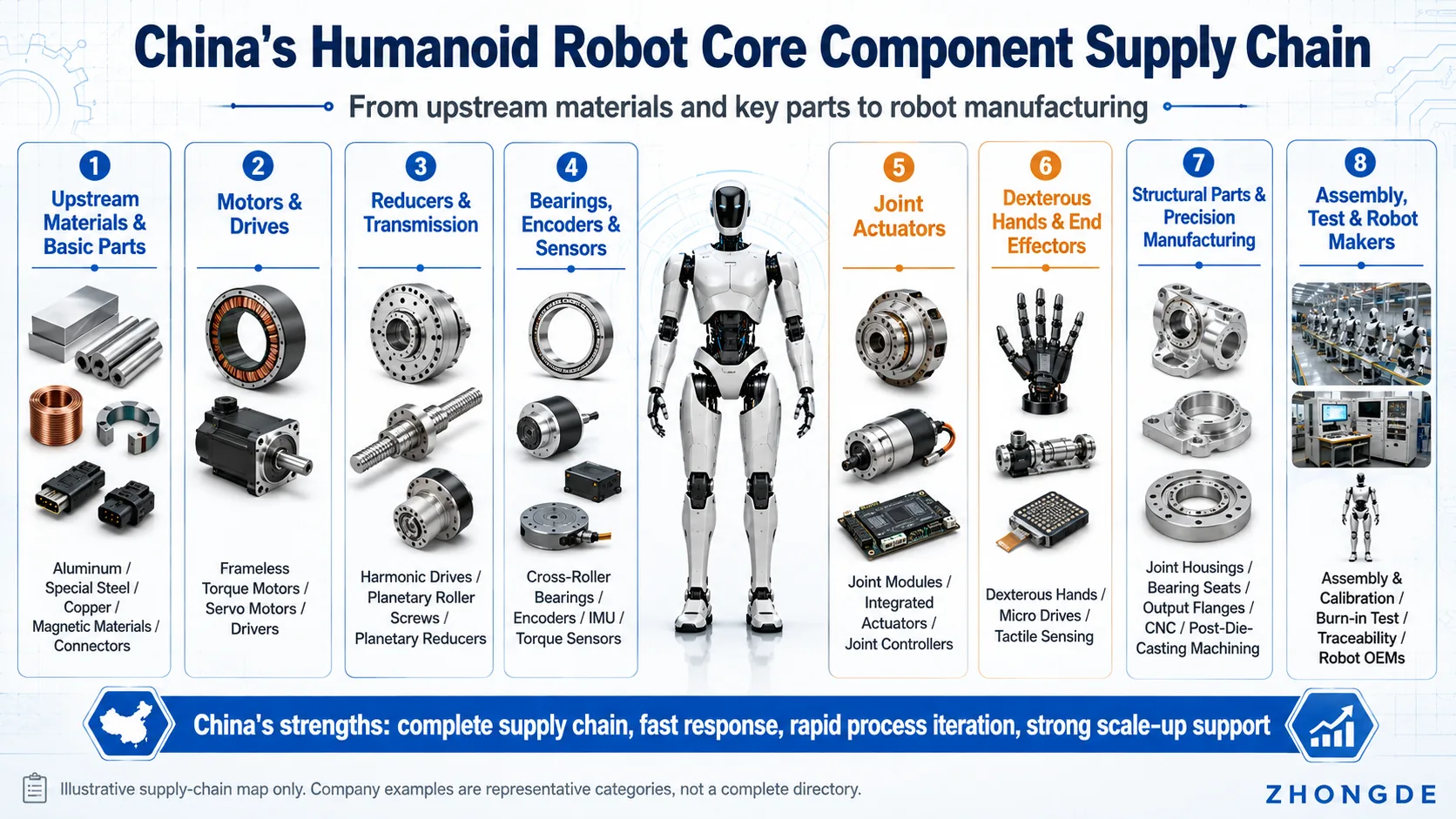
The Chinese humanoid robot supply chain should not be understood as a list of dozens of companies. A useful analysis must answer three questions:
- Which segments truly determine robot cost and performance?
- Which companies have clear products, capacity or commercial orders?
- Which segments are still in prototype validation, process ramp-up or import-substitution stages?
Guosen Securities, in Humanoid Robot Industry Review II: The Breakout Year and an Unlimited Market, analyzes the industry from the hardware bill of materials and company disclosures, with reducers, screws, motors, sensors, bearings and dexterous hands as major focus areas. Dagong Global Credit Rating, in Humanoid Robots: Industry Differentiation During the Mass-Production Breakthrough, divides the chain into upstream parts, midstream robot integration and downstream applications, and identifies upstream hardware as the main concentration of cost and technical barriers.
Combining these two perspectives produces a more manufacturing-oriented industry map.
1. Why divide the industry into upstream, midstream and downstream?
Upstream: core components and basic support
Upstream contains most of the robot hardware value:
- perception: vision, position, torque, six-axis force, tactile sensing and electronic skin;
- control: controllers, servo drives and motion-control software;
- motion execution: motors, reducers, screws, bearings and joint modules;
- other foundations: batteries, chips, connectors, structural parts and lightweight materials.
The Dagong report estimates that hardware cost is highly concentrated upstream, at roughly 60% to 70% of total chain value. This is an industry-research estimate rather than a universal BOM, but it supports a clear conclusion: robot cost and performance are first determined by core hardware.
Midstream: design, system integration and production delivery
Midstream robot makers must complete more than final assembly. They are responsible for:
- body architecture and degree-of-freedom design;
- motion control and embodied-AI algorithms;
- integrated joint and wiring architecture;
- system testing, simulation and digital twins;
- assembly processes, calibration, burn-in and traceability.
Midstream companies bear greater product risk because they must convert individual component performance into stable operation in real applications.
Downstream: industrial, logistics, special-duty and home applications
Applications define the requirements that flow back into the hardware chain. Industrial handling emphasizes duty cycle, payload, takt time and reliability. Logistics emphasizes mobility and picking. Special-duty systems emphasize environmental resistance. Home robots require safety, compliance, low noise and dexterous manipulation.
The chain therefore evolves through continuous feedback among applications, robot makers and component suppliers.
2. Which components hold the most value?
Guosen Securities published a research model for an Optimus Gen 3-like configuration. It is not an actual procurement BOM, but it is useful for understanding value concentration.
| Module | Estimated current value share | Estimated share after million-unit scale | Main components |
|---|---|---|---|
| Rotary joints | 22.9% | 19.8% | Frameless motors, harmonic reducers, bearings, position and force sensors |
| Linear joints | 27.6% | 24.5% | Motors, planetary roller screws, bearings and sensors |
| Dexterous hands | 32.9% | 32.9% | Coreless motors, micro screws, tendons, force and flexible sensors |
The exact percentages should not be copied into every robot design. The more important conclusions are:
- Joint systems and dexterous hands are major value concentration areas.
- Scale production can reduce unit prices without eliminating the strategic importance of core parts.
- Cost reduction requires joint optimization of design, materials, processes, testing and sourcing.
3. Reducers and precision transmission
Harmonic reducers
Harmonic reducers are widely considered for compact rotary joints because they combine high reduction ratio with low backlash.
Representative companies listed in the Guosen report include:
- Leader Harmonious Drive: harmonic reducers and integrated mechatronic products, with additional work in planetary roller screws;
- Shuanghuan Driveline: RV and harmonic reducer products;
- Reddy Drive: humanoid-robot-related harmonic reducer orders were disclosed, although scale revenue had not yet formed at the report date;
- Zhongda Leader, Guomao, SILING, Fengli Intelligent and others: development in high-rigidity reducers, precision reducers, new production lines or miniature reducers.
Evidence should be separated into four levels:
Product applicable to robotics
< robot-specific product released
< order or pilot-batch delivery disclosed
< stable mass revenue and long-term delivery
Only the last two levels are strong indicators of supply-chain maturity.
Planetary roller screws
Planetary roller screws are high-value, high-barrier parts in linear actuators. Their production requires control of:
- thread geometry;
- materials and heat treatment;
- grinding and surface quality;
- transmission efficiency and life;
- high-volume consistency.
The reports highlight companies such as Hengli Hydraulic, Zhenyu Technology and Leader Harmonious Drive. Compared with harmonic reducers, stable high-volume domestic supply of high-performance planetary roller screws remains more limited.
4. Motors and drives: industrial and automotive capabilities migrate into humanoids
Humanoid robots mainly use two motor families:
- frameless torque motors in major joints;
- coreless or miniature brushless motors in dexterous hands.
| Direction | Representative companies | Main evaluation points |
|---|---|---|
| Servo, drive and motion control | Inovance, Kinco, Leadshine, Veichi | Control algorithms, drives, motor platforms and industrial application experience |
| Miniature hand drives | Moons, Zhaowei | Miniaturization, gearboxes, encoders, inertia and assembly repeatability |
| Joint motors | Multiple industrial motor and robot suppliers | Torque density, thermal rise, cogging torque, insulation and automated production |
A motor supplier becomes production-ready only when it can solve torque density, heat removal, low inertia, low cogging torque, encoder matching, winding and magnet consistency, automated testing and cost reduction together.
5. Bearings, encoders and force sensors: small parts that set the system limit
Bearings
Joint bearings may need to carry radial, axial and overturning loads in very limited space. Cross-roller bearings, thin-section bearings and custom support structures therefore influence stiffness, friction and life.
The Dagong report discusses companies such as Wuzhou Xinchun in the context of core-component expansion, while the Guosen report includes Jindi and Sinomach Precision Engineering among potential related companies.
Encoders and position feedback
Position sensors must remain stable under speed, temperature rise, shock and mounting eccentricity. Important metrics include:
- absolute accuracy;
- repeatability;
- thermal drift;
- shock resistance;
- mounting clearance;
- batch calibration efficiency.
Six-axis force and tactile sensing
The Dagong report identifies six-axis force sensors, encoders and advanced sensing as relatively weak domestic-substitution segments, and cites Keli Sensing and Haozhi among companies entering the field.
High-end force sensing must solve not only accuracy, but also overload protection, thermal compensation, decoupling algorithms, zero stability and mass calibration.
6. Dexterous hands: high value and high uncertainty
A dexterous hand can combine coreless motors, micro screws, reducers, tendons, encoders, force sensors, flexible sensors and a precision frame.
The Guosen model assigns a high share of total robot value to dexterous hands. This does not mean every robot has the same design, but it shows how rapidly cost grows with the number of degrees of freedom and miniature mechanisms.
Representative observation targets include:
- Zhaowei: miniature transmission and dexterous-hand systems;
- Moons: miniature motors, gearboxes and encoders;
- Inspire Robots: anthropomorphic five-finger hands and miniature actuators;
- DH-Robotics: industrial end effectors and dexterous-hand products.
The real mass-production barriers are continuous life, grasp success rate, tactile stability, assembly cost, calibration and repair—not the number of degrees of freedom alone.
7. Joint modules and complete robots: moving into scale validation
An integrated joint combines motor, reducer, bearings, encoder, drive electronics, housing and wiring in one module. It is therefore the main aggregation point of supply-chain value.
The Dagong report describes integrated joints and dexterous hands entering automated production and scale-validation stages, while identifying Unitree, AgiBot and UBTECH among representative domestic robot makers with strong production or application validation.
The robot maker must integrate:
Component performance
+ system control
+ assembly calibration
+ field reliability
+ cost and delivery
For this reason, the final test of a component is not its laboratory specification, but its long-duration behavior in the complete robot.
8. Regional clusters in China
The Dagong report describes a cluster-based domestic structure:
- Yangtze River Delta: Shanghai, Hangzhou and Suzhou combine robot makers, core parts and ecosystem companies;
- Pearl River Delta: Shenzhen provides dense R&D, while Guangzhou, Foshan and Dongguan contribute agile manufacturing and consumer-electronics supply chains;
- Beijing-Tianjin-Hebei: Beijing focuses on AI and system architecture, with Tianjin and Hebei supporting manufacturing and high-end assembly;
- other cities: differentiated strengths in open-source systems, special-purpose robots and vertical applications.
The likely long-term model is not one city owning the entire chain, but a network of R&D centers, component clusters, manufacturing bases and application customers.
9. Which segments are relatively mature, and which still need breakthroughs?
| Segment | Current assessment | Main validation focus |
|---|---|---|
| Harmonic reducers | Strong domestic industrial base | Life, backlash, consistency and scale delivery |
| Motors and drives | Industrial and automotive capabilities are reusable | Torque density, heat, noise and automated cost reduction |
| Conventional bearings and structures | Broad manufacturing base | Lightweighting, preload, thin-wall distortion and assembly stability |
| Planetary roller screws | Key development stage | Materials, heat treatment, grinding, efficiency and life |
| High-end six-axis force sensors | Large import-substitution opportunity | Decoupling, thermal drift, overload and batch calibration |
| Dexterous hands | Rapid product growth | Continuous life, tactile reliability and repair cost |
| Integrated joints | Scale-validation stage | Thermal, shock, control, assembly and consistency |
| Complete robots | Shipments increasing | Application closure, failure rate, service and commercial return |
10. Practical opportunities for precision manufacturers
For a precision manufacturer such as Zhongde, the most relevant opportunities lie at the mechanical interfaces between core components and complete robot systems:
- joint housings;
- reducer locating seats;
- bearing seats and bores;
- output flanges;
- screw support and mounting structures;
- encoder and force-sensor datums;
- dexterous-hand frames and miniature precision parts;
- precision finishing of die-cast, forged or formed blanks.
These parts typically require:
Complex coaxial and positional relationships
+ thin-wall lightweight design
+ stable assembly behavior
+ prototype-to-production process conversion
+ inspection and traceability
Winning long-term business therefore requires more than machining capability. The supplier must connect CTQs, fixturing, inspection, surface treatment, assembly validation and production data.
Conclusion
The two reports reach the same broad conclusion from different angles: humanoid robotics is moving from prototype competition toward production and application validation, while value and technical barriers remain concentrated in upstream core components.
China’s strengths are supply-chain completeness, response speed, cost control and manufacturing scale. The next stage of competition will depend on progress in advanced sensing, precision transmission, dexterous-hand life, core algorithms and high-volume consistency.
For manufacturers, the strongest strategy is not to pursue a vague robot concept, but to identify a critical component or process position that can be delivered reliably over the long term.
FAQ
What are the main layers of the Chinese humanoid robot core component supply chain?
The chain can be divided into upstream core components, midstream robot design and system integration, and downstream applications. Upstream includes motors and drives, reducers and screws, bearings, encoders, force sensors, dexterous hands, joint modules, structural parts and basic materials.
Which humanoid robot components have relatively high value and technical barriers?
Industry studies generally identify joint systems and dexterous hands as major value concentration areas. Frameless torque motors, harmonic reducers, bearings and sensors in rotary joints, planetary roller screws in linear joints, and coreless motors, micro screws and tactile sensors in dexterous hands usually carry high value and technical barriers.
Which Chinese companies are representative observation targets in each segment?
The reports identify companies such as Leader Harmonious Drive, Shuanghuan Driveline, Reddy Drive and Guomao in reducers; Hengli Hydraulic and Zhenyu Technology in screws; Inovance, Kinco, Leadshine and Moons in motors and drives; Keli Sensing and Haozhi in sensors; and Unitree, AgiBot and UBTECH in complete robots. Specific supply relationships should still be confirmed through formal company disclosures.
What are the clearest strengths and weaknesses of the Chinese humanoid robot supply chain?
The strengths are supply-chain completeness, fast prototyping, rapid process iteration, cost control and scale manufacturing. The main weaknesses remain high-end sensors, selected high-precision transmission parts, long-life dexterous hands, core algorithms, and life, thermal, shock and consistency validation at large scale.
What practical opportunities exist for precision manufacturers?
Opportunities are concentrated in joint housings, reducer locating seats, bearing seats, output flanges, screw supports, sensor mounting datums, dexterous-hand frames and post-die-casting precision-machined parts. The key capability is not isolated extreme precision, but dimensional relationships, batch consistency, assembly validation and traceable delivery.