
In This Article
Direct Comparison
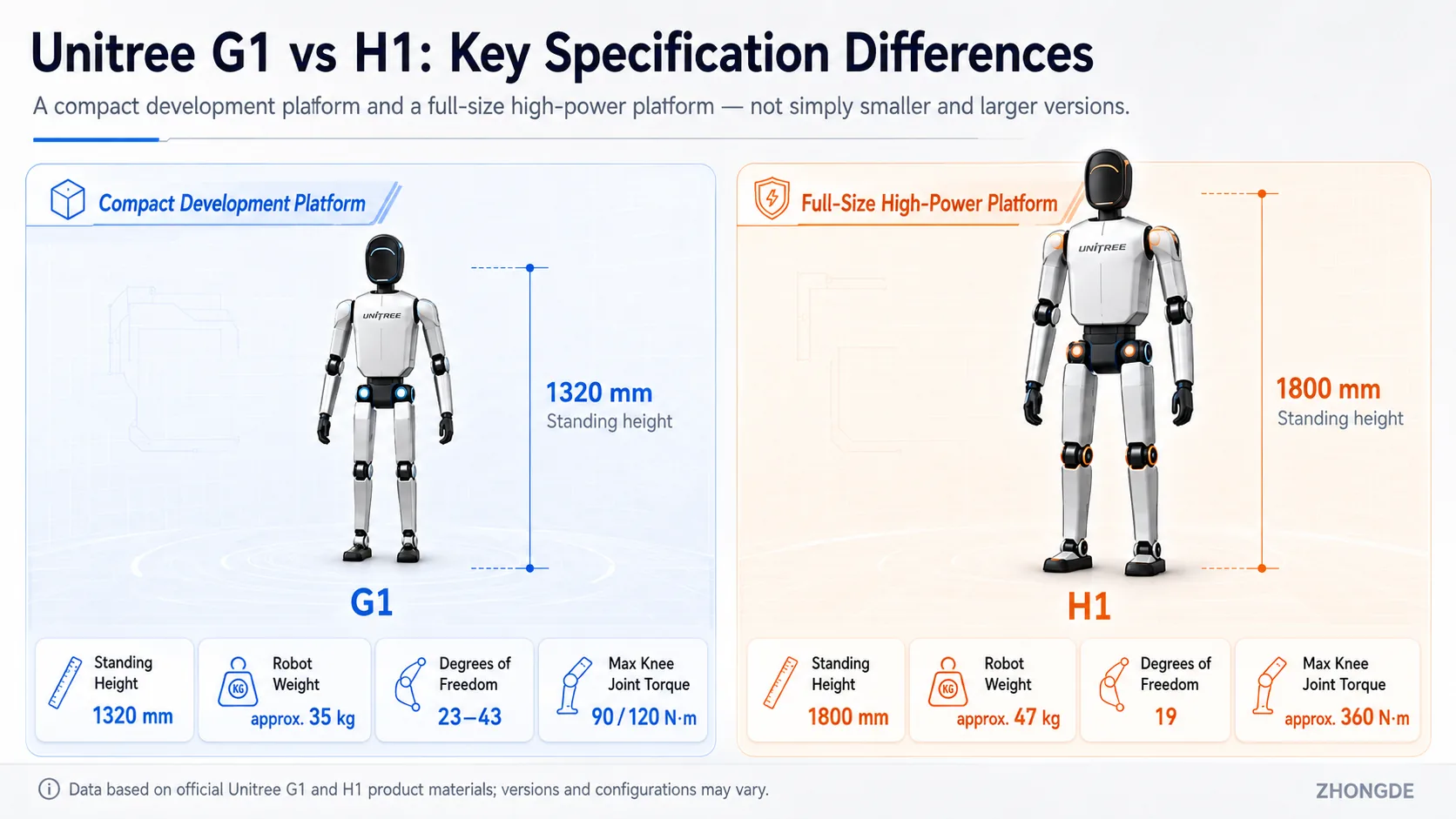
G1 and H1 represent two different Unitree product positions:
| Item | G1 / G1 EDU | H1 | H1-2 |
|---|---|---|---|
| Platform scale | Compact humanoid | Full-size humanoid | Enhanced full-size humanoid |
| Standing height | 1320 mm | About 1800 mm | About 1780 mm |
| Weight | About 35 kg | About 47 kg | About 70 kg |
| Total DOF | 23 / 23–43 | 19 | 27 |
| DOF per leg | 6 | 5 | 6 |
| DOF per arm | 5 | 4, expandable | 7 |
| Maximum knee torque | 90 / 120 N·m | About 360 N·m | About 360 N·m |
| Main emphasis | Compact, open, dexterous expansion | Speed, torque and full-size dynamics | More complete arms and ankles |
| Typical direction | Research, education, embodied AI and indoor manipulation | Full-size locomotion and dynamic handling | Industrial manipulation and whole-body control |
The useful question is not which specification is larger:
G1 reduces size, mass and development burden; H1 supplies the power, speed and impact capacity required by a full-size biped.
1. G1 and H1 Are Not Simple Size Variants
G1 packages 23 to 43 controlled axes, dual encoders, full-joint hollow electrical routing, local air cooling, depth sensing, 3D LiDAR, a quick-release battery and optional compute, wrists and dexterous hands into a robot weighing about 35 kg. Its central engineering challenge is functional density in a compact volume.
H1 is designed around a body approximately 180 cm tall and high-dynamic locomotion. Longer legs and a higher center of mass increase joint moment, landing impact and overturning load. Its architecture therefore places greater emphasis on high-torque joints, high-capacity output bearings, lightweight full-size structure, running stability, battery energy and structural survival during falls and impacts.
Even when the two platforms use related motor, encoder and bearing technologies, their housings, reducer interfaces, output flanges and frames cannot be scaled linearly.
2. What Size and Weight Mean in Practice
G1: 1320 mm and About 35 kg
G1 measures 1320 × 450 × 200 mm standing and approximately 690 × 450 × 300 mm folded. Its compact scale makes transport, storage, laboratory deployment, fall protection and maintenance easier. It also lowers test-space and floor-load requirements.
The trade-off is tighter packaging. Harness routing, cooling, assembly sequence, service access and tolerance accumulation all become more difficult when many functions share a small envelope.
H1: About 1800 mm and About 47 kg
H1 uses roughly 400 mm thigh and 400 mm calf lengths, bringing its workspace closer to a human adult. It is more representative for human-scale facilities and stride lengths, but it also introduces greater center-of-mass travel, joint bending moment, landing impact, braking demand and structural fatigue.
A weight of about 47 kg at this scale indicates aggressive light-weighting. Thin-wall housings, high-strength aluminum, compact bearings and optimized frames must work together without losing joint alignment or fatigue life.
3. Why 23–43 DOF and 19 DOF Are Not Directly Comparable
G1 Configurations
The base G1 has 23 DOF:
- six per leg;
- one at the waist;
- five per arm.
G1 EDU can expand to 43 DOF by adding waist axes, wrist axes and dexterous hands. The optional Dex3-1 three-finger hand has seven active DOF, and two additional wrist DOF can also be configured.
H1 Configurations
The base H1 has 19 DOF:
- five per leg;
- four per arm;
- one at the waist.
H1-2 increases this to 27 DOF with six per leg and seven per arm, together with more complete waist and upper-body motion.
DOF Is Only One Layer of Capability
| Parameter | Practical effect |
|---|---|
| Joint range | Determines crouching, turning, reach and collision avoidance |
| Continuous and peak torque | Determines payload, acceleration and impact margin |
| Speed | Determines cycle time and dynamic mobility |
| Backlash and friction | Determine position control, force control and backdrivability |
| End effector | Determines grasping, sensing and object interaction |
| Control access | Determines whether developers can actually use the axes |
G1’s higher configurations favor dexterous manipulation and embodied-AI development. The base H1 uses fewer axes but delivers much greater joint power and whole-body dynamics.
4. Joint Torque Is the Clearest Engineering Difference
Unitree notes that different joints use different motor sizes and that the published maximum is the largest joint motor in the machine.
G1
| Version | Maximum knee torque | Maximum arm load |
|---|---|---|
| G1 | 90 N·m | About 2 kg |
| G1 EDU | 120 N·m | About 3 kg |
H1
| Joint | Maximum torque |
|---|---|
| Knee | About 360 N·m |
| Hip | About 220 N·m |
| Ankle | About 59 N·m |
| Arm | About 75 N·m |
H1-2 retains approximately 360 N·m maximum leg torque, while shoulder and elbow torque are about 120 N·m and the two-DOF ankle is listed at about 75 × 2 N·m.
Moving from 120 to 360 N·m is not a matter of tripling wall thickness. Engineers must recalculate output-bearing loads, bearing span, pilot and bolt-circle load distribution, local housing deformation, reducer alignment, flange torsional stiffness, impact fatigue, thermal paths and the mass penalty of the larger actuator.
5. Speed and Dynamic Mobility
H1 publishes a moving speed of 3.3 m/s and potential mobility above 5 m/s. Its priorities clearly include fast walking, running, jumping and high-dynamic balance.
G1 emphasizes compact agile motion, folding, sitting, imitation learning and reinforcement learning. In most laboratories and indoor manipulation tasks, top speed matters less than controllability, development access and repeatable data.
High-speed bipedal motion magnifies production variation in left-right mass, friction, backlash, output zero, ankle-axis alignment, frame geometry and bolt preload. For H1-class platforms, production quality must control not only individual dimensions but also bilateral and assembly-level parameter matching.
6. Shared Joint Architecture
Official information for both G1 and H1 identifies several common directions:
- low-inertia, high-speed internal-rotor permanent-magnet synchronous motors;
- industrial crossed-roller output bearings;
- compact high-precision, high-load joint construction;
- 3D LiDAR and depth-camera perception;
- quick-replaceable batteries;
- continuing OTA updates.
G1 additionally specifies dual encoders, full-joint hollow electrical routing and local air cooling.
This suggests a platform approach in motors, encoders, bearings, controls and development tools, followed by different joint sizes for different robot scales. Suppliers can reuse manufacturing and quality methods, but not all component dimensions.
7. Where G1 Fits Better
G1 is closer to a deployable embodied-AI development platform.
Typical directions include:
- university and laboratory research;
- imitation and reinforcement learning;
- teleoperation and data collection;
- multimodal perception and interaction;
- dexterous grasping and object manipulation;
- indoor service and inspection validation;
- small-space motion planning;
- education and competitions.
The lower mass reduces facility cost, manual handling difficulty, fall damage and test energy. It still has powerful joints and requires controlled operation, adequate clearance and fall protection.
8. Where H1 and H1-2 Fit Better
H1 provides an adult-scale powered biped for:
- high-speed walking and running;
- complex-terrain locomotion and dynamic balance;
- human-scale workspace validation;
- handling trials in automotive and logistics environments;
- high-inertia whole-body control;
- high-power actuator and thermal studies;
- fall, impact and recovery research.
H1-2 adds seven-DOF arms, two-DOF ankles and a more capable waist. Its rated single-arm load is about 7 kg and peak load about 21 kg, expanding industrial manipulation research. The increase to about 70 kg also shows the cost of additional DOF, payload and structure in mass, energy and safety requirements.
9. Manufacturing Challenges in G1-Class Compact Joints
| Component or interface | Critical CTQs |
|---|---|
| Joint housing | Thin-wall distortion, bearing-seat coaxiality, thermal path and mass |
| Hollow shaft | Wall thickness, coaxiality, harness clearance and torsional stiffness |
| Output flange | Runout, bolt-circle position and flatness |
| Motor housing | Stator fit, bearing seats and air-gap consistency |
| Encoder datum | Face, centering, zero reference and thermal drift |
| Harness passage | Burrs, edges, bend radius and assembly access |
| Dexterous-hand interface | Small datums, repeatability and quick-change alignment |
In compact products, a fraction of a millimeter can affect wiring, cooling or assembly. Drawing review therefore needs to consider assembly order and service access in addition to dimensional tolerance.
10. Manufacturing Challenges in H1-Class High-Torque Joints
| Component or interface | Critical CTQs |
|---|---|
| Knee housing | High-torque stiffness, bearing span, fatigue and fall impact |
| Hip housing | Multi-axis load, pilot coaxiality and frame-interface stiffness |
| Ankle structure | Coupled axes, foot datum, impact and sealing |
| Output flange | Torsional stiffness, runout, bolt preload and contact pressure |
| Frame connector | Datum spacing, overturning load and anti-loosening |
| Motor/reducer seat | Thermal deformation, coaxiality, lubrication and life |
| Left/right parts | Mass, center of gravity, friction and assembly matching |
A dimensionally acceptable part does not guarantee an acceptable actuator. Assembly validation should cover no-load friction, backlash, torsional stiffness, temperature rise, encoder consistency, zero repeatability, noise, vibration and performance after load cycling.
11. Engineering Selection Matrix
| Requirement | More favorable to G1 | More favorable to H1 / H1-2 |
|---|---|---|
| Limited laboratory space | Yes | No |
| Frequent transport and maintenance | Yes | No |
| Visual-language embodied-AI development | Yes | Possible, but higher burden |
| Dexterous hand and indoor manipulation | G1 EDU | H1-2 for heavier loads |
| Human-scale workspace | Partial | Yes |
| High-speed running and large-inertia balance | Limited | Yes |
| Industrial handling and higher payload | Light-duty validation | H1-2 |
| Lower fall-loss exposure | Better | Stronger protection required |
| Highest joint torque | No | Yes |
| Cost and deployment sensitivity | Better | Higher |
The task should be converted into measurable requirements before selection: object mass, reach, walking speed, floor conditions, daily runtime, fall risk, data rate, low-level control access, tactile-hand requirements, maintenance resources and spare-parts strategy.
12. Implications for Humanoid Component Suppliers
G1 and H1 show why a supplier should not quote every part under one generic category of “humanoid joint component.” At minimum, components should be divided into:
- small wrist, hand and end-effector joints;
- medium shoulder, elbow and waist joints;
- high-torque hip and knee joints;
- two-DOF ankle structures;
- frames and connector blocks;
- encoder, sensor and brake interfaces.
Each group requires a different material, blank, machine, fixture and inspection strategy.
G1-class programs emphasize compact complex geometry, rapid revision, thin walls, lightweighting, hollow routing, assembly access and stable transition from prototype to low volume. H1-class programs emphasize torque, impact, large thin-wall stiffness, bearing preload, reducer life, bilateral matching, high-load end-of-line testing and lifecycle traceability.
The highest-value manufacturing capability is the ability to translate torque, backlash, heat, life and control requirements into CTQs, tolerance chains and a stable production-control plan.
13. RFQ and Technical Review Inputs
| Category | Required information |
|---|---|
| Robot | Height, weight, center of gravity, DOF and target task |
| Joint | Position, continuous torque, peak torque, speed and impact |
| Transmission | Reducer type, ratio, backlash, lubrication and life |
| Support | Bearing type, preload, span, radial and overturning loads |
| Motor | Stator fit, rotor, air gap, insulation and thermal path |
| Structure | Material, mass target, wall thickness, datums and finish |
| Harness | Hollow diameter, bend radius, motion range and abrasion control |
| Calibration | Encoder datum, zero, torque sensing and software parameters |
| Quality | CTQs, tolerance stack-up, gaging, capability and traceability |
| Volume | Concept, engineering build, pilot, ramp and annual demand |
| Test | Backlash, friction, stiffness, temperature, noise and life cycle |
| Service | Module replacement, recalibration, spares and version compatibility |
Frequently Asked Questions
Is Unitree G1 or H1 better for embodied-AI development?
G1 EDU is usually the more practical choice for algorithm validation, secondary development, data collection, indoor manipulation and a lower deployment burden. H1 or H1-2 is more representative when the research requires full-size locomotion, high-speed dynamics, larger inertia or industrial-scale loads. SDK access, compute, end effectors and the safety environment must still be confirmed.
Does the higher DOF count make G1 more flexible than H1?
Not automatically. The 23 to 43 DOF available on G1 cover different waist, wrist and dexterous-hand configurations, while the base H1 has 19 DOF and H1-2 has 27. DOF only counts controlled axes. Practical flexibility also depends on range of motion, speed, torque, interference, controls and task load.
Why is H1 knee torque much higher than G1 knee torque?
H1 is a roughly 180 cm full-size platform with longer legs, greater inertia, faster dynamic motion and higher landing loads. Its knee, hip and ankle structures therefore need more peak torque and stiffness. G1 is smaller and lighter, allowing lower torque, actuator mass, energy use and fall energy.
Can G1 and H1 joint parts be shared?
Motor technology, encoders, crossed-roller output bearings and hollow-routing principles can be platformized, but housing size, bearing span, reducer interfaces, output flanges, thermal paths and fastening levels cannot be shared directly. High-torque H1 joints require greater stiffness, fatigue life and impact margin.
What information does a supplier need to evaluate a G1- or H1-class joint project?
The supplier needs joint position, continuous and peak torque, speed, impact cases, reducer and bearing interfaces, material, mass target, harness space, thermal path, surface treatment, calibration datums, production phase and CTQs. A 3D model alone is not sufficient to define a production process.