In This Article
Direct Answer
Five distinct engineering routes are emerging:
| Route | Representative | Primary goal | Manufacturing characteristics |
|---|---|---|---|
| General autonomy and scale | Tesla Optimus | General bipedal work | Bespoke motors, gears, actuator validation and production-system co-development |
| High-torque modularity | Unitree G1/H1 | Dynamic performance and developer access | Modular joints, dual encoders, hollow routing and local cooling |
| AI and volume design | Figure 03 | Whole-body autonomy for home and business | Structural redesign, tooled forming and vertically integrated digital manufacturing |
| Industrial strength and service | Boston Dynamics Atlas | Industrial material handling | Repeated subassemblies, identical limbs and no cables across joints |
| Home safety and compliance | 1X NEO | Long-term operation around people | Tendon drive, soft body, low noise and pinch protection |
Humanoids are not industrial arms mounted on legs. Their architecture balances power density, distal mass, compliance, wiring, calibration, cost and manufacturing volume.
1. Why Height, DoF and Maximum Torque Are Not Enough
Public comparisons often list height, weight, degrees of freedom, maximum torque, speed, runtime, payload and price. These do not reveal the production architecture.
The same advertised joint torque could come from an internal-rotor motor and low ratio, frameless torque motor and harmonic reducer, planetary or cycloidal transmission, remote belt, tendon or quasi-direct drive.
Manufacturing difficulty is defined by continuous thermal output, peak duration, overturning load, changing backlash and friction, harness architecture, post-service calibration and the transition from CNC prototypes to production processes.
2. Overall Public-Technology Comparison
This article uses publicly verifiable information available through August 2026. Undisclosed gear geometry, bearing preload, material grade and tolerance chains are not inferred from videos.
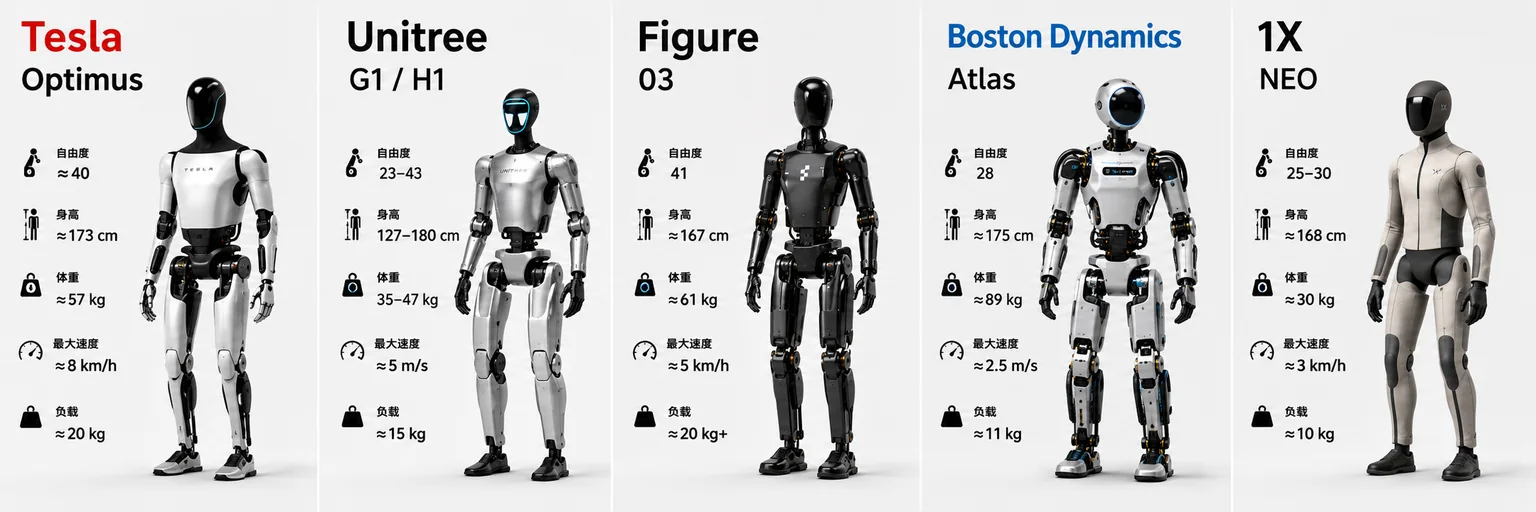
| Item | Tesla Optimus | Unitree G1/H1 | Figure 03 | Atlas | 1X NEO |
|---|---|---|---|---|---|
| Main use | General tasks and material handling | Research, education, dynamics and platform development | General home and commercial work | Industrial material handling | Home service |
| Actuation tendency | Bespoke motor-gear actuators | High-torque modular joints | Electric whole-body system redesigned for scale | Industrial electric joints | Tendon drive |
| Structural focus | Performance, AI and scale | Compactness, low mass and open interfaces | Lower mass, soft covers and tooled forming | Commonality, symmetry and continuous rotation | Soft body, pinch protection and quietness |
| Routing focus | Not fully disclosed | Hollow internal routing and dual encoders | Sensor and hand redesign for AI | No cables across joints | Tendons integrated with flexible structure |
| Manufacturing focus | Actuator and production equipment developed together | Standard joints and rapid iteration | BotQ, digital systems and vertical integration | Repeated modules and field service | Vertical motor, tendon, hand and soft-body production |
3. Tesla Optimus: Bespoke Actuators and Scale
Tesla defines Optimus as a general-purpose autonomous biped for unsafe, repetitive or boring work. It requires balance, navigation, perception, planning, control and physical interaction.
Tesla stated in its Q2 2026 update that first-generation Optimus production lines were being installed in preparation for production in 2026.
The relevant manufacturing signal is the transition from prototypes into actuator validation, bespoke robot motors, geartrains, electrical-mechanical integration, dynamometers, motor calibration, automated assembly, end-of-line testing and serialized traceability.
| System | Co-design requirement |
|---|---|
| Motor | Torque constant, speed, inertia, winding, insulation and heat |
| Geartrain | Ratio, efficiency, lost motion, lubrication and life |
| Output support | Bearing span, overturning moment and impact |
| Sensors | Motor-side, output-side, torque and temperature |
| Brake and safety | Power-off holding and abnormal states |
| Housing | Coaxiality, thermal path, sealing and thin-wall stiffness |
| Production | Press fits, preload, fastener torque, test and calibration |
| Data | Parts, assembly, curves and software revision |
Tesla has not publicly disclosed a complete current joint BOM, so external appearance should not be treated as proof of a specific reducer or bearing architecture.
4. Unitree G1/H1: Modular Joints and Torque Density
Unitree publishes relatively clear mechanical parameters.
H1 is approximately 180 cm and 47 kg, with a published maximum joint torque of about 360 N·m, peak torque density of about 189 N·m/kg and movement speed of about 3.3 m/s. Its thigh and calf are each about 400 mm.
H1-2 publishes about 360 N·m maximum leg-joint torque and about 120 N·m maximum arm-joint torque.
G1 is approximately 1320 mm and 35 kg with 23 to 43 joint motors by configuration. Public features include dual encoders, hollow routing through joints, local air cooling, quick-change battery support and secondary development.
Manufacturing lessons:
- use several joint sizes rather than one universal actuator;
- standardize encoders and routing;
- control distal mass;
- keep simulation and physical parameters aligned;
- combine platform commonality with axis-specific duty design.
5. Figure 03: Whole-Body AI Meets High-Volume Design
Figure 03 publishes a height of about 5 feet 8 inches, mass of about 61 kg, payload of about 20 kg, runtime of about five hours and speed of about 1.2 m/s.
It was redesigned around Helix, including its perception and hands. Helix 02 extends control into continuous whole-body walking, balance and manipulation.
At BotQ, Figure publicly described moving selected long-cycle CNC structures toward:
- injection molding;
- diecasting;
- metal injection molding;
- stamping;
- dedicated tooling and automation.
This does not eliminate CNC. It changes its role from machining entire structures to precision interfaces, tooling, fixtures and localized finishing.
| Prototype | Production |
|---|---|
| Extensive whole-part CNC | Near-net-shape forming plus finishing |
| General fixtures | Dedicated molds, gauges and automation |
| Part inspection | Process capability and online inspection |
| Manual assembly | Error-proofing and automated fastening |
| Drawing revision | MES, PLM, ERP and WMS integration |
By April 2026, Figure reported more than 350 Figure 03 units delivered from BotQ and a production-rate improvement from one robot per day to one per hour.
6. Boston Dynamics Atlas: Industrial Commonality and Infinite Rotation
Electric Atlas targets real industrial applications rather than using human joint limits as the design boundary.
Boston Dynamics publicly described:
- repeated subassemblies;
- identical left and right arms;
- identical left and right legs;
- repeated shoulder and pelvis structures;
- infinitely rotating actuators;
- elimination of cables across joints;
- validation in real customer applications.
Cross-joint harnesses create rotation limits, torsional fatigue, rubbing, connector failures, sensor reaction forces and different bilateral variants.
Atlas publicly confirms the no-cross-joint-cable goal, but not every internal power and communication detail.
Commonality reduces parts, fixtures, spares and service training, although it should not force oversized actuators into low-load joints.
7. 1X NEO: Tendon Drive and a Soft Home Robot
NEO is designed for homes rather than heavy industrial material handling.
Its public hardware route includes:
- 1X Tendon Drive;
- custom 3D lattice polymer over the body;
- externally covered pinch-proof joints;
- soft knit suit and shoes;
- low-energy and low-noise motion;
- 22-DoF hands;
- mass of about 29.94 kg;
- published carrying capability of about 24.95 kg;
- noise around 22 dB.
Tendon drive can move motors toward the torso or proximal link, reducing distal mass and allowing compliant motion.
Its production risks include tendon stretch, fatigue, creep, routing friction, pulley wear, pretension, anchoring, calibration and service after tendon replacement.
1X describes vertical production of motors, tendons, hands and soft structures. Its NEO factory reported manufacturing approximately 17,000 motors.
8. Understanding the Five Actuator Routes
| Route | Representative tendency | Advantage | Main risk |
|---|---|---|---|
| Bespoke motor-gear actuator | Optimus | Joint-specific optimization | High development and validation investment |
| High-torque modular joint | G1/H1 | Fast development and unified interfaces | Excessive commonality adds mass |
| Electric actuation redesigned for scale | Figure 03 | AI, hardware and manufacturing aligned | High tooling and design-freeze cost |
| Infinite-rotation industrial joint | Atlas | Large range and fewer harness failures | More local electrical integration |
| Tendon drive | NEO | Low distal mass, compliance and quietness | Friction, pretension, routing and life |
The correct route depends on work environment, continuous load, human contact, dynamic motion, backdrivability, service model and annual volume.
9. Transmission Tradeoffs
| Transmission | Power density | Backlash | Backdrivability | Impact | Manufacturing focus |
|---|---|---|---|---|---|
| Harmonic | High | Low but life-dependent | Low to medium | Flexspline validation | Pilots, coaxiality and flexspline life |
| Planetary | High | Stage accumulation | Medium | Good capacity | Gears, bearings, lubrication and noise |
| Cycloidal | High | Potentially low | Low to medium | Good impact resistance | Eccentricity, pins and vibration |
| Quasi-direct drive | Medium-high | Low | Good | Responsive | Large motor, heat and current |
| Remote belt | Medium | Tension-dependent | Good | Some compliance | Tension, tracking and guarding |
| Tendon | Layout-dependent | Stretch/friction dependent | Compliant | Human-contact friendly | Material, pretension, path and life |
Different body regions may use different transmissions.
10. Structural Materials and Process Divergence
Industrial humanoids prioritize stiff aluminum and steel interfaces, bearing support, impact covers, replaceable modules and stable tolerance chains.
Home humanoids prioritize lightweight skeletons, soft covers, low pinch risk, quietness and cleanable surfaces.
High-volume products prioritize injection molding, diecasting, MIM, stamping, mold life, automated assembly and online inspection.
Development platforms prioritize CNC iteration, modular joints, removable structures, open interfaces and simulation consistency.
11. CNC Moves Toward Critical Interfaces
High-volume forming can replace full CNC on large covers and ordinary brackets, but precision machining remains central for:
- reducer housings and pilots;
- bearing seats;
- output flanges;
- motor housings and stator interfaces;
- encoder mounts;
- torque-sensor interfaces;
- precision hollow shafts;
- mechanical stops;
- mold inserts and slides;
- assembly, press-fit and calibration fixtures.
A capable supplier must add blank design, CTQ review, tolerance-stack analysis, assembly-state inspection, automation, SPC/CPK, cleanliness and traceability.
12. Harness Architecture Is Mechanical Architecture
Unitree demonstrates hollow routing. Atlas publicly emphasizes eliminating cables across joints. NEO integrates tendons, signals and flexible covers.
Hollow routing cleans the exterior but weakens shaft section and creates bend-radius, connector-density, EMC and thermal challenges.
Removing cross-joint cables shifts design into local electronics and rotating transmission interfaces.
Tendon systems make routing itself part of transmission accuracy and life.
Routing must be frozen during joint architecture design, not added after housing completion.
13. Whole-Body AI Changes Mechanical Requirements
Figure Helix 02 connects vision, walking, balance and manipulation in continuous whole-body control. Tesla also publicly emphasizes perception, planning, balance and physical interaction.
AI requires mechanics with predictable friction, stable lost motion, traceable encoder zero, bilateral consistency, measurable temperature, calibrated elastic deflection, machine-readable actuator parameters and rapid model recovery after module replacement.
AI cannot compensate for bearing binding, pinched harnesses, permanent deformation, random loosening or nonrepeatable friction.
14. Five Safety Philosophies
| Robot | Safety emphasis |
|---|---|
| Optimus | Perception, planning, control and actuator validation |
| Unitree | Motion control, joint states and developer constraints |
| Figure 03 | Soft goods, multidensity foam and home/commercial use |
| Atlas | Industrial reliability and hardware-failure reduction |
| NEO | Tendon compliance, soft body, pinch protection and quietness |
Safety means keeping stiffness in load paths while limiting collision force, protecting contact surfaces, monitoring torque, defining power-loss behavior and validating falls and recovery.
15. Prototype-to-Volume Process Transition
| Stage | Typical quantity | Process tendency |
|---|---|---|
| Concept prototype | 1-10 | CNC, additive manufacturing and manual assembly |
| Engineering validation | 10-100 | Stable blanks, dedicated fixtures and end-of-line tests |
| Pilot production | 100-1,000 | Diecasting/molding introduction, semi-automation and SPC |
| Volume production | Thousands to tens of thousands | Tooled forming, automated tests and MES traceability |
| Mass product | Tens of thousands and above | High commonality, automation and tiered supply chain |
Production maturity reduces part count, standardizes interfaces, error-proofs assembly, automates calibration, links data to serial numbers and preserves model compatibility through design changes.
16. Matching Routes to Applications
| Application | Priority characteristics |
|---|---|
| Automotive material handling | Atlas-like strength, commonality and service |
| General manufacturing/logistics | Optimus-like autonomy and actuator-production co-development |
| Research and education | Unitree-like modularity and open interfaces |
| General home service | Figure-like AI and volume design or NEO-like compliance |
| Close human collaboration | Low collision energy, torque sensing and soft covers |
| Dynamic running and jumping | High power density, low distal mass and impact resistance |
| Consumer scale | Tooled forming, automation, low noise and reliable service |
17. CTQs for Humanoid Suppliers
| Component | Key CTQs |
|---|---|
| Actuator housing | Bearing-seat coaxiality, pilot, face, wall and thermal path |
| Output flange | Flatness, runout, position and bolt circle |
| Motor housing | Stator fit, bearing seat, air gap and heat transfer |
| Hollow shaft | Coaxiality, wall, torsion and cable space |
| Skeleton | Datum length, axes, stiffness and mass |
| Tendon pulley/guide | Groove, surface, coaxiality and wear |
| Sensor interface | Flatness, preload, center and thermal drift |
| Mold/fixture | Repeat location, life, venting, distortion and service |
| Assembled module | Lost motion, friction, stiffness, heat and calibration repeatability |
18. Evidence of Real Manufacturing Maturity
Look beyond demonstration videos:
- continuous runtime and accumulated cycles;
- customer-site operation;
- disclosed production equipment and inspection;
- module replacement and repair;
- process transition at volume;
- serialized testing and calibration;
- safety and abnormal-state definitions;
- linkage between software models and mechanical parameters.
By 2026, Figure had disclosed BMW deployment and BotQ ramp, Atlas had begun customer-oriented deployment, Tesla disclosed production-line installation, 1X disclosed NEO factory operations and motor manufacturing, and Unitree continued publishing product and developer documentation.
19. Lessons for Precision Manufacturers
Do not wait passively for complete drawings. Early customers need manufacturability review, blank/process recommendations, bearing-seat and pilot tolerance stacks, thin-wall control, prototype-to-production conversion, inspection/calibration fixtures and commonality review.
Prototype programs often contain many drawings with only one or two pieces each. Long-term value begins when the customer moves toward joint platforms, shared parts, stable batches, automated clamping, formed blanks, end-of-line tests and serialized production.
High-volume humanoids combine molding, diecasting, MIM, stamping, CNC finishing, surface treatment, assembly and inspection. A single isolated CNC operation is more vulnerable during cost reduction than an integrated manufacturing capability.
20. RFQ and Engineering Review Information
| Category | Required information |
|---|---|
| Application | Factory, home, logistics, research or collaboration |
| Robot | Height, mass, DoF, center of gravity and workspace |
| Joint | Continuous/peak torque, speed, impact and backdrivability |
| Actuator | Motor, reducer, bearing, brake and sensors |
| Structure | Material, interface, datums, mass and covers |
| Harness | Power, data, encoders, bending and twist |
| Safety | Collision, power loss, fall, pinch and thermal states |
| Volume | Prototype, pilot, annual demand and ramp plan |
| Process | CNC, diecasting, molding, MIM, stamping and finishing |
| Quality | CTQ, stack-up, CPK, end-of-line test and traceability |
| Calibration | Zero, axes, load, temperature and software parameters |
| Service | Module replacement, spares and revision compatibility |
Frequently Asked Questions
Which humanoid robot technology route is the best?
There is no best route without a task. Atlas emphasizes industrial strength, commonality and serviceability; Figure 03 emphasizes whole-body AI and high-volume design; NEO emphasizes home safety and compliance; Unitree emphasizes torque density, modularity and developer access; Optimus emphasizes general autonomy, bespoke actuators and manufacturing scale.
Why can different humanoid robots not use one identical joint module everywhere?
Hip, knee, ankle, shoulder, elbow and finger joints have different continuous torque, peak torque, speed, impact, backlash, packaging, thermal and compliance requirements. Excessive commonality adds distal mass, energy use or insufficient performance, so modules should only be shared across similar duty cycles.
Does humanoid precision machining disappear when Figure uses molding and diecasting?
No. Molding, diecasting, metal injection molding and stamping suit high-volume covers, brackets and near-net-shape parts, while bearing seats, reducer pilots, output flanges, sensor datums, sealing faces and critical assembly interfaces still require precision finishing or highly accurate tooling.
What is the main difference between tendon drive and integrated joint actuators?
An integrated actuator concentrates the motor, reducer and bearings near the joint, giving direct modeling and fast response but adding local mass and size. Tendon drive can move motors toward the torso or proximal link and improve compliance, but adds friction, stretch, pretension, routing and life-control challenges.
What information should a supplier request first for a humanoid project?
The supplier needs the robot task, joint degrees of freedom, continuous and peak loads, speed, impact cases, structural interfaces, materials, mass target, production phase, calibration method and CTQs. A 3D model and isolated part tolerances are not enough to select a production process correctly.