In This Article
Engineering answer
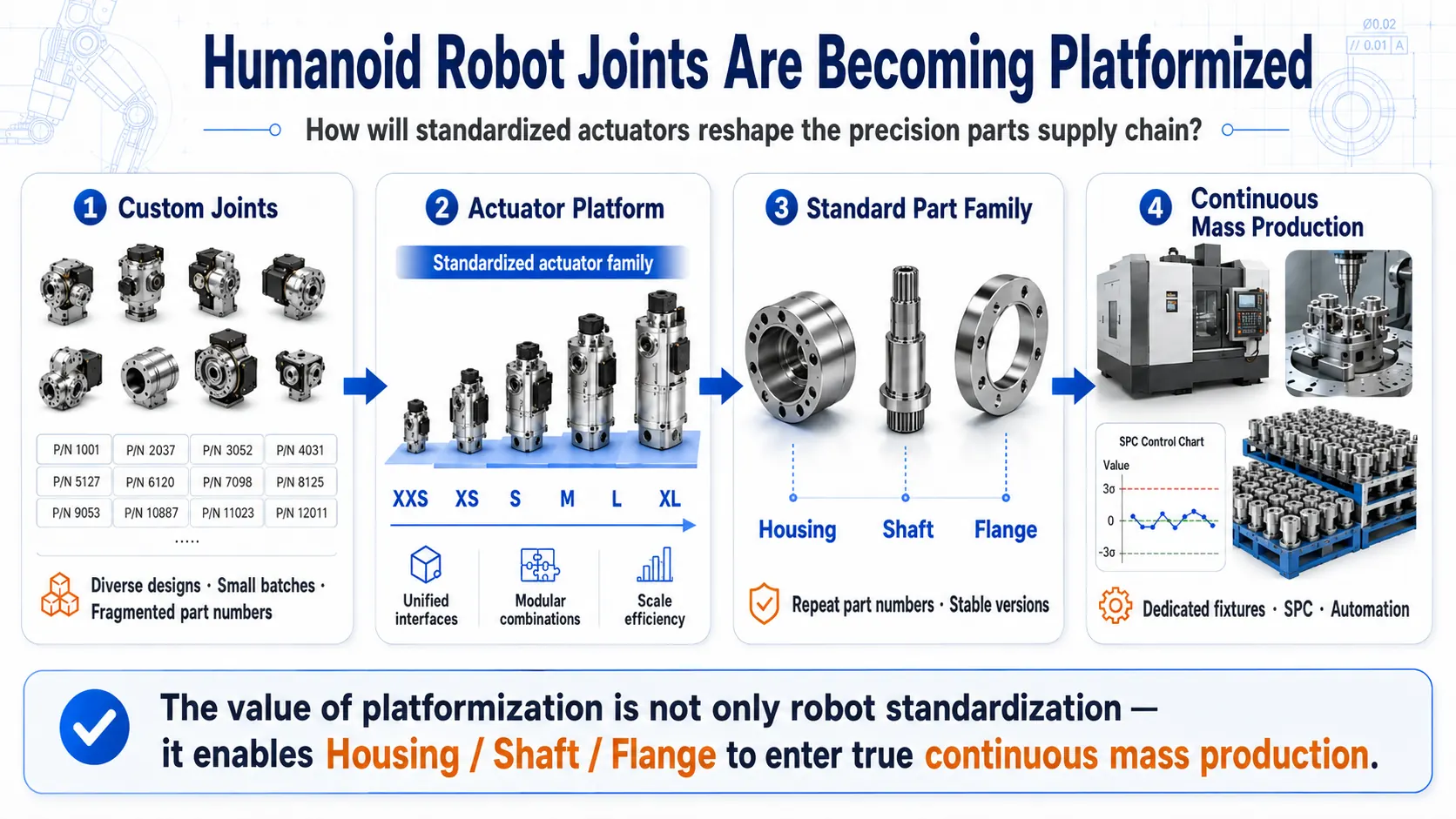
A change is emerging in the humanoid robot supply chain that matters more to a machining supplier than the question of which robot brand will win: joint actuators are beginning to move from project-specific designs toward platform products.
In the earlier model, a new humanoid often led to new shoulder, elbow, hip, knee and ankle packaging. Outside diameter, actuator length, reducer, motor, encoder, bearings, housing and cable interfaces could all change with the robot. For a machine shop, the workflow looked familiar:
new robot program
→ new joint design
→ new drawing
→ new fixture
→ new program
→ small prototype lot
→ another revision
The main problem is not necessarily part difficulty. It is that the same part number often does not run for long enough to absorb setup and engineering cost.
In 2026, the signal began to look different. Schaeffler publicly presented a multi-size rotary actuator platform from XXS to XL, stating that the family is intended to cover roughly 80% of market demand. The company also disclosed about 30 prototype orders, five contracts and a plan to begin series SOP in Q2 2026 with further ramp-ups later in the year.
The design logic is therefore shifting from:
redesign the joint for every robot
toward:
build an actuator family first, then select the appropriate platform size for each joint and robot.
For precision manufacturers, that matters because housings, shafts, flanges and bearing supports can begin to behave like platform part numbers with repeat orders and longer production lives, rather than one-off prototype drawings.
The key qualification, however, is important: platformization is not the same as universal standardization.
1. What signal is Schaeffler sending?
Schaeffler highlighted its humanoid actuator platform as a “New Growth” initiative in its Q1 2026 Factbook. Four points stand out from a manufacturing perspective.
| Public signal | Disclosed position | Supply-chain meaning |
|---|---|---|
| Multi-size family | Rotary actuator platform from XXS to XL | A product family rather than one single-purpose actuator |
| Broad coverage | Schaeffler says the sizes cover about 80% of market demand | Architecture intended for reuse across many joints and customers |
| Commercial engagement | About 30 prototype orders and five contracts | Beyond internal R&D into customer validation and contracted programs |
| Series ramp | First series SOP planned for Q2 2026, with Q3/Q4 ramp-ups | The supply chain must begin solving cycle time and consistency, not only prototype feasibility |
The 2026 Hermes Award platform also illustrates what “modular” means technically. Schaeffler combines efficient motors, integrated power electronics and high-precision encoders with either two-stage planetary or strain-wave gearing depending on the requirement. The platform therefore is not simply one actuator scaled up and down; it is a common architecture that supports different performance configurations.
Schaeffler has separately published a 60–250 Nm torque range for a planetary actuator intended for humanoid joints. That helps explain why high-load shoulders, hips and knees need several performance classes, but it does not establish a one-to-one mapping between XXS, XS, S, M, L and XL and specific torque values.
A conceptual ladder such as:
10 Nm
30 Nm
60 Nm
120 Nm
250 Nm
is therefore useful for thinking about how product families may emerge, but it should not be presented as an established Schaeffler or industry standard.
2. What does actuator platformization actually mean?
There are at least four levels of platformization.
| Level | What is platformized | Must everything be identical? |
|---|---|---|
| Performance family | Torque, speed, power, diameter and length fall into defined classes | No |
| Architecture family | Motor, reducer, bearings, encoder and control arrangement are reused | Largely reusable |
| Interface family | Pilots, flanges, wiring, power, communication and sensor interfaces converge | Partially standardized |
| Part-number family | Housings, shafts and flanges repeat across multiple programs | Depends on platform strategy |
For a machining supplier, the fourth level creates the economic change.
The real transformation is not that “robotics now has one standard connector.” It is that:
the same controlled mechanical part number can begin appearing in multiple joint locations, robot generations or OEM programs.
Once reuse reaches that level, manufacturing economics change.
3. Why were humanoid precision parts difficult to industrialize before?
Early humanoid development behaves more like advanced equipment R&D than a mature product business.
Engineering teams first need to:
- achieve the required torque;
- reduce mass;
- fit the actuator into a tight envelope;
- build the next prototype quickly;
- modify the design after gait, temperature and impact testing.
A machining supplier therefore often sees a sequence such as:
Rev.A  20 pcs
↓
hole pattern changed
↓
Rev.B  50 pcs
↓
wall thickness reduced
↓
Rev.C  100 pcs
↓
reducer changed
↓
housing redesigned again
That is normal for development, but poor economics for CNC production.
Machining becomes most efficient after the process is stable enough to copy repeatedly:
fixed stock
+ fixed fixtures
+ fixed tooling
+ fixed NC program
+ fixed inspection
+ long uninterrupted runs
Platformization is valuable because it moves the industry from repeatedly redesigning parts toward repeatedly producing validated parts.
4. What changes for the actuator housing?
The housing is often the clearest mechanical carrier of the actuator platform.
It may locate or support:
- the motor stator;
- reducer pilots and faces;
- input and output bearings;
- encoder datums;
- the robot-link interface;
- sealing and cable passages;
- thermal and lightweight structures.
In a project-specific model, a change in joint packaging often triggers a new housing.
In a platform model, a family can instead develop around size classes:
XXS housing family
XS housing family
S housing family
M housing family
L housing family
XL housing family
Within one class, localized hole patterns, connectors or software parameters can adapt the same base design to different robots.
The most important manufacturing change is not that one housing immediately becomes a million-piece order. It is that the part number can live much longer.
If an M-size housing is reused for a shoulder axis, another robot generation, an adjacent joint with similar duty, or even several OEM customers buying the same platform, cumulative annual demand can become far more stable than isolated prototype lots.
5. Why do shafts and flanges benefit as well?
Once the actuator platform is stable, the internal rotating chain tends to stabilize too.
A typical mechanical chain is:
motor rotor
→ input shaft / hollow shaft
→ reducer
→ output shaft
→ output flange
→ robot link
These shafts and flanges carry features such as:
- bearing fits;
- reducer interfaces;
- torque-transfer geometry;
- encoder references;
- output faces and pilots;
- bolt and dowel patterns.
If every robot is redesigned, these remain high-mix, low-volume precision parts.
If the actuator platform is reused, suppliers can build a different production system:
| Item | Project production | Platform production |
|---|---|---|
| Stock | Purchased for each job | Standardized and framework-purchased |
| Fixtures | Reworked for each revision | Reused with preventive maintenance |
| Tooling | Selected project by project | Fixed tool lists and life databases |
| NC programs | Optimized once | Continuously optimized around takt time |
| Inspection | Strong focus on first articles | Fixed CMM programs and SPC |
| Revisions | Frequent engineering change | Controlled ECN/ECR transition |
| Cost | Engineering cost is a large share | Engineering cost is amortized over volume |
That is the direct manufacturing consequence of platformization.
6. Platformization does not freeze every mechanical feature
The trend should not be over-interpreted.
Robot OEMs will continue to customize around:
- complete robot packaging;
- load paths at shoulders, hips and knees;
- required angular travel;
- hollow cable routing;
- thermal architecture;
- brakes and functional safety;
- sealing and environmental protection;
- sensor locations;
- cost and lifetime targets.
The likely industrial pattern is therefore a high level of common platform content plus localized customer-specific interfaces, not one identical joint across the global market.
For a precision-parts supplier, the useful question becomes:
Which features are platform CTQs, and which features belong to a controlled customer-variable zone?
7. Platform CTQs matter more than one-off extreme accuracy
As an actuator moves from prototype to series production, the customer’s question changes.
At prototype stage:
Can you make it?
At production stage:
Can you keep making it after 10,000 pieces?
Typical platform-part CTQs
| Part | Platform CTQs | Consequence of drift |
|---|---|---|
| Housing | Bearing-axis relationship, reducer pilot, mounting faces, free-state thin-wall geometry | Friction, noise, bearing side load, assembly difficulty |
| Hollow shaft | Bearing fits, runout, wall thickness, coaxiality | Encoder error, vibration, shortened life |
| Output shaft | Spline/tooth form, bearing journal, face geometry, torque interface | Backlash, wear, output runout |
| Output flange | Pilot, bolt pattern, face runout, flatness | Robot-link pose error and assembly shift |
| Bearing support | Fit, roundness, cylindricity, shoulder squareness | Incorrect preload, heat and early failure |
| Encoder interface | Datum face, axial gap, radial eccentricity | Zero shift and control error |
The main danger in platform production is not one obvious reject. It is a process center that slowly drifts without detection.
That makes SPC, tool-life control, fixture condition and measurement-system stability core manufacturing capabilities rather than secondary quality activities.
8. The supplier model shifts from quoting drawings to industrializing a platform
A conventional machining job may follow:
drawing received
→ quote
→ prototype
→ inspection
→ shipment
A platform program looks more like:
concept
→ DFM
→ prototype
→ DV validation
→ design freeze
→ tooling freeze
→ PV / pilot build
→ SOP
→ capacity ramp
→ continuous cost reduction
The later a supplier enters, the more likely it is to compete only on price for a frozen drawing.
A supplier that participates early can influence higher-value manufacturing questions:
- billet, forging, extrusion or die-cast blank selection;
- features that should be completed in one setup;
- stock allowances for critical fits;
- thin-wall fixturing strategy;
- anodizing compensation;
- alignment of CMM datums with functional datums;
- CTQs that should enter SPC;
- cycle-time reduction after volume ramp.
That is the boundary between a machining vendor and a manufacturing-engineering supplier.
9. The biggest economic improvement is lower changeover cost
Part cutting time is only part of machining cost.
The hidden cost is often:
programming
+ tool preparation
+ fixture preparation
+ setup
+ first-article approval
+ measurement programming
+ engineering communication
+ revision changeover
If one machine runs five different part numbers in a day, each requiring setup and first-article confirmation, spindle utilization can look acceptable while overall engineering efficiency remains poor.
If platform production turns the same part number into longer runs:
100 pcs
→ 500 pcs
→ 2,000 pcs
→ 10,000 pcs
then it becomes rational to invest in:
- dedicated fixtures;
- multi-station workholding;
- automated loading;
- in-process measurement;
- tool-life prediction;
- poka-yoke;
- automated cleaning;
- dedicated gauging.
This is why platformization can matter even more to a machining supplier than headline robot shipment growth.
10. Robot volume is multiplied by joint count
A humanoid is not a single-axis product. One robot contains many actuators.
Schaeffler has stated that a humanoid may require roughly 25 to 30 actuators on average. Actual counts vary by degree of freedom and architecture, but the scale illustrates an important point:
robot volume is not actuator volume.
For illustration only:
| Annual robot volume | Actuators per robot | Implied actuator volume |
|---|---|---|
| 1,000 | 25 | 25,000 |
| 10,000 | 25 | 250,000 |
| 50,000 | 25 | 1,250,000 |
This is not a forecast for any company; it simply shows the multiplication effect.
A more concrete signal is Schaeffler’s 2026 long-term supply arrangement with Humanoid, in which actuator deliveries were expected to reach a seven-digit unit count over the agreement period. If contracts of that scale execute, the production model for housings, shafts and flanges will be fundamentally different from the prototype phase.
11. Which precision parts are most likely to become platform production first?
Not every robot structural part will standardize at the same speed.
From a manufacturing standpoint, the parts most likely to stabilize first are the mechanical elements inside the actuator and at its boundary interfaces.
| Priority | Part | Why it is likely to platformize |
|---|---|---|
| High | Actuator housing | Directly tied to motor, bearing and reducer architecture |
| High | Output flange | Output interface can be organized around size classes |
| High | Hollow/input shaft | Closely linked to bearing, motor and encoder tolerance chains |
| High | Bearing support | Reusable after bearing sizes and architecture freeze |
| Medium-high | Reducer locating ring/seat | Tied to the reducer platform |
| Medium | Motor bracket | Depends on motor family and thermal design |
| Medium | Encoder mount | Becomes reusable after sensing architecture freezes |
| Lower | External link and cosmetic shell | More sensitive to robot geometry and industrial design |
For a precision-machining supplier seeking repeat volume, the best target is therefore not simply “any metal part on a robot.” It is:
a part strongly tied to the actuator platform, with slow revision cycles and high repetition per robot.
12. What production data should suppliers build from the prototype phase?
Platformization does not automatically create a qualified supplier. Manufacturers must build process knowledge before SOP.
| Phase | Data to establish |
|---|---|
| Prototype | Actual datums, difficult features, distortion locations, measurement method |
| Engineering lot | CTQ capability, tool-change effect, fixture repeatability, post-finish dimensional shift |
| Design freeze | Fixed process route, control plan, gauge/CMM program, revision baseline |
| Pilot production | Cycle time, yield, tool life, machine capability, failure modes |
| SOP | SPC, lot traceability, preventive maintenance, capacity and delivery control |
| Ramp-up | Automation, bottleneck removal, yield improvement, continuous cost reduction |
For a platform part, a beautiful one-time full inspection report is less valuable than proof that:
process capability remains stable over repeated lots.
13. What should a supplier ask during RFQ?
When a customer describes a program as a “standard actuator platform,” a supplier should ask for more than a 2D drawing.
| RFQ question | Why it matters |
|---|---|
| Which actuator size/class does the part belong to? | Identifies whether it is a long-life platform part number |
| How many joints or robot models reuse it? | Reveals true cumulative demand |
| What is the annual demand and ramp plan? | Determines fixture, machine and automation investment |
| Is the program at EVT, DVT, PVT or SOP? | Shows design maturity |
| Which characteristics are platform CTQs? | Focuses machining and inspection resources |
| Is there a customer-variable zone? | Prevents mixed revisions and variant errors |
| Is final acceptance before or after surface treatment? | Prevents fit disputes |
| Are PPAP, SPC, Cpk or similar records required? | Allows quality planning before ramp |
| How are ECNs cut in? | Prevents old/new revision mixing |
| Is there a long-term cost-down target? | Guides automation and process strategy |
These questions help distinguish a prototype that is still changing from a platform that is genuinely preparing for long-term production.
14. The real opportunity is not “robotics hype”; it is part-number stability
A large robotics market does not automatically create profitable work for every machine shop.
If the order pattern remains:
100 drawings
× 1–20 pieces each
then changeovers, engineering communication and quality risk can consume much of the margin.
The production model that fits precision machining better is:
a limited set of critical part numbers
× stable revisions
× long product life
× repeated demand
Actuator platformization is changing exactly this condition.
From a manufacturing perspective, the key benefit of a platform joint is not that it sounds more advanced. It is that it can move the supply chain from a project business toward a product business.
Conclusion: for humanoids to become industrial products, joints must become products first
Humanoids cannot scale from hundreds or thousands of units to industrial volumes while every robot and every joint remains a new engineering project.
A more scalable path is:
joint requirement definition
↓
a limited number of performance classes
↓
actuator family
↓
reused architecture and interfaces
↓
stable mechanical part numbers
↓
series manufacturing and automation
↓
continuous cost reduction
Schaeffler’s XXS-to-XL rotary actuator platform, together with disclosed prototype orders, contracts and series-production plans, shows that this transition is moving from concept toward industrialization.
For robot OEMs, platformization can shorten development cycles and reduce BOM and validation cost.
For precision manufacturers, the implication is more concrete:
a joint housing, shaft or flange can stop being “one drawing for this prototype” and become a platform part produced repeatedly for years.
The right preparation is therefore not simply adding more machines after robot volumes rise. It is building CTQ control, reusable fixturing, measurement systems, traceability and engineering-change discipline before platform volumes arrive.
FAQ
Does actuator platformization mean different robot brands will eventually use exactly the same joint?
No. Platformization first means converging on a limited number of size, torque and interface classes while reusing motor, gearbox, sensing, control and mechanical architectures. OEMs may still customize envelopes, cable routing, mounting interfaces, software and thermal design, so the trend is closer to product families and modular reuse than one universal joint standard.
Why can platformization make housings, shafts and output flanges better candidates for continuous production?
When one actuator size is reused across several joint positions, robot models or customer programs, the life and cumulative demand of its mechanical part numbers increase. Suppliers can then stabilize stock, cutters, fixtures, inspection programs and machining parameters instead of repeatedly changing over and revalidating short prototype lots.
Has Schaeffler shown that humanoid actuators are entering series production?
In its Q1 2026 Factbook, Schaeffler disclosed about 30 prototype orders and five contracts and planned first series SOP for Q2 2026 with further ramp-ups in Q3 and Q4. This shows that platformized actuators are moving beyond a product concept into commercialization and industrialization, although the wider market is still in an early phase with multiple customers and architectures being validated in parallel.
What becomes more important for precision-machining suppliers after platformization?
Single-part precision remains essential, but long-term competitiveness shifts toward production consistency. Suppliers must demonstrate process capability on critical dimensions, fixture and tool-life control, free-state inspection, dimensional closure after surface treatment, revision traceability, fast abnormal-response systems and ongoing cost reduction.
Will 10 Nm, 30 Nm, 60 Nm, 120 Nm and 250 Nm become universal industry standards?
There is not enough evidence to say that today. Those values are useful as an illustrative product ladder, but they should not be treated as established industry standards. Schaeffler’s public material confirms a multi-size rotary actuator platform from XXS to XL and says it can cover about 80% of market demand; actual torque and size boundaries will continue to depend on robot mass, joint duty, gear ratio, speed and thermal limits.