In This Article
Direct Answer
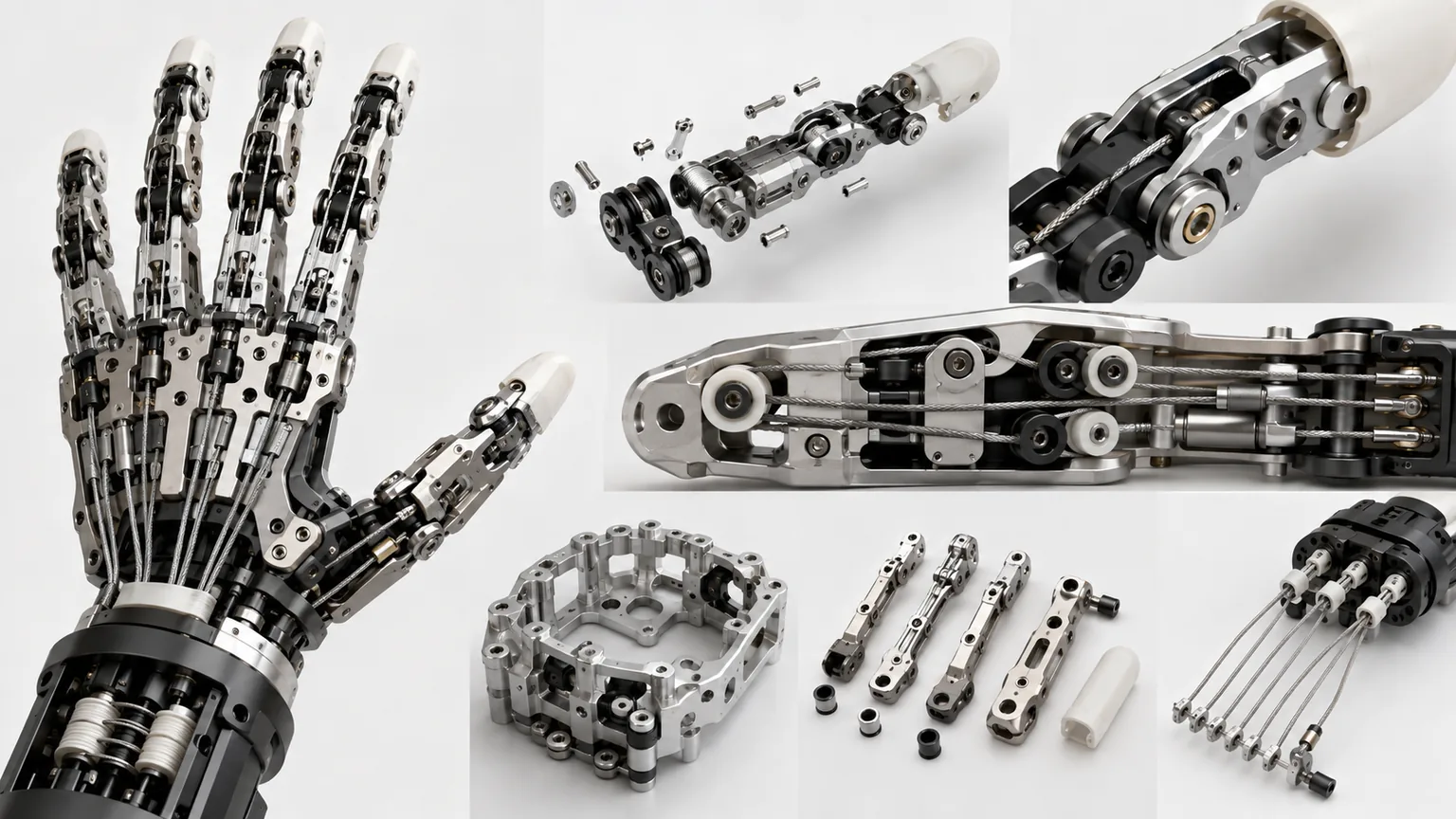
The humanoid hand combines four systems:
- Structural skeleton: maintains the palm, finger links and joint centers;
- Transmission platform: supports motors, reducers, linkages, pulleys, tendons and springs;
- Sensing carrier: integrates joint position, tendon tension, fingertip force and distributed touch;
- Contact interface: interacts with objects through fingertips, pads and palm.
The manufacturing goal is not merely a human-like appearance. Motion, friction, compliance, touch and service condition must remain predictable.
| Module | Function | Manufacturing focus |
|---|---|---|
| Palm frame | Connect wrist, thumb and four fingers | Datums, stiffness, packaging and cables |
| Thumb base | Opposition, abduction and rotation | Multi-axis geometry and workspace |
| Finger links | Proximal, middle and distal segments | Low mass, joint centers and stiffness |
| Pins and joints | Low-friction articulation | Coaxiality, clearance, finish and wear |
| Tendon / linkage | Transfer actuator motion | Routing, pretension, friction and backlash |
| Fingertip / skin | Force, contact and slip sensing | Mounting, coverage, wiring and calibration |
1. Why a Hand Is Harder to Industrialize Than a Normal Joint Module
A dexterous hand compresses many joints into a small envelope. The palm must contain:
- actuators or remote transmission interfaces;
- pulleys, capstans, differentials and tensioners;
- position, tension, force and tactile sensors;
- power, communication and flexible circuits;
- mechanical stops and overload protection;
- replaceable fingertips and skins.
A small hole-position error, shim variation or tendon rub can accumulate across several joints and appear as fingertip error, high friction or failed grasping.
2. Select Architecture from the Task
| Architecture | Advantage | Main risk | Typical direction |
|---|---|---|---|
| Direct multi-joint drive | Direct control and clear model | Many actuators, mass and volume | High-performance research |
| Coupled linkage | Stable motion relationship and efficiency | Geometry changes trajectory | Repeated grasps and coordinated motion |
| Tendon drive | Moves actuators into palm/forearm | Friction, stretch and service | Lightweight dexterous hands |
| Underactuated hand | Few actuators adapt to objects | Joint state is not fully controlled | General-purpose grasping |
| Compliant / soft hand | Safe, adaptive and impact tolerant | Precision and life are harder | Human interaction and fragile objects |
| Hybrid structure | Rigid skeleton plus compliant contact | Interface and calibration complexity | Practical general-purpose hands |
Degrees of freedom, actuator count and independently controllable joints are different quantities. Coupling, differentials and underactuation can drive many joints with fewer actuators, but manufacturing variation and friction have a greater effect on actual motion.
3. Separate Structural DoF, Active DoF and Transmission
Dexterous-hand discussions often mix together “many joints,” “many motors” and “complex transmission.” Engineering review should separate three dimensions:
- Structural degrees of freedom: mechanically movable joints;
- Active degrees of freedom: independently driven and controlled inputs;
- Transmission: how actuator force or motion reaches each joint, such as tendons, linkages, screws, gears or hydraulics.
High structural DoF does not imply high active DoF. An underactuated hand can have many moving joints but fewer actuators, using differentials, springs or object contact to distribute motion. A nearly fully actuated hand provides greater independent motion but increases mass, heat, wiring, control and service burden.
| Actuation philosophy | Typical characteristic | Manufacturing and production focus |
|---|---|---|
| Tendon underactuation | Few actuators drive many joints and conform to objects | Tension distribution, friction, stretch, backlash and recalibration |
| Near-full actuation | Strong independent motion and tool manipulation | Miniature actuators, thermal design, harnesses and assembly density |
| Hybrid actuation | Base joints or thumb active, distal joints passive | Active/passive trajectory matching and mechanical stops |
| Task-specific hand | Three-finger, gripper or dedicated end effector | Reliability, takt time and task boundary |
| High-power-density actuation | High output and fast response | Sealing, piping, valves, leakage and maintenance complexity |
Transmission and actuation philosophy are independent choices. A hybrid hand may use tendons, linkages, screws or gears. A specification should identify which joints are active, coupled or passive, and how they are calibrated and serviced.
| Transmission | Main advantage | Main manufacturing risk |
|---|---|---|
| Tendon / cable | Light fingers and remote actuator placement | Friction, stretch, winding radius, pretension and rubbing |
| Linkage | High stiffness and repeatability | Part count, joint clearance and trajectory variation |
| Screw / linear drive | High force and direct input-output relation | Wear, heat, contamination and backdrivability |
| Gear | High torque, stiffness and clear control model | Backlash, noise, lubrication, sealing and finger volume |
4. Use Springs and Elastomers to Define Joint Flexion and Extension Order
When one tendon pulls several finger joints, the joints do not automatically bend in the desired order. The sequence depends on friction, moment arms, spring stiffness, skin resistance and object contact. A traditional single flexion tendon with spring return may also have insufficient extension force.
A useful design approach is to create the sequence through joint elasticity:
- assign different spring stiffness to different joints;
- change attachment location and effective moment arm of one spring;
- use tension springs for extension;
- use compression springs to supplement or replace tension springs;
- use the compliant skin as both surface material and restoring element;
- independently control the MCP joint while PIP and DIP joints follow a designed ratio.
For example, a lower equivalent restoring stiffness at a distal joint can make it flex earlier. Changing attachment spacing can modify the effective joint behavior without changing the spring material.
This moves “natural bending” partly from software into mechanical design, but creates new CTQs:
| CTQ | Control content |
|---|---|
| Spring stiffness | Material, wire, coils, free length and lot variation |
| Attachment location | Hole, groove, moment arm and bilateral mirror accuracy |
| Pretension | Reference posture, assembly length and tension fixture |
| Joint friction | Pins, bushings, lateral clearance, lubrication and skin compression |
| Elastomer behavior | Thickness, hardness, temperature, aging and bonding |
| Flexion sequence | Joint angle-time relation under free and contact conditions |
| Extension capability | Residual flexion, return time and repeatability |
A correct unloaded flexion sequence does not prove grasp performance. The hand must still conform after contact, generate sufficient force and return fully after release.
5. Human-Contact Hands Need “Touch Quality” in the Engineering Specification
A hand for part handling and a hand for handshaking, care, service or remote touch have different success criteria. A human-contact hand may require:
- skin-like warmth;
- a soft continuous surface without hard spots;
- enough grip to feel held without discomfort;
- natural and predictable finger motion;
- heating, compliant material, transmission and sensing within a human-hand envelope.
A research prototype used a silicone cord heater for warmth, urethane gel for softness and servo-driven high-strength fiber lines to reproduce grip and finger motion. These exact materials are not universal solutions, but they show that skin, temperature and motion cannot be late-stage add-ons.
A general-purpose humanoid also needs to handle uncertain object shape, friction and position. Precision position control alone is insufficient; compliant mechanics, tactile feedback and material technology work together to create stable contact.
| Human-contact need | Engineering metric |
|---|---|
| Warmth | Surface temperature, warm-up time, uniformity and overtemperature protection |
| Softness | Hardness, compression curve, rebound, hysteresis and aging |
| Safe grip | Maximum force, pressure distribution, pinch points and power-loss state |
| Natural motion | Flexion order, smooth speed, noise and bilateral consistency |
| Tactile feedback | Coverage, minimum detectable force, spatial resolution and drift |
| Human-size envelope | Complete volume of frame, heater, sensors, tendons, skin and harness |
| Serviceability | Replaceable skin, heater, sensor and tendon modules |
A compliant skin can perform several functions: contact surface, skeleton protection, friction, tactile transfer and joint restoring force through local thickness or hardness. The more functions one material carries, the more important lot control, bonding, temperature, fatigue and post-service calibration become.
6. The Palm Frame Is the Master Datum
The palm must provide:
- wrist-flange stiffness;
- geometric relationship of the thumb and four finger bases;
- mounting for actuators, pulleys, electronics and harnesses;
- support for palm tactile skin;
- rapid service access;
- inspectability after impact.
Common routes include monolithic CNC palms, upper/lower shells, plate frames, metal skeletons with polymer covers and additively manufactured routing structures.
| Palm CTQ | Failure effect | Control |
|---|---|---|
| Wrist face and center | Whole-hand pose and eccentric load | Common datum, face and pilot inspection |
| Finger-base spacing | Finger parallelism and grasp envelope | Position and paired inspection |
| Thumb-base orientation | Opposition and pinch error | Multi-axis angle and datum transfer |
| Pulley/capstan bores | Tendon rub and length change | Coaxiality, face and rotational resistance |
| Cable channels | Pinch, bend and interference | Full-range cable check |
| Shell interface | Assembly distortion and skin unevenness | Flatness, location and torque |
7. Thumb Opposition Defines Useful Workspace
The thumb needs more than flexion; it requires abduction, rotation and opposition.
Engineering questions include:
- how many thumb-base freedoms are necessary;
- whether axes intersect, are offset or are linkage-coupled;
- whether the fingertip can reach the index, middle finger and palm;
- whether the thumb base interferes with actuators, cables or covers;
- whether power grasp and precision pinch share the same path;
- whether impact is handled by compliance or a mechanical stop.
Kinematic simulation shows theoretical reach, but the full-hand model must also check physical links, skin, wires and fasteners.
8. Balancing Finger-Link Mass and Stiffness
Finger mass is distal and increases inertia and actuator load. Common solutions include:
- thin-wall aluminum links;
- titanium or steel pins and inserts;
- engineering-polymer or printed links;
- CFRP sheet or tube reinforcement;
- rigid skeletons with compliant pads and skin.
| Feature | Purpose | Manufacturing risk |
|---|---|---|
| Thin-wall box section | Efficient bending/torsion stiffness | Distortion and wall variation |
| Open skeleton | Low mass and cable access | Weak lateral impact resistance |
| Local metal insert | Durable bores and threads | Looseness, eccentricity and mixed materials |
| Replaceable fingertip | Serviceable tactile module | Reassembly and sealing variation |
| Compliant skin | Friction and safety | Interference, hysteresis and aging |
Finger links require side-impact, tip-load, repeated-flexion and tendon-load validation, not only static strength.
9. Pins, Bores and Lateral Clearance Control Motion Stability
Small hand joints are highly sensitive to friction and clearance.
Control:
- bore coaxiality and center distance;
- pin straightness, roundness and surface;
- bushings, miniature bearings or sliding fits;
- parallel side plates;
- shims and thrust features;
- axial play and lateral wobble;
- free rotation after tightening.
Too little clearance creates binding and heat; too much increases fingertip backlash and tactile-position error. Production criteria should combine dimensions, rotational resistance and assembled functional testing.
10. Tendon Drive Must Remain Consistent Over Life
Tendon systems reduce finger mass but change with use.
Error sources include:
- tendon stretch and creep;
- pulley-groove radius and finish;
- friction in guides and sheaths;
- changing effective capstan radius with winding layers;
- tensioner and spring variation;
- assembly-length difference;
- skin and harness resistance.
| Control item | Recommended method |
|---|---|
| Tendon length | Define reference posture and measurement tension |
| Pretension | Use fixture or tension sensing |
| Pulley alignment | Inspect groove center, face and wear |
| Capstan | Control effective radius and winding layers |
| Friction | Measure unloaded input-output difference |
| Service | Define replacement and recalibration |
| Traceability | Record material lot, length and pretension |
Replacing a tendon requires more than restoring nominal length. Joint zero, fingertip position and grasp force must be checked again.
11. Coupled Linkages and Underactuation Reduce Complexity
Four-bar linkages, differentials and motion synergies can coordinate multiple joints with fewer actuators.
Benefits include:
- fewer actuators and electrical interfaces;
- passive adaptation during grasping;
- lower palm volume and cost;
- finger trajectories matched to common motions.
Coupled mechanisms are sensitive to link length, hole centers, joint clearance and stops. Production should use:
- trajectory fixtures or vision measurement;
- multi-pose joint-angle inspection;
- fingertip position and orientation comparison;
- finger-to-finger and left-right coordination;
- loaded trajectory testing.
12. Compliance Must Absorb Impact and Remain Understandable to Control
Compliance can be implemented through springs, elastomers, flexures, series elasticity or variable stiffness.
Benefits:
- lower collision peak load;
- adaptation to object shape;
- less dependence on perfect positioning;
- protection of gears, bearings and tactile sensors.
It also introduces:
- hysteresis and nonlinearity;
- temperature and aging effects;
- indirect joint-angle estimation;
- pose-dependent grasp stiffness;
- variation across fingers and hands.
Compliant elements need batch identification, stiffness curves, preload, orientation and life revalidation rather than only a nominal hardness value.
13. Integrating Tactile Sensors and Compliant Skin
Touch may cover fingertips, pads, finger sides and palm.
| Region | Main use | Structural interface |
|---|---|---|
| Fingertip | Fine contact, slip and small objects | Replaceable module and protected edge |
| Finger pad | Enveloping grasp and pressure distribution | Compliant skin, cable and bond |
| Finger side | Narrow spaces and side contact | Thin package and wear resistance |
| Palm | Large-object support and contact recognition | Large-area coverage and zoned calibration |
| Fingernail side | Bracing and narrow contact | Rigid boundary and sensor protection |
Screws, sharp skeleton edges and harnesses must not create local hard spots. After skin installation, recheck zero, sensitivity, spatial location and cross-influence.
14. Joint Sensing and Tendon-State Estimation
Small fingers cannot always carry a precise encoder at every joint. Options include:
- direct joint encoders;
- motor encoders with a transmission model;
- tendon displacement and tension sensing;
- vision or external motion capture;
- multi-sensor state estimation.
Motor position is not actual joint position when tendon stretch, compliance and contact loads exist. Full-hand calibration should connect:
Motor/tendon state → joint angles → fingertip pose → contact state
and confirm that the model remains valid across temperature, load, tendon age and service condition.
15. Materials and Manufacturing Routes
| Area | Typical material/route | Main concern |
|---|---|---|
| Palm frame | CNC aluminum, magnesium or metal AM | Stiffness, mass and internal packaging |
| Finger links | Aluminum, titanium, polymer or CFRP | Distal mass and impact |
| Pins/bushings | Stainless, alloy steel or titanium | Wear, straightness and mass |
| Pulleys/capstans | Aluminum, steel or engineering polymer | Groove, friction and life |
| Tendons | High-strength fiber, wire or composite transmission | Stretch, bending life and friction |
| Fingertip skin | Silicone, polyurethane or flexible composite | Friction, wear and tactile transfer |
| Sensor support | Precision polymer, thin metal or flex circuit | Location, protection and service |
Additive manufacturing is useful for early motion validation, but production may redistribute parts among machining, molding and assembly based on wear, stability, appearance, takt time and supply.
16. From Prototype to Production
- 01Define TasksObjects, payload, speed, contact regions and service.
- 02Select ArchitectureDirect, linkage, tendon, underactuated or compliant.
- 03Motion and InterferenceThumb opposition, fingertip workspace and physical envelope.
- 04Engineering PrototypeFriction, backlash, pretension, touch and cables.
- 05Full-Hand CalibrationActuator, joint, fingertip and tactile relationships.
- 06Life and CollisionTendons, pins, skins, fingertips and service cycles.
- 07Freeze ProductionDatums, fixtures, pretension, torque, inspection and traceability.
17. Information Required for RFQ and Engineering Review
| Information | Recommended content |
|---|---|
| Task | Object, mass, size, surface and manipulation |
| Motion | Freedom, ranges, speed and fingertip workspace |
| Transmission | Motor location, linkage, tendon, reduction and pretension |
| Structure | Wrist flange, palm, thumb and finger bases |
| Sensors | Position, tension, force, touch and temperature |
| Material/finish | Links, pins, pulleys, skin and lubrication |
| Mass target | Hand mass, finger mass, center and inertia |
| Validation | Force, backlash, life, collision and environment |
| Service | Tendon, fingertip, skin and sensor replacement |
| Traceability | Part lots, assembly, calibration and life records |
Frequently Asked Questions
Is more freedom always better for a humanoid dexterous hand?
No. More freedom can expand capability, but it also increases actuators, bearings, sensors, harnesses, tolerance chains, control and maintenance complexity. Production design should select the freedom required by the task and use coupling, underactuation or motion synergies to remove unnecessary complexity.
Why does a tendon-driven hand develop position error?
Tendon stretch, sheath compression, pulley eccentricity, friction, pretension change, winding-radius variation and joint backlash all separate input displacement from finger-joint angle. Tendon length, pretension, routing, friction and full-hand calibration must be controlled together.
Why can a finger bind when every finger-link dimension passes inspection?
Multi-joint fingers are sensitive to bore coaxiality, pin straightness, lateral clearance, shim thickness, surface finish, tendon rubbing and skin interference. Passing individual dimensions does not prove that the assembled joint chain has acceptable friction and alignment.
What is most important before humanoid-hand production?
Validate thumb opposition and grasp workspace, fingertip repeatability, joint backlash, tendon or linkage life, grasp force, collision compliance, tactile sensing, thermal effects, bilateral consistency, cable life and the ability to recalibrate after service.