In This Article
“Robot dog” is the name most people recognize first. In engineering, the more precise term is quadruped robot.
Unlike wheeled robots, a quadruped robot does not rely on continuous rolling contact with the ground. Instead, it repeatedly cycles through:
lift → swing → land → support → push → lift again
for each leg.
That may sound like only a different way of moving, but from a manufacturing standpoint, it changes the engineering problem completely. Every step introduces a new load cycle into the leg joints, bearings, output shafts, links, and foot structure.
A quadruped leg should therefore not be understood simply as a set of CNC parts assembled together. A better way to understand it is:
It is a dynamic tolerance chain that continuously experiences changing direction, impact, and fatigue loading.
Why are quadruped robots suitable for complex environments?
Wheeled robots are highly efficient on flat surfaces. But when the environment includes:
stairs, trenches, gravel, pipes, steps, slopes, mud, and discontinuous terrain
mobility becomes much more difficult.
A quadruped robot can independently control the position of each foot. It does not need a fully continuous path; it only needs a suitable foothold for each step.
| Mobility Type | Ground Requirement |
|---|---|
| Wheeled robot | Relatively continuous rollable path |
| Tracked robot | Can handle rougher terrain, with trade-offs in turning and efficiency |
| Quadruped robot | Can actively select individual footholds |
This is why quadruped robots are especially suitable for:
industrial inspection, energy facilities, mining, firefighting, emergency response, and challenging outdoor environments.
What is inside one robot dog leg?
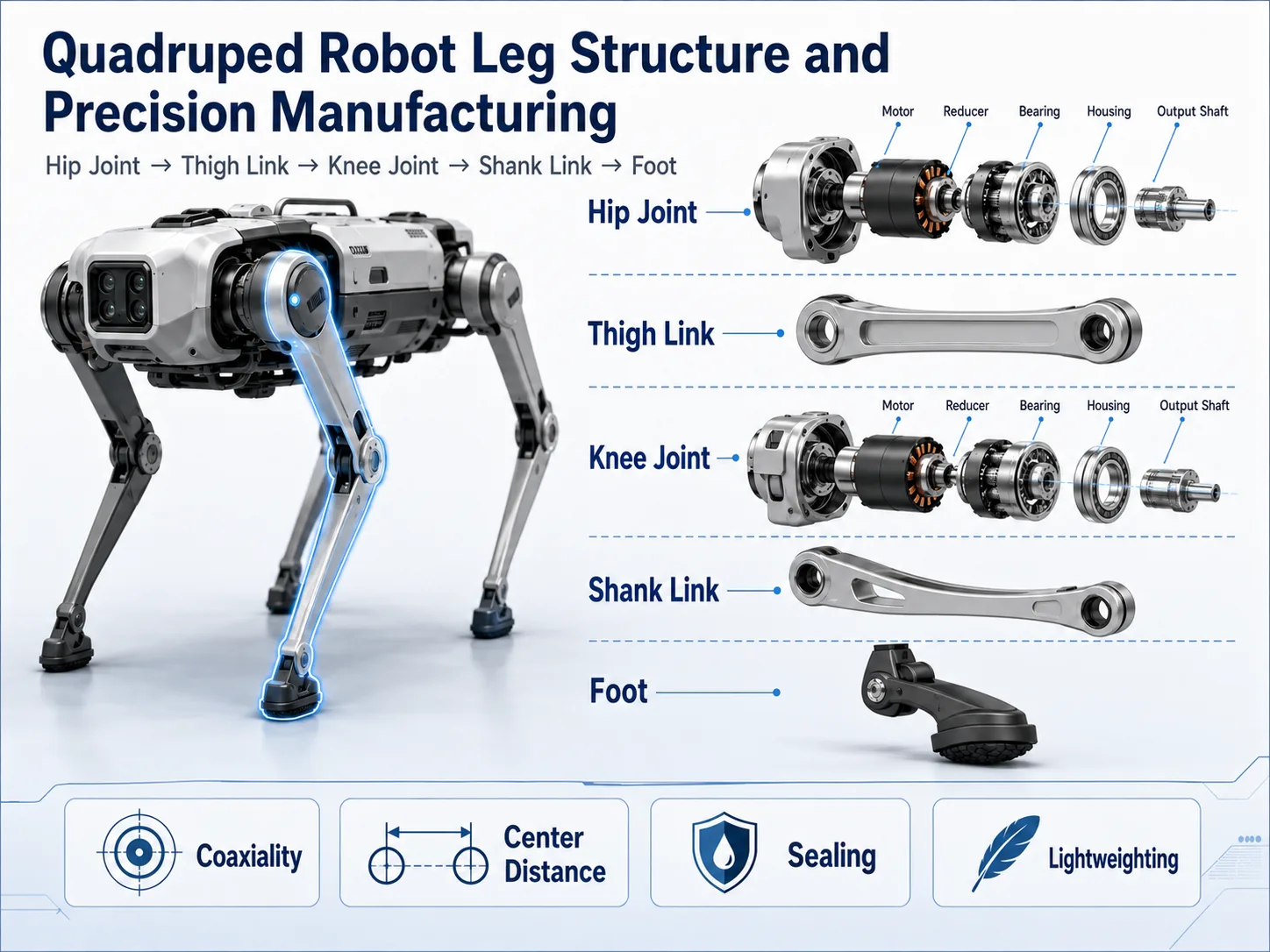
A typical electrically driven quadruped leg can be understood as:
Hip → Thigh → Knee → Shank → Foot
From the actuator viewpoint, that often expands to:
hip lateral joint → hip swing joint → thigh link → knee joint → shank link → foot
In many common designs, each leg uses 3 active degrees of freedom. That leads to:
3 DOF × 4 legs = 12 DOF
for the full robot. However, this is only a common architecture, not a strict requirement for every quadruped design.
Why is the hip joint more complex than it looks?
From the outside, a robot dog hip may appear to be just a cylindrical or box-shaped joint. Internally, it often has to do several things at once:
generate torque, support body weight, control leg angle, carry radial and axial loads, measure joint position, and transmit power and signals.
A typical joint actuator may include:
| Module | Main Function |
|---|---|
| Motor | Generate power |
| Reducer | Reduce speed and increase torque |
| Bearing | Support the output shaft system |
| Encoder | Measure joint position |
| Torque / Force sensing | Capture loading state |
| Housing | Carry load and establish mechanical datums |
| Output shaft | Transmit torque |
| Output flange | Connect to the next leg structure |
This means quadruped robots share many actuator fundamentals with humanoid robots. But quadruped legs also face one especially important issue:
repeated foot impact.
Why do quadruped robots place so much emphasis on impact and fatigue?
When a robot is standing still, the legs mainly carry static loads. But once it begins:
running, jumping, climbing stairs, or stepping over obstacles
the instant the foot touches the ground, it creates a dynamic load event. The load path can be simplified as:
Ground Impact → Foot → Shank → Knee Joint → Thigh → Hip Joint → Robot Body
That means output shafts, bearing seats, and leg links are not only subjected to stable one-directional force. They repeatedly experience combinations of:
tension, compression, bending, torsion, and impact.
So quadruped robot components should not be evaluated only by peak static load. The more important question is:
How many load cycles must the part survive?
What are the key precision parts in a quadruped robot?
| System | Typical Parts | Main Manufacturing Focus |
|---|---|---|
| Joint actuator | Housing, bearing seat, output shaft | Coaxiality, runout, fit |
| Leg structure | Thigh, shank, bracket | Lightweighting, stiffness, positional accuracy |
| Foot assembly | Foot, foot adapter | Impact, wear, interface accuracy |
| Main body | Main frame, side housing | Joint mounting position, stiffness |
The most important question is not simply the overall shape dimensions. It is:
Where does the load enter, which parts carry it, and through which datums is it finally transferred?
A robot leg is also a tolerance chain
Suppose the control system commands the foot to move to a target position in space. That position is not determined by a single dimension alone. It can be influenced by:
hip joint center position + thigh length + knee joint center position + shank length + foot mounting position
As a result, from a manufacturing perspective:
the geometric accuracy of the leg ultimately serves foot position.
That is very different from thinking only about whether one hole can be machined to ±0.01 mm.
Typical CTQs in quadruped robots
Quadruped designs vary, so CTQs should always be defined according to actual kinematics and load paths. But the following features are often critical:
| Component | Typical CTQ | Possible Effect |
|---|---|---|
| Joint housing | Bearing bore coaxiality | Rotational resistance and bearing life |
| Joint housing | Mounting face perpendicularity | Joint axis position |
| Output shaft | Runout | Output stability |
| Output flange | Hole position | Link assembly |
| Thigh link | Center distance | Foot motion geometry |
| Shank link | Center distance | Foot position |
| Body frame | Left-right joint mounting position | Robot posture and gait |
| Foot interface | Mounting position | Ground contact position |
| Seal interface | Groove and mating surface | Dust and water sealing |
Why do quadruped robots need lightweighting so much?
Mass in the robot leg is not equivalent to mass in the main body. The closer the mass is to the end of the leg, the more it increases inertia during rapid leg swing. That is why lightweighting usually focuses especially on:
leg links, structures around the knee, the shank, and the foot.
But simply making everything thinner is not the right answer. Good lightweighting is a balance between:
mass, stiffness, strength, and manufacturing stability.
Why is sealing so important for outdoor robot dogs?
One of the most typical applications for quadruped robots is entering places that are difficult or unsafe for humans to work in continuously. That means the robot may face:
rain, mud, dust, metal particles, humidity, and temperature variation.
As a result, an industrial quadruped is not only a robot problem. It is also a:
moving mechanism + environmental sealing
problem. And sealing design directly affects manufacturing.
How does the manufacturing route change from prototype to production?
| Stage | Possible Process |
|---|---|
| Prototype | Billet CNC |
| Engineering sample | CNC + dedicated fixtures |
| Pilot production | Stable blank + CNC |
| Medium volume | Forging / extrusion + CNC |
| Higher volume | Die casting / forging / near-net-shape + CNC |
The most important principle remains:
Prototype process ≠ mass-production process
What information should a quadruped robot RFQ include?
| RFQ Information | Manufacturing Purpose |
|---|---|
| 3D model | Understand overall structure |
| 2D drawing | Confirm dimensions and GD&T |
| Material | Evaluate machining and deformation risk |
| Heat treatment | Understand material condition |
| Datum system | Establish machining and inspection references |
| CTQ | Define priority dimensions |
| Assembly interface | Understand tolerance chain |
| Load direction | Understand load path |
| Surface treatment | Evaluate dimensional effect |
| Sealing requirement | Assess sealing interface |
| Prototype quantity | Plan prototype route |
| Annual volume | Plan production route |
| Inspection requirement | Define inspection plan |
Conclusion: a quadruped robot ultimately depends on a stable, repeatable mechanical system
AI may determine where the next step should land, and the control system may calculate how much each joint should rotate. But whether the foot actually reaches that target accurately still depends on:
actuator precision, joint stiffness, bearing clearance, link dimensions, assembly error, and structural deformation.
So for a precision manufacturing company, the real opportunity in quadruped robotics is not only “how big is the robot dog market?” The more meaningful question is:
What kind of stable and repeatable mechanical system is required for one intelligence to control four legs reliably?
That is where precision manufacturing enters the quadruped robot supply chain.
FAQ
What is the difference between a robot dog and a quadruped robot?
Robot dog is a more popular term, while quadruped robot is the more precise engineering term. A quadruped robot does not have to imitate the appearance of a dog. Its core feature is the use of four independently controlled legs for walking, running, climbing slopes, stairs, and moving over uneven terrain.
What joints are typically used in one quadruped robot leg?
A typical electrically driven quadruped robot often uses a hip abduction or lateral joint, a hip swing joint, and a knee joint in each leg. This commonly results in 3 active degrees of freedom per leg and 12 leg degrees of freedom for the full robot, although architectures can vary.
Why do quadruped joint actuators require high torque density?
During starting, running, jumping, climbing stairs, and foot impact, a quadruped robot leg must support body weight and dynamic loads at the same time. To keep leg inertia low while still generating sufficient output torque, the actuator must balance motor, reducer, bearing, housing, and thermal requirements within a compact package.
What are the most important CTQs in quadruped robot precision parts?
Typical CTQs include bearing bore size and coaxiality, output shaft runout, mounting face perpendicularity, joint center distance, link hole position, foot interface position, and sealing interfaces. The actual critical dimensions should be defined according to the robot’s kinematics and load path.
Do manufacturing processes change when quadruped robot parts move from prototypes to production?
Yes. Prototype parts are often best made by billet CNC machining to support rapid design changes. Once volume becomes more stable, the manufacturing route may shift toward forging, die casting, extrusion, or other near-net-shape methods followed by CNC finishing of bearing seats, datums, and other CTQ features.