In This Article
Direct Answer
The transition is not simply “replace 54V with 800V.”
A more accurate description is:
low-voltage, very-high-current, in-rack conversion
→ higher-voltage, lower-current power distribution with a redesigned conversion hierarchy
→ 800VDC delivered close to the rack or compute tray
→ DC/DC conversion steps bring the voltage down to the level actually used by the GPU.
Using the ideal DC relationship (P=VI):
| Rack Power | Bus Voltage | Ideal Current |
|---|---|---|
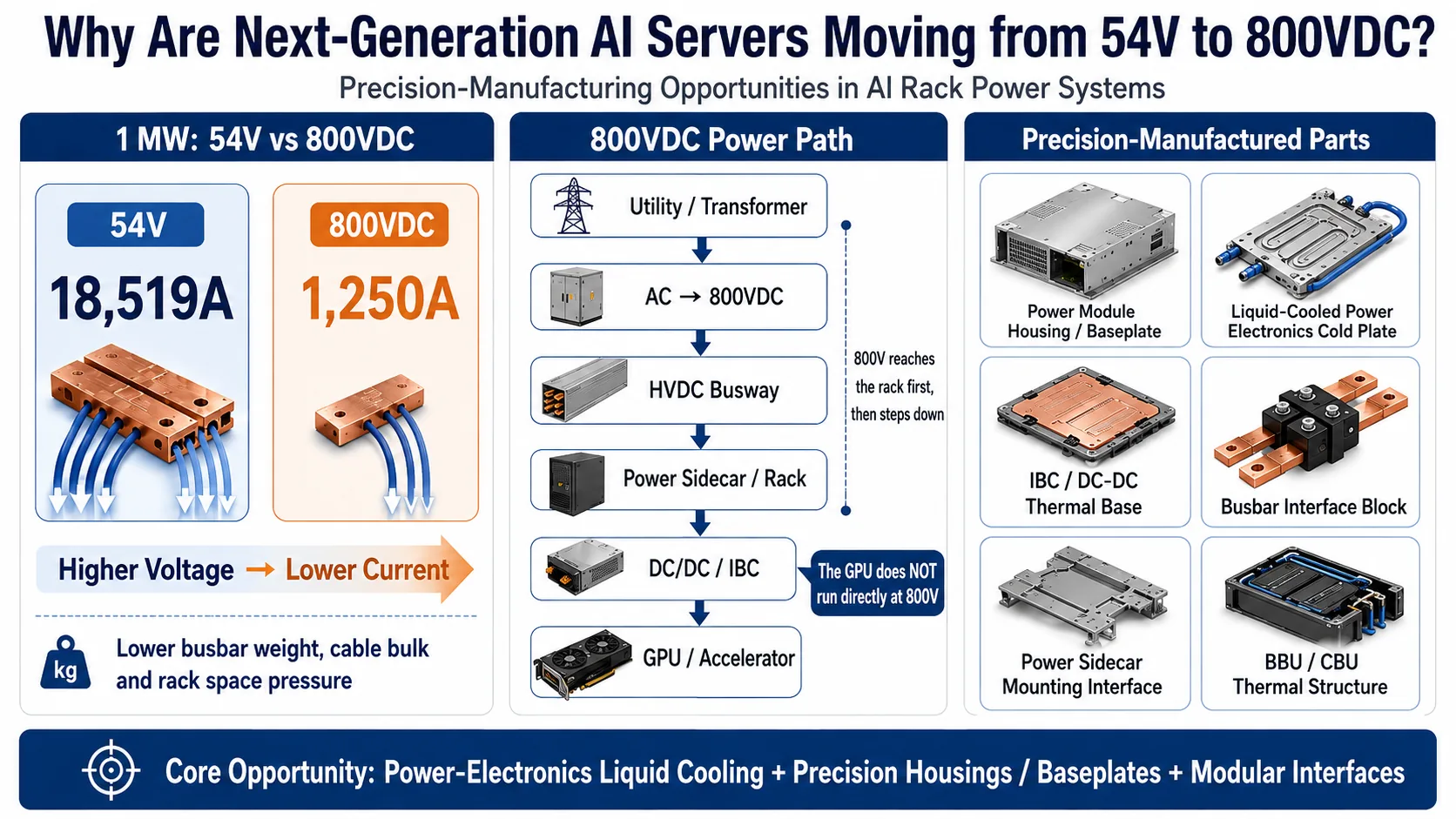
| 1 MW | 54 VDC | about 18,519 A |
| 1 MW | 800 VDC | 1,250 A |
At the same 1MW load, the current at 800V is about 1/14.8 of the current at 54V.
Real conductor sizing does not shrink by the same factor because thermal limits, voltage drop, fault current, insulation, redundancy and standards still apply. But the direction is clear:
At several hundred kilowatts to megawatt rack power, moving enormous current around a 54V rack becomes physically and economically difficult.
NVIDIA now describes the legacy 54V standard as a bottleneck for the next generation of AI factories and positions 800VDC as a foundation for 1MW IT racks and beyond.
NVIDIA 800 VDC Architecture
For precision manufacturers, the important opportunity is not the power semiconductor die itself. It is the growing family of mechanical, thermal, structural and electrical-interface parts around this architecture.
1. One Important Correction: The GPU Does Not Directly Run at 800V
The headline “AI servers move from 54V to 800VDC” is convenient, but the engineering architecture is more nuanced.
A current 54V path can be simplified as:
Facility AC
→ Rack Power Shelf / PSU
→ 54V DC Bus
→ Compute Tray
→ 12V / Intermediate Bus
→ <1V GPU Core
The 800VDC architecture moves high-voltage DC much closer to compute:
Utility / MVAC
→ Centralized AC/DC Conversion
→ 800VDC Distribution
→ Rack / Power Sidecar / Compute Tray
→ HV Hot-Swap
→ 800V→50V / 12V / 6V IBC
→ Multiphase Buck
→ <1V GPU Core
Texas Instruments disclosed a 2026 reference architecture that reduces the path to two major conversion stages:
800V → 6V → <1V
Its 800V portfolio also includes:
- 800V hot-swap;
- 800V-to-6V DC/DC;
- 800V-to-12V DC/DC;
- a 30kW 800V power supply;
- an 800V capacitor-bank unit.
So the real change is the distribution hierarchy from facility to rack and from rack to tray, not the processor operating voltage.
Texas Instruments 800 VDC Power Architecture
2. Why 54V Hits a Physical Limit in Megawatt AI Racks
NVIDIA explains that current AI racks use 54VDC distribution with large copper busbars carrying power from rack-mounted power shelves to compute trays. Above roughly 200kW per rack, the problem becomes a space-and-material constraint as much as an electrical problem.
Copper mass grows rapidly
NVIDIA estimates that retaining 54VDC for a 1MW rack could require about 200kg of rack busbar copper.
Power shelves consume compute space
GB200 and GB300 NVL72 systems can already use multiple power shelves. NVIDIA estimates that a Kyber-class megawatt rack using the same 54V architecture could require as much as 64U of power-shelf space.
Conversion stages add loss and failure points
Traditional architecture may include:
Medium Voltage
→ Low-Voltage AC
→ UPS
→ PDU / Busway
→ Rack PSU AC/DC
→ 54VDC
→ Intermediate DC
→ GPU Core
Every stage adds conversion loss, heat, components, service work and space.
The value of 800VDC is therefore not only higher voltage. It is the opportunity to shorten and reorganize the full power path.
NVIDIA Technical Blog: 800 VDC Architecture
3. How the Power Chain Changes From 54V to 800V
The industry is unlikely to jump from current AC facilities to native 800VDC data halls overnight.
A staged transition is more realistic.
| Stage | Typical Structure | Main Characteristic |
|---|---|---|
| Current | Facility AC → Rack PSU → 54V | Many rack PSUs and very high bus current |
| Transition | Existing AC → 800V Power Sidecar → Compute Rack | Keeps 800V close to compute |
| Expansion | Central AC/DC → 800VDC Busway → Rack | Removes more rack-level AC/DC conversion |
| Native DC AI Factory | MVAC → 800VDC → Rack / Tray DC/DC | Further simplifies grid-to-chip power flow |
Vertiv’s 2026 practical roadmap describes the near-term model as moving power shelves out of the IT rack into a dedicated 800VDC power sidecar. Its PowerDirect 5000 is positioned as a 400kW-to-900kW sidecar feeding a GPU rack over busbar.
This makes the future electrical stack increasingly modular:
Power Rack / Sidecar
↕ 800VDC Busbar Interface
Compute Rack
Modularity is important for manufacturing because it tends to create stable mechanical interfaces and repeat part numbers.
Vertiv: The Practical Path to 800 VDC
4. What Hardware Ecosystem Will 800VDC Create?
Public roadmaps from NVIDIA, TI, Infineon, ABB, Eaton and Vertiv point to a layered ecosystem.
| Power Layer | Key Hardware | Function |
|---|---|---|
| Grid / Power Room | Transformer, Rectifier, MV UPS | Convert and stabilize incoming power |
| Data Hall | 800VDC Busway, Protection | High-density DC distribution |
| Row / Pod | Power Center, Power Sidecar | Feed one or more AI racks |
| Rack Input | HV Hot-Swap, Protection, Busbar Interface | Safe connection, precharge and isolation |
| Compute Tray | 800V→50V / 12V / 6V IBC | Intermediate bus conversion |
| Processor Board | Multiphase Buck | Convert to processor-core voltage |
| Ride-Through | BBU / CBU | Short-duration energy support |
| Thermal | Cold Plate / Heat Spreader | Remove conversion losses |
ABB’s 800VDC white paper and NVIDIA collaboration also emphasize the combination of medium-voltage UPS, DC distribution and solid-state power electronics in future AI data centers.
ABB: Redefining Power Infrastructure for AI — The Role of 800 VDC
5. Which Parts Are Actually a Good Fit for Precision Machining?
This is the most important manufacturing question.
A fast-growing 800VDC BOM does not mean every component becomes a CNC opportunity.
| Component | Typical Process | CNC Fit | Why It Matters |
|---|---|---|---|
| Power Module Housing / Baseplate | Aluminum CNC, die-cast + CNC | High | Thermal surface, module position, sealing and interfaces |
| Power Electronics Cold Plate | CNC channels, brazing/FSW, leak test | High | High power density makes liquid cooling valuable |
| IBC / DC/DC Thermal Base | Precision aluminum/copper base | High | Thermal contact and assembly chain are critical |
| BBU / CBU Thermal Structure | Housing, cold plate, mounting plate | Medium-High | Energy-storage modules are moving to higher power density |
| Power Sidecar Precision Interface | Machined seats, datum plates, interface parts | Medium-High | Modular rack interfaces can become repeat production |
| Busbar Terminal / Interface Block | Copper/aluminum machining and plating | Medium | Contact surface and position are critical |
| Copper Busbar Body | Stamping, bending, lamination, plating | Medium-Low | Mass production favors dedicated busbar processes |
| Power Shelf Chassis | Sheet metal, extrusion, welding, local CNC | Medium-Low | CNC mainly adds value at key datum interfaces |
| HV Connector Housing | Molding, stamping, specialist connector processes | Low | Usually dominated by connector specialists |
| Insulation / Mounting Structure | Engineering polymer/composite molding | Low | Material qualification matters more than metal machining |
For a precision manufacturer already active in AI liquid cooling, the three highest-priority targets are:
Power Module Housing + Liquid-Cooled Power Electronics Cold Plate + IBC/DC/DC Thermal Base
They reuse capabilities in precision CNC, aluminum and copper, thermal contact surfaces, flatness, flow channels, sealing, cleanliness, surface treatment and production consistency.
6. Power-Electronics Cold Plates May Be the Natural Extension of AI Liquid Cooling
Moving to 800VDC does not remove thermal-management demand.
AC/DC rectifiers, DC/DC or IBC stages, hot-swap devices, SiC and GaN power stages, backup units and high-frequency magnetics still generate concentrated heat.
TI has shown a 30kW-class 800V PSU, while Infineon has introduced 30kW-class power solutions for 800VDC / ±400V architectures and high-voltage IBC designs for 800V-to-50V and 800V-to-12V conversion.
As power modules move from several kilowatts to tens of kilowatts, thermal management becomes a larger part of mechanical design.
A strong manufacturing overlap is therefore:
AI Liquid Cooling
×
AI Power Electronics
or:
GPU Cold Plate
→ Power Electronics Cold Plate
→ IBC Thermal Base
→ Rectifier / PSU Cooling Plate
→ BBU / CBU Thermal Structure
For a machining supplier, this is often a more realistic entry point than attempting to enter the power-semiconductor supply chain itself.
Infineon: 30 kW AI PSU for 800 VDC
7. Why a Power Module Housing Is More Than a Simple Enclosure
A thin sheet-metal power box is not necessarily a high-value CNC part.
The more interesting component is a housing/baseplate that integrates structure, thermal management and electrical interfaces.
It can carry:
- power-module datums;
- insulator datums;
- busbar interfaces;
- cold-plate mounting;
- thermal-contact surfaces;
- shielding and grounding;
- cover sealing;
- high-voltage connector mounting;
- sensor mounting;
- service/removal features.
Its CTQs therefore go beyond outer dimensions.
| CTQ | Manufacturing Significance |
|---|---|
| Power-device mounting flatness | Controls TIM thickness and thermal resistance |
| Module hole position | Affects terminal and busbar assembly |
| Busbar interface height | Affects contact force and stack-up |
| Cold-plate interface | Affects sealing, flow and service |
| Grounding surface | Requires controlled surface treatment |
| Mechanical spacing in HV zones | Must follow the approved electrical-insulation design |
| Housing distortion | Can shift thermal, electrical and structural interfaces together |
The value is not “machining an aluminum box.” It is using one stable datum system to lock electrical, thermal and assembly interfaces together.
8. Busbars Matter, but Do Not Automatically Mean Large CNC Orders
800VDC reduces copper requirements, but it does not eliminate busbars.
Busbars still connect:
- power sidecar to rack;
- rack to tray;
- modules;
- BBU / CBU;
- grounding and return paths.
However, high-volume busbar manufacturing is commonly:
copper sheet or strip
→ stamping / cutting
→ bending
→ lamination
→ tin/silver plating
→ insulation
→ contact-resistance validation
rather than full CNC machining from billet.
A machining supplier should focus on:
- complex terminal blocks;
- busbar adapter blocks;
- precision contact surfaces;
- bolted/compression interfaces;
- busbar supports;
- sensor mounts;
- prototype and low-volume complex conductors.
“More busbar demand” should not be translated directly into “more general CNC copper work.”
9. At 800V, Mechanical Interfaces Become Part of Electrical Safety
In a 54V system, some mechanical variation may primarily create an assembly problem.
At 800VDC, mechanical structure is more deeply involved in:
- insulation boundaries;
- spacing;
- connector mating;
- precharge and hot-swap mechanisms;
- grounding;
- keying;
- protective covers;
- service isolation.
TI explicitly notes the need for higher-voltage hot-swap, isolation, sensing and protection architecture. Infineon also emphasizes serviceability and controlled board replacement on an 800VDC bus.
For a mechanical supplier, the rule is simple:
Do not independently “optimize” geometry related to high-voltage spacing, insulation or protection.
The correct chain is:
system owner defines electrical-safety boundaries
→ engineering converts them into mechanical CTQs
→ manufacturing controls the dimensions
→ inspection and traceability prove conformity.
10. 800VDC Plus Modularity Can Create Real Repeat Production
There is an important parallel with platformization in other industries.
If power sidecars, MGX power racks, IBC modules, backup units and rack interfaces become standardized, the supply chain gains:
**fixed envelope
- fixed connector
- fixed busbar interface
- fixed cooling interface
- fixed mounting datums
- reuse across multiple compute generations**
Eaton is integrating 800VDC into its grid-to-chip and modular AI-factory strategy, while Vertiv is building 400kW-to-900kW sidecar infrastructure.
Supplier competition then moves from:
“Can you build the first prototype?”
to:
“After 1,000 or 10,000 units, are flatness, interface position, cleanliness, sealing, finish and assembly consistency still stable?”
That is a much more attractive market for a production-oriented precision manufacturer.
11. Which Capabilities Are Worth Building First?
A practical strategy is to extend existing precision and liquid-cooling capabilities rather than trying to build a complete power system.
| Existing Capability | Extension into AI Power Infrastructure |
|---|---|
| AI cold-plate machining | Power-electronics cold plate |
| Precision aluminum CNC | Power module housing / baseplate |
| Deep-hole and flow-channel machining | Power cooling manifold / distribution block |
| Brazing, FSW and sealing | High-power liquid-cooled power assembly |
| Flatness and stack-up control | IBC / PSU thermal base |
| Surface treatment | Housing, grounding and non-wetted functional surfaces |
| Leak and flow testing | Liquid-cooled power-module validation |
| CMM / SPC | Modular interface production control |
New knowledge should focus on:
- high-voltage interface CTQs;
- stricter change control around insulation boundaries;
- copper/aluminum combinations and plating;
- thermal test interfaces for power modules;
- vibration, thermal cycling and traceability.
12. What Should Be Confirmed at RFQ Stage?
An 800VDC mechanical RFQ should not be quoted from a 3D model alone.
| Category | Information to Confirm |
|---|---|
| System position | Power Room / Sidecar / Rack / Tray / Board |
| Electrical boundary | Rated voltage/current, peaks, grounding, insulation zones |
| Function | Housing / Baseplate / Cold Plate / Busbar Interface |
| Thermal conditions | Module loss, heat flux, coolant, flow and pressure drop |
| Materials | Aluminum, copper, stainless, insulation materials |
| Surface treatment | Anodizing, plating, grounding faces, wetted-surface limits |
| Mechanical CTQs | Flatness, position, interface height, mounting stack-up |
| Liquid CTQs | Channels, seal grooves, leak rate, proof pressure, cleanliness |
| Reliability | Thermal cycling, vibration, insertion cycles, life |
| Production | Prototype, EVT/DVT/PVT, annual volume, SPC, traceability |
High-voltage safety and insulation requirements must be defined by qualified system engineers. The precision supplier’s role is to manufacture the approved geometry and interfaces consistently.
Frequently Asked Questions
Does 800VDC mean the GPU runs directly at 800 volts?
No. Public NVIDIA, TI and Infineon architectures use 800VDC primarily for high-voltage distribution from the data center to the rack or compute tray. The compute side still uses high-voltage hot-swap and intermediate conversion stages such as 800V to 50V, 12V or 6V, followed by multiphase conversion to the sub-1V level required by the GPU core.
Why does 54V distribution become difficult at a 1MW rack?
In an ideal DC calculation, 1MW at 54V requires about 18,519A, compared with about 1,250A at 800V. Extremely high current drives larger conductor cross-section, copper mass, parallel connections and I²R-loss management. NVIDIA also states that retaining a 54V architecture at 1MW could require around 200kg of rack busbar copper and consume substantial rack space with power shelves.
Will 800VDC eliminate copper busbars?
No. It reduces the current needed for a given power level and therefore can reduce conductor cross-section, copper use and cable bulk, but racks, sidecars and distribution systems still require busbars, connectors, protection devices and grounding structures. The manufacturing opportunity shifts toward higher-voltage precision interfaces, insulation support, structural integration and thermal management.
Which AI rack power-system parts are the best fit for precision machining?
High-fit parts include aluminum power-module housings and baseplates, liquid-cooled power-electronics cold plates, DC/DC or IBC thermal bases, thermal structures for BBU and capacitor-bank units, precision interface plates and mounting seats in power sidecars, and selected busbar terminal or sensor-mounting parts. Busbar bodies, molded insulators and connector plastic housings usually depend more on stamping, bending, lamination, molding and specialist electrical processes than on general CNC machining.
Why will 800VDC power hardware become more closely connected with liquid cooling?
As PSU, DC/DC, IBC and backup-unit power density rises, heat flux from power semiconductors, magnetics and electrical interfaces rises as well. TI and Infineon have already disclosed 30kW-class 800V power designs and high-density conversion architectures. This makes liquid-cooled cold plates, thermal baseplates, module housings and cooling interfaces a natural overlap between AI power infrastructure and liquid-cooling manufacturing.
What information is needed to quote mechanical parts for an 800VDC system?
Provide 2D drawings and 3D models, the position of the component in the power system, rated and peak voltage/current, grounding and insulation boundaries, materials and surface treatments, heat loss and cooling method, thermal-contact requirements, coolant flow and pressure drop, sealing and leak-test requirements, busbar and connector interfaces, mounting dimensional chains, vibration and thermal-cycle requirements, prototype quantity and expected annual volume. High-voltage safety parameters should be defined by a qualified electrical engineering team, with the mechanical supplier manufacturing to the approved design boundaries.