
In This Article
Direct Answer
A fishing reel handle knob is not only a cosmetic accessory. It sits between the user’s hand and the handle arm, so it must manage grip, force transfer, rotation, corrosion resistance and appearance at the same time.
Material selection should therefore not begin with “carbon fiber or aluminum?” A better sequence is:
How will it be held → how much load → what size → what target mass → what bearings and shaft → what saltwater environment → then material and process.
For custom manufacturing, the functional system is:
knob geometry + body material + metal core / insert + bearings + axial clearance + handle interface + surface finish + final assembly condition.
01|Why should knob geometry usually be decided before material?
The same material can produce completely different handling characteristics. A small round knob, paddle, large power knob and wide-palm T-bar are designed around different hand-contact patterns.
| Knob geometry | Typical direction | Main design focus | Common material direction |
|---|---|---|---|
| Small round knob | Freshwater, light baitcasting | Low mass, fast finger changes | Aluminum, POM, rubber, wood |
| Paddle grip | Baitcast, light-to-medium load | Fingertip control, comfort | Engineering plastic, rubber, aluminum |
| Large round power knob | Jigging, offshore | Contact area, non-slip grip | Aluminum, EVA, carbon fiber |
| Wide-palm T-bar | Offshore, conventional, higher load | Stable grip, palm-pressure distribution | Carbon fiber, aluminum, titanium, EVA, hybrid structures |
There is no independent answer to “which material is best.” Define how the hand contacts the part first, then choose the material that supports that geometry.
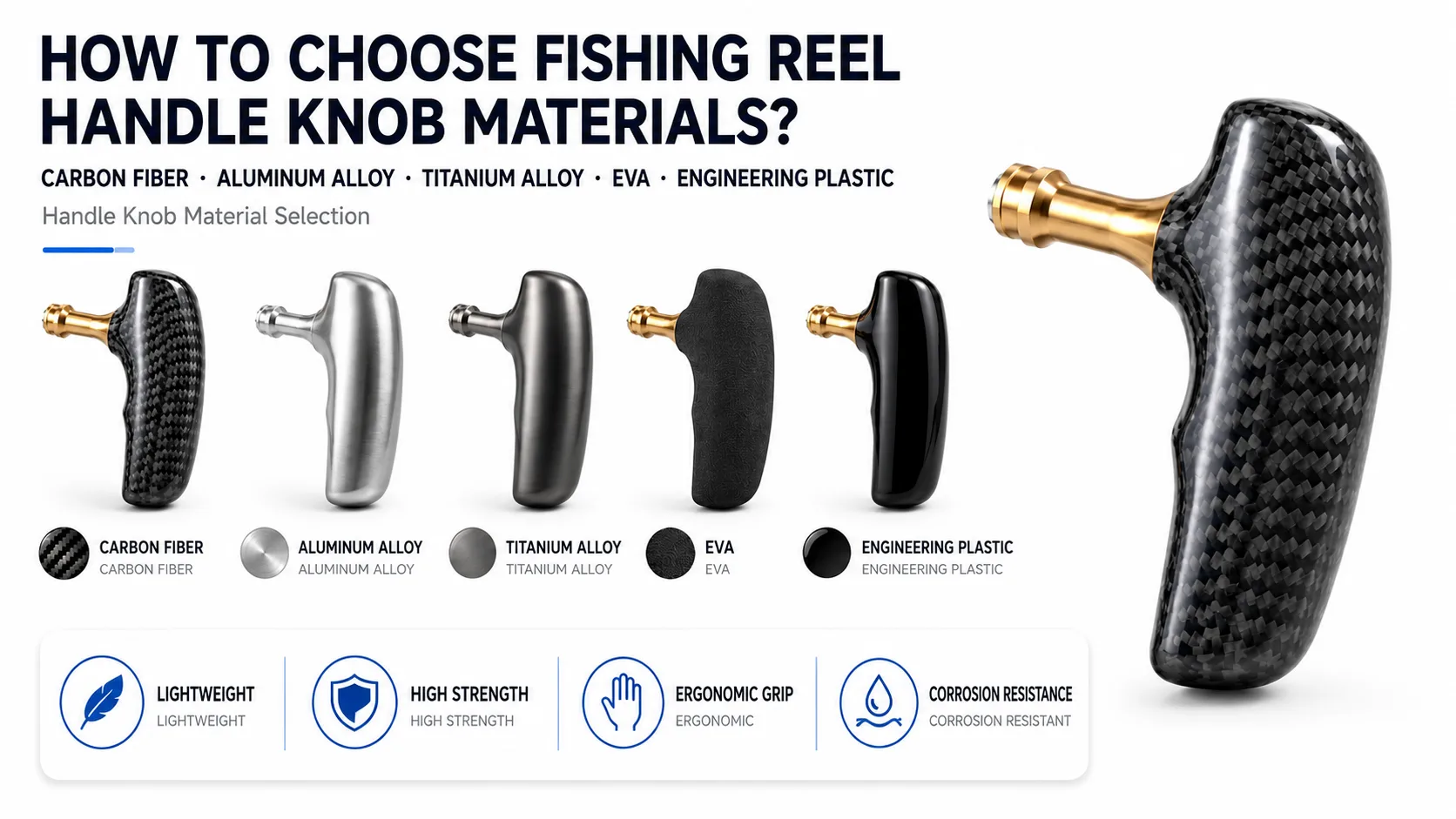
Figure: Fishing reel handle knobs can be developed in carbon fiber, aluminum alloy, titanium alloy, EVA or engineering plastics according to weight, strength, grip comfort, corrosion resistance and target cost.
02|Material selection matrix for fishing reel handle knobs
| If the project prioritizes… | Consider first | Key verification |
|---|---|---|
| Low mass + premium composite appearance | CFRP / forged carbon | Molding quality, inserts, edges, surface |
| Maximum CNC design freedom | Aluminum | Thin sections, tool marks, post-anodize dimensions |
| Anodized colors and metallic feel | Aluminum | Color consistency, rack points, masking of functional areas |
| Premium saltwater corrosion resistance | Titanium | Cost, machining efficiency, final surface |
| Strong compact shaft or insert | Stainless steel / titanium | Fits, wear, corrosion, mass |
| High-volume cost control | POM / PA engineering plastics | Shrinkage, inserts, dimensional stability |
| Soft non-slip low-pressure grip | EVA / elastomer | Density, texture, core bonding |
| Distinctive classic appearance | Wood | Moisture, sealing, waterproofing, stability |
| Low-mass body with precise interface | Composite or soft body + metal core | Joining and galvanic isolation between materials |
This table is not a material limit. OEM and ODM projects can evaluate other metals, engineering plastics, composites, soft materials and hybrid constructions. The goal is not to force every material through one process, but to match each material with the correct forming, machining, finishing and assembly route.
03|“Carbon knob” can mean at least two different composite routes
Consumer products often use Carbon, Carbon Fiber and Forged Carbon almost interchangeably, but manufacturing should distinguish them.
| Carbon route | Typical structure | Appearance | Manufacturing focus |
|---|---|---|---|
| Woven / prepreg CFRP | Continuous-fiber laminate | Regular woven pattern | Lay-up, cure, trimming, drilling, inserts |
| Forged carbon / chopped-fiber compression molding | Chopped carbon + resin molding compound | Irregular fragmented pattern | Mold filling, resin/fiber distribution, hole edges, inserts, consistency |
Both can make premium knobs, but surface pattern alone does not prove internal strength or architecture.
When the knob uses a metal shaft core or aluminum insert, additional questions matter:
- How is load transferred between composite body and metal insert?
- Are bearing fits machined directly into the composite, or carried by a precision metal sleeve?
- Can saltwater enter the interface over long-term use?
- Is a resin barrier, coating, insulating layer or seal needed between carbon composite and aluminum?
- Are drilled edges, thin walls or tight radii potential damage initiation points?
For a part that rotates and sees repeated hand loading, a carbon outer structure combined with a precision metal internal interface is often easier to control than asking the composite alone to provide every precision fit.
04|Case example: why design a wide-palm T-shaped carbon knob as a system?
A recently developed wide-palm T-shaped carbon knob installed on a double-axis / conventional reel shows why this category is different from a small round knob. The goal is not simply to make the accessory larger. The broad contact zone gives the palm a more stable interface during sustained higher-load retrieves.
The design logic has four layers.
1. Wide-palm geometry
A larger contact area distributes local palm pressure and reduces the need to pinch a small-diameter knob continuously with the fingertips.
2. T-shaped support
The transverse T profile gives the hand a repeatable support direction during sustained cranking, which is useful when the retrieve requires more continuous force.
3. Carbon composite body
For a relatively large external shape, a composite body can reduce the mass of the grip body while creating a strong premium visual identity.
4. Precision metal rotating interface
The internal shaft, bearings, sleeves, shims and retention system still determine rotational smoothness and long-term reliability. A premium outer material cannot compensate for unstable axial clearance or misaligned bearing support.
One distinction is important: the T-bar improves grip and force transfer; the handle arm length remains the main geometric factor that sets mechanical leverage. Knob and handle arm should therefore be designed as one human-machine interface.
05|Why is aluminum still the most versatile premium knob material?
The main advantage of aluminum is not simply low density. It offers a strong balance between shape freedom, dimensional control, appearance and scalable production.
CNC machining can create:
- large radii and palm-contoured surfaces;
- internal weight-reduction pockets;
- non-slip textures;
- bearing bores and metal-core structures;
- brand-specific profiles and decorative lines;
- blasted, polished and anodized finish combinations.
Two risks need attention.
First, cosmetic zones and functional zones should be controlled separately. Whether anodize is allowed in bearing bores, locating holes, threads or fits should be defined by final dimensional and assembly requirements.
Second, when aluminum is in direct contact with carbon composite in a saltwater environment, the design should consider galvanic isolation and sealing rather than relying only on a cosmetic finish.
06|Where do titanium, stainless steel, engineering plastics, EVA and wood fit?
| Material | Typical use | Strengths | Main trade-off / risk |
|---|---|---|---|
| Titanium alloy | Premium body, shaft, connector | Corrosion resistance, high specific strength, premium feel | Higher material and machining cost |
| Stainless steel | Shaft, screw, bearing sleeve, high-load insert | Strength, wear resistance, corrosion resistance | High density can increase total mass |
| POM | Core, sleeve, smaller body | Low friction, good dimensional stability, machinable | Less premium cosmetic character, thermal behavior matters |
| PA / reinforced PA | Injection-molded body, high-volume structure | Scalable molding, high shape freedom | Moisture and molding shrinkage need control |
| EVA | Large soft-grip outer layer | Light, soft, non-slip, low palm pressure | Surface durability and core bonding must be validated |
| Rubber / TPE | Overmolded and non-slip zones | Comfort, texture freedom | Aging, adhesion and saltwater behavior need validation |
| Wood | Boutique or classic customization | Unique touch and appearance | Waterproofing, moisture content and batch stability |
Materials are therefore not arranged on a simple “premium to low-end” ladder. They solve different functions.
07|Many strong knob designs are multi-material systems
A premium custom knob does not have to use one material throughout.
A more robust architecture may be:
outer grip body + precision metal core + bearings + sleeve / shims + retention system
Examples include:
| Combination | Main purpose |
|---|---|
| Carbon outer + stainless shaft | Lightweight appearance + precise wear-resistant interface |
| Carbon outer + titanium shaft | Higher-end lightweight corrosion-resistant combination |
| EVA outer + aluminum skeleton | Soft grip + stable internal support |
| Engineering plastic body + metal insert | Production cost + local precision |
| Wood outer + metal shaft | Distinctive tactile surface + reliable rotating interface |
The challenge moves from single-material machining to interface engineering: bonding, press fits, mechanical locking, sealing, thermal expansion mismatch and corrosion all become part of the design.
08|Fitment begins with the internal interface system
For aftermarket and OEM platform development, compatibility is usually controlled more by the internal interface than by whether the outside shape is round or T-shaped.
At minimum define:
| Interface item | What must be confirmed |
|---|---|
| Knob shaft | Diameter, effective length, shoulders, thread or rivet form |
| Bearings | ID, OD, width, quantity, sealing type |
| Internal sleeve | Material, length, relationship to bearing and body |
| Washers / shims | Thickness combinations and axial-clearance range |
| Retainer | Screw, nut and anti-loosening method |
| Handle connection | Single / double handle, shaft format, installation direction |
| Final clearance | Smooth rotation, no excessive axial play, no interference |
If one core knob is intended to cover several reel families, a better engineering strategy is often to standardize the external body and use different shafts, sleeves, bearings and shim kits as fitment packages rather than changing the full knob each time.
09|Which CTQs matter most for fishing reel handle knobs?
| CTQ | Why it matters | Typical verification approach |
|---|---|---|
| Bearing-bore size | Controls press fit / clearance and rotation | Bore gauge, plug gauge or CMM |
| Coaxial relation of bearing supports | Prevents forced bearing misalignment | CMM, purpose gauge, rotation test |
| Shaft size and straightness | Affects rotation and wobble | OD measurement, runout check |
| Axial clearance | Too little causes drag; too much causes looseness | Shim stack + assembly validation |
| Insert pull-out / torsional reliability | Prevents metal core separation from composite or plastic body | Pull, torque or life test |
| Profile and edge radii | Controls palm pressure and comfort | Profile check, prototype evaluation, limit sample |
| Mass and center of mass | Affects handle dynamic feel | Weighing and prototype comparison |
| Surface texture | Controls grip and tactile feel | Cosmetic standard and tactile sample |
| Saltwater-resistant architecture | Affects metal, fastener and multi-material interface life | Material/finish plan and environmental validation as required |
Bearing fits, tolerances and axial clearance cannot be judged independently from the assembled condition. A dimensionally conforming part is not automatically a smooth-running knob assembly.
10|Different materials require different manufacturing routes
| Material route | Typical process chain |
|---|---|
| Aluminum | Stock / forging → CNC → deburr → blast / polish → anodize → functional reinspection → assembly |
| Titanium | Bar / forging → CNC → finishing → surface / passivation-type process → cleaning → assembly |
| Stainless steel | Turn-mill → finish machining → polish / surface process → cleaning → assembly |
| Woven CFRP | Lay-up → molding / cure → trim → CNC drilling → inserts → surface → assembly |
| Forged carbon | Chopped-fiber charge → compression cure → trim → hole machining / inserts → surface → assembly |
| POM and similar plastics | CNC or injection molding → deburr → functional inspection → insert / assembly |
| PA / TPE volume parts | Tooling → injection / overmolding → post-process → dimensional and cosmetic validation → assembly |
| EVA | Form / machine → texture and profile finishing → core bonding → assembly |
The earlier an OEM project defines its material direction, the easier it is to plan molds, CNC fixtures, surface finishing and inspection together instead of freezing the appearance first and searching for a manufacturing route afterward.
11|What drifts when a knob moves from prototype to mass production?
Prototype
First validate three things: Does it feel right, does it fit, and does it rotate smoothly?
This is the stage to compare geometry, material, mass and axial-clearance options before freezing every parameter.
Pilot Production
Begin locking down:
- body material and incoming condition;
- mold or CNC datum strategy;
- metal insert and shaft specification;
- bearing brand / specification or performance requirement;
- shim stack;
- bonding, press-fit or mechanical retention method;
- cosmetic limit samples;
- final rotation-feel and clearance acceptance method.
Mass Production
Watch the variables that drift slowly: mold wear, tool wear, plastic shrinkage, composite molding batches, anodize color, adhesive condition, bearing batches and mixed shim stacks.
The objective is not to make one exceptionally smooth knob. It is to keep grip, rotation, appearance and fit within the same acceptable window across batches.
12|What should a custom knob RFQ contain?
| RFQ information | Why it matters |
|---|---|
| 3D model / major dimensions | Evaluates ergonomic surfaces, machining and tooling feasibility |
| Knob style | Round, paddle, power knob, T-bar, etc. |
| Target size | Defines palm area, material use and process route |
| Material or performance target | If material is open, weight, corrosion, appearance and cost can drive selection |
| Weight target | Influences material, hollowing and metal-core architecture |
| Shaft and bearing specification | Defines internal interface and rotating CTQs |
| Handle-arm connection | Defines core and adapter design |
| Surface / color | Defines anodize, polish, texture or composite appearance route |
| Use environment | Freshwater, saltwater, high load, long-duration use, etc. |
| Target reel models | Enables fitment and installation matrix |
| Prototype and annual volume | Determines CNC, tooling, fixture and inspection investment |
If the customer has not selected a material, the RFQ can start with a target such as: “approximately 85 mm wide-palm T-bar, lighter than an equivalent aluminum concept, saltwater use, premium appearance, dual-bearing rotation.” Manufacturing can then evaluate material, structure, process and cost together through DFM.
Frequently Asked Questions
Is a carbon fiber fishing reel knob always better than an aluminum knob?
No. Carbon fiber is attractive for lightweight construction and a premium composite appearance, while aluminum is easier to machine into complex shapes with stable precision and many anodized finish options. The right choice depends on knob size, target mass, structural load, saltwater exposure, cosmetic goals, cost and production volume rather than the material name alone.
Why are large T-bar knobs useful for offshore fishing and higher-load retrieves?
A T-bar or wide-palm knob increases hand contact area and improves load distribution, helping the user maintain a stable grip and apply force over long retrieves or higher-load conditions. The handle arm length is what primarily determines mechanical leverage; knob geometry mainly improves grip, force transfer and fatigue behavior rather than creating additional mechanical ratio by itself.
Can fishing reel knobs from different brands and models be used interchangeably?
Compatibility cannot be judged from outside shape alone. It depends on the knob shaft design, shaft diameter, bearing ID, OD and width, sleeves, washers or shims, screw or rivet retention, axial clearance and the connection to the handle arm. An OEM program should establish an interface and compatibility matrix before deciding whether one knob body can use multiple shaft or adapter kits or whether separate versions are required.
What information should be included in an RFQ for a custom fishing reel handle knob?
Provide a 3D model or major dimensions, target knob style and size, material or performance objective, weight target, shaft and bearing specifications, handle-arm connection, finish requirements, saltwater use conditions, target reel models, prototype quantity and expected annual volume. If a physical sample exists, an assembled reference and target feel are especially useful for identifying the real CTQs.