In This Article
Direct Answer
Direct-to-chip and immersion cooling solve the same problem: moving heat from high-power IT equipment into a liquid. They change the server and data-center architecture in very different ways.
Direct-to-chip cooling (D2C) installs cold plates on CPUs, GPUs, accelerators or other high heat-flux components. Coolant stays inside controlled tubing and cold-plate channels and does not contact the circuit board. Some air cooling normally remains.
Immersion cooling places a server board or purpose-built IT system in a dielectric fluid. The fluid contacts many electronic components directly, so fans, conventional heat sinks, rack structures and maintenance procedures may be redesigned.
The ASHRAE AI Data Center Framework evaluates D2C, immersion, CDUs, cold plates, manifolds, tanks and controls as parts of a complete technology cooling system. The OCP Design Guidelines for Immersion-Cooled IT Equipment also show that immersion affects materials, mechanical design, electronics, connectivity and service procedures, not only heat transfer.
The selection should therefore address:
- Whether existing servers and racks must be retained;
- Which components contact the coolant;
- How residual heat is removed;
- How servers are replaced and serviced;
- How fluid and material compatibility are qualified;
- Which modules can be sourced, manufactured and tested;
- Whether the facility and operations team can support the architecture.
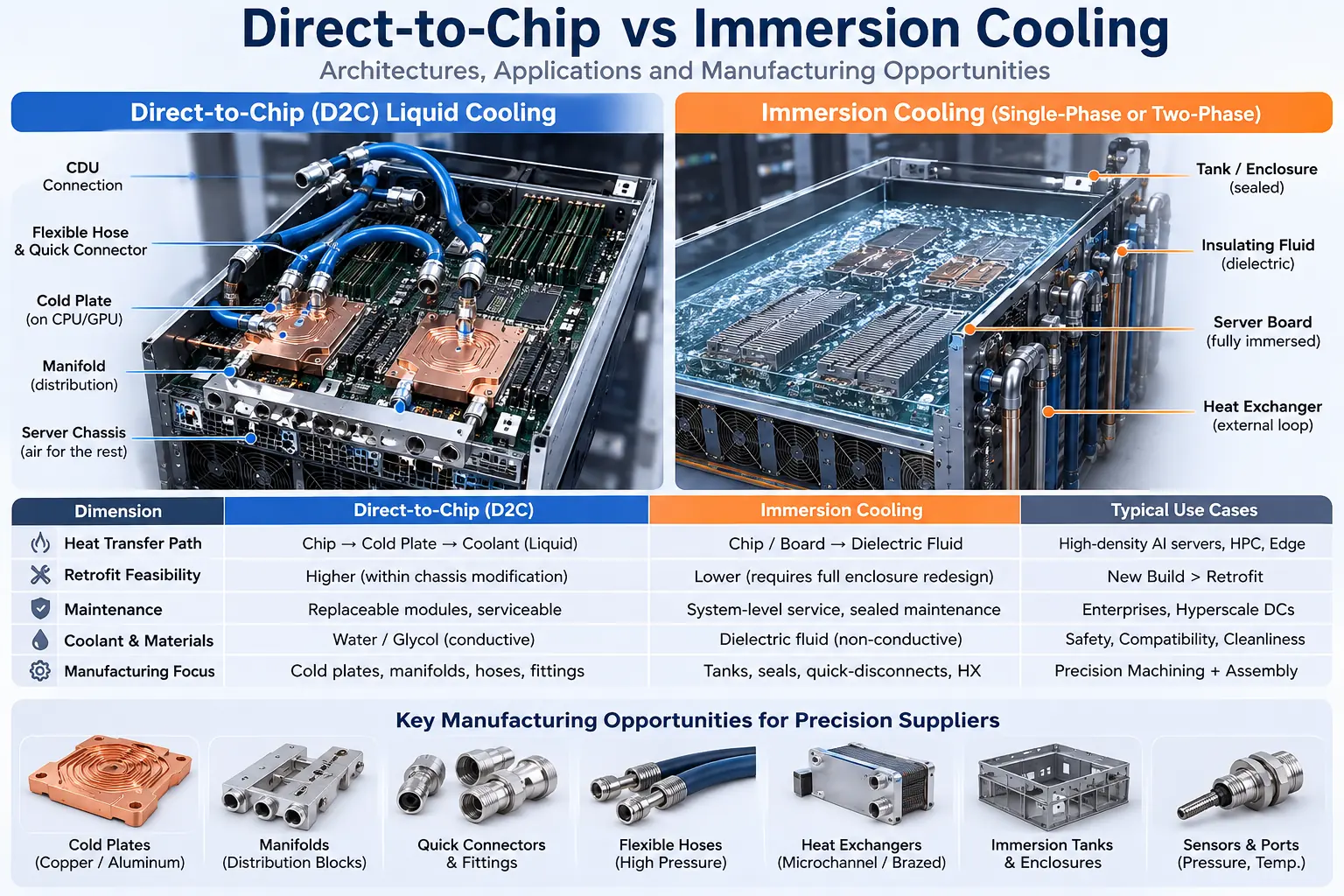
Direct-to-chip cooling keeps coolant inside cold plates and tubing, while immersion cooling places electronic hardware directly in dielectric fluid.
1. Core Architectural Difference
| Comparison | Direct-to-Chip | Immersion |
|---|---|---|
| Fluid-contact boundary | Cold plates, tubing, manifolds and CDU | Many electronic components and tank internals |
| Main thermal interface | Chip-to-cold-plate contact | Electronic component-to-dielectric-fluid contact |
| Server format | Can remain close to standard server architecture | Often requires purpose-built layout, tank or sealed chassis |
| Air cooling | Normally handles residual heat | Can be greatly reduced, depending on equipment design |
| Main fluid components | Cold plates, hoses, quick disconnects, manifolds and CDU | Tank, pumps, heat exchanger, fluid distribution and recovery |
| Compatibility focus | Wetted metals, seals, tubing and coolant | Electronics, plastics, adhesives, cables, labels and dielectric fluid |
| Service model | Server or cold-plate module service | Fluid drainage, drip control and immersed-equipment handling |
| Machining focus | Cold plates, manifolds, valve blocks and connector interfaces | Tank modules, pump blocks, heat-exchanger interfaces and structures |
2. Direct-to-Chip Heat Path
A typical D2C heat path is:
Chip → TIM → Cold Plate Base → Internal Channels → Technology-Side Coolant → CDU Heat Exchanger → Facility Water
Key components include:
- CPU, GPU or accelerator cold plates;
- Server hoses or hard tubes;
- Server manifolds;
- Quick disconnects;
- Rack manifolds;
- CDU;
- Sensors, valves, filters and leak-detection devices;
- Air cooling for residual loads.
The OCP Cold Plate Requirements combine thermal performance, pressure drop, materials, leakage, proof pressure and interfaces. D2C is therefore an interface chain from the chip contact surface to the rack and facility loop, not an isolated cold-plate project.
3. Immersion Heat Paths
Immersion systems are commonly divided into single-phase and two-phase architectures.
Single-Phase Immersion
The dielectric fluid remains liquid during normal operation. Heat moves from electronics into the fluid and then through pumped or natural circulation to an internal or external heat exchanger.
Electronics → Dielectric Liquid → Pump or Natural Circulation → Liquid-to-Liquid Heat Exchanger → Facility Water
Two-Phase Immersion
The dielectric fluid boils at a controlled temperature. Vapor rises, condenses on a heat exchanger and returns to the bath.
Electronics → Boiling Liquid → Vapor → Condenser → Liquid Return
Two-phase systems add phase-change, condensation, fluid-loss and enclosure-control requirements. Single-phase and two-phase immersion should not be treated as the same manufacturing or operating condition.
4. Why D2C Is Often Easier to Introduce into Existing Facilities
D2C can be deployed around existing rack formats, server envelopes and service procedures. Cold plates address the highest heat loads, while air continues to manage other components.
This hybrid architecture is useful when a project needs to:
- Add AI servers to an existing data center;
- Retain established network, power and storage equipment;
- Increase liquid-cooling coverage in stages;
- Keep conventional server replacement and remote-service procedures;
- Limit the fluid boundary to cold plates and tubing.
D2C still requires engineering changes. Racks need manifolds and CDUs; servers need quick disconnects, hoses, leak detection and drain procedures; the facility must provide suitable supply temperature, flow, differential pressure and redundancy.
5. Why Immersion Changes IT and Service Procedures
Immersion expands the fluid boundary to the electronics. The design must address:
- Board and server orientation;
- Removal of fans and conventional heat sinks;
- Power and network connector placement;
- Equipment lifting, draining and temporary storage;
- Fluid filtration, sampling and replenishment;
- Tank sealing, spill control and maintenance;
- Cleaning and transportation after removal;
- Operator procedures for fluid handling.
The OCP immersion guide specifically reviews material compatibility, thermal design, mechanical design, electronic design and software management. Immersion is a system-level equipment architecture, not simply a standard server placed in a liquid.
6. Coolant and Material Compatibility
Direct-to-Chip
The wetted material set normally includes:
- Aluminum, copper and other cold-plate metals;
- Brazed, welded or mechanically sealed joints;
- Hoses and hard tubes;
- O-rings and gaskets;
- Quick disconnects and valves;
- CDU heat exchangers and pumps.
Corrosion, galvanic interaction, additives, particles, ions and biological contamination must be managed.
Immersion
The dielectric fluid may also contact:
- PCBs and solder joints;
- Cable jackets;
- Connector plastics;
- Labels and inks;
- Adhesives;
- Coatings and potting materials;
- TIMs;
- Capacitors, storage devices and other components.
The compatibility scope is therefore much wider. Electrical insulation alone does not prove that all materials will remain stable over long exposure.
7. Is Air Cooling Still Required?
D2C normally prioritizes CPUs and GPUs. Residual heat may come from:
- Memory;
- Power supplies;
- Storage;
- Network interfaces;
- Voltage regulators;
- Board losses;
- Accelerators and peripherals not covered by cold plates.
D2C servers may therefore retain fans. Higher liquid-cooling coverage can reduce airflow, but fan removal requires full-system thermal validation.
Immersion exposes more components to liquid and can reduce internal fans and airflow structures. The tank headspace, pumps, heat exchangers, condensers and fluid-management systems still require engineering.
8. Serviceability and Failure Boundaries
| Item | Direct-to-Chip | Immersion |
|---|---|---|
| Server replacement | Similar to a standard rack, with fluid disconnection | Equipment must be removed and drained |
| Leakage points | Cold plates, fittings, hoses, manifolds and CDU | Tank, heat exchanger, pump, tubing and seals |
| Fault isolation | Server or branch isolation | Tank, chassis or fluid-loop isolation |
| Cleanliness focus | Cold-plate channels and tubing particles | Fluid condition, tank contamination and carry-out liquid |
| Spare parts | Cold plates, hoses, QDs, valves and sensors | Fluid, filters, tank parts and compatible IT hardware |
| Operating risk | Misconnection, residual pressure, drips and trapped air | Fluid exposure, spills, lifting and material changes |
A selection should evaluate failure recovery, not only normal thermal performance.
9. Manufacturing Opportunities
Direct-to-Chip Precision Parts
D2C creates a long modular component chain:
- CPU and GPU cold plates;
- Microchannel or pin-fin bases;
- Cold-plate covers;
- Server manifolds;
- Rack manifolds;
- Valve blocks and connector seats;
- Quick-disconnect mounting interfaces;
- Sensor bosses;
- Leak trays;
- Brackets, clamps and locating parts;
- CDU pump blocks, heat-exchanger end plates and structures.
These parts commonly require CNC machining, flatness, channels, seal grooves, interface position, joining, cleaning and leak testing. They can be managed through defined CTQs and production processes.
Immersion Precision Parts
Immersion opportunities are more concentrated in:
- Tanks and lids;
- Fluid distribution and return structures;
- Pump and valve modules;
- Heat-exchanger interfaces;
- Condenser mounting structures;
- Power and network bulkhead interfaces;
- Equipment carriers and lifting structures;
- Filtration and fluid-service modules;
- Sealing frames and large structures.
Immersion may reduce the number of chip-level cold plates but increases the need for fluid-management and enclosure components.
10. D2C Manufacturing CTQs
| Component | Key CTQs |
|---|---|
| Cold plate | Contact flatness, roughness, channels, pressure drop, cleanliness and leakage |
| Manifold | Hole pattern, branch consistency, interface alignment, proof pressure and cleanliness |
| Valve block | Valve bores, sealing surfaces, cross-hole deburring and flow resistance |
| Connector seat | Threads, seal groove, orientation, wall thickness and tool clearance |
| Bracket | Datums, hole position, stiffness and assembly stack |
| Leak tray | Coverage, drain path, sensor location and false-alarm prevention |
Many D2C failures arise from accumulated interface variation across the server, rack and CDU rather than one isolated dimension.
11. Immersion Manufacturing CTQs
| Component | Key CTQs |
|---|---|
| Tank | Weld integrity, sealing, flatness, fluid resistance and spill control |
| Lid | Seal compression, opening mechanism, viewing and service interfaces |
| Bulkhead | Power and network sealing, compatibility and strain relief |
| Pump/valve module | Flow, vibration, sealing, filtration and service clearance |
| Heat-exchanger interface | Distribution, connector position, proof pressure and removability |
| Equipment carrier | Load, location, lifting, retention and fluid drainage |
| Fluid service | Sampling, filtration, filling, draining and contamination control |
Immersion parts must remain stable after long fluid exposure, not only pass dimensional inspection in air.
12. Selection Matrix
| Project Condition | Favors D2C | Favors Immersion |
|---|---|---|
| Retain standard servers and racks | Yes | More difficult |
| Retrofit an existing facility | Generally easier | Larger changes required |
| Deploy in stages | Easier | Often deployed by tank or area |
| Modular component sourcing | Clear cold-plate, manifold and CDU chain | Depends on tank-system architecture |
| Remove most internal fans | Partial | More likely |
| Material-compatibility scope | More concentrated | Much broader |
| Conventional remote service | Closer to existing practice | New process required |
| Large tanks and fluid management | Limited | Core requirement |
| Small precision fluid parts | More numerous | Concentrated in system modules |
| Freedom to redesign IT equipment | Lower | Higher |
Architecture, thermal, hydraulic, material, service and supply-chain teams should review the decision together.
13. RFQ Information
Direct-to-Chip Project
- Chip heat load and cold-plate contact area;
- Coolant, temperature, flow and pressure drop;
- Operating, peak and proof pressure and leak rate;
- Server, rack and CDU connection diagram;
- Cold plate, manifold, QD and hose specifications;
- Contact surface, channels, materials and cleanliness;
- Residual air load and fan strategy;
- Prototype, validation, production and traceability requirements.
Immersion Project
- Single-phase or two-phase architecture;
- Dielectric fluid and operating temperature;
- Compatible IT material list;
- Tank dimensions, capacity and loading method;
- Pump, heat exchanger, condenser and filtration plan;
- Power, network and bulkhead interfaces;
- Equipment removal, drainage and service process;
- Sealing, overflow, fluid monitoring and safety requirements;
- Prototype validation and long-term compatibility plan.
14. Manufacturing-Supplier Perspective
For a supplier with aluminum and copper machining, joining, surface treatment, assembly, cleaning and leak-testing capabilities, D2C normally provides a clearer component-level entry point. Cold plates, manifolds, valve blocks, interface parts and structures can be controlled by drawings, CTQs and production volumes.
Immersion also creates manufacturing opportunities, but projects are often closer to tank systems, fluid equipment and large integrated structures. They require stronger capability in sealed welding, sheet-metal structures, heat exchangers, pump and valve integration and fluid-compatibility validation.
A credible supplier should not merely state that it can manufacture liquid-cooling parts. It should define:
- Which wetted components it can manufacture;
- Which channel, flatness, sealing and cleanliness CTQs it can control;
- Which joining, assembly and functional tests it can perform;
- How prototypes will transition to stable production;
- Which system responsibilities must be shared by the customer, cooling solution provider and manufacturer.
Frequently Asked Questions
Which is better, direct-to-chip or immersion cooling?
There is no universal answer for every data center. Direct-to-chip cooling fits projects that need to retain conventional servers, racks and service procedures. Immersion cooling fits projects that can redesign IT equipment, tanks, cabling and operating procedures. The decision should consider heat load, retrofit constraints, maintenance capability, coolant, material compatibility, supply chain and total cost.
Can direct-to-chip cooling eliminate all server fans?
Not always. Cold plates normally cover CPUs, GPUs or accelerators, while memory, power supplies, storage, network devices and board-level losses may still require air cooling. Fan reduction or removal must be validated against liquid-cooling coverage, server layout and residual heat.
Why is material compatibility especially important for immersion cooling?
Dielectric fluid remains in contact with cables, seals, plastics, adhesives, labels, coatings, connectors, thermal interface materials and electronic components. These materials can swell, shrink, extract, embrittle or change performance, so compatibility must be validated for the selected fluid, temperature and exposure time.
Which liquid cooling route creates more opportunities for precision-machined parts?
In a conventional precision-manufacturing supply chain, direct-to-chip systems normally create more separately sourced cold plates, manifolds, valve blocks, connector seats, interface blocks, brackets and leak-detection structures. Immersion opportunities are more concentrated in tanks, lids, fluid distribution, heat-exchanger mounting, pump and valve modules and larger structural parts. The actual opportunity depends on system modularity and outsourcing strategy.