目次
直接回答
CPO(Co-Packaged Optics)による最大の製造変化は、「さらに小さい光モジュール」が登場することではありません。
光学の境界そのものが移動します。
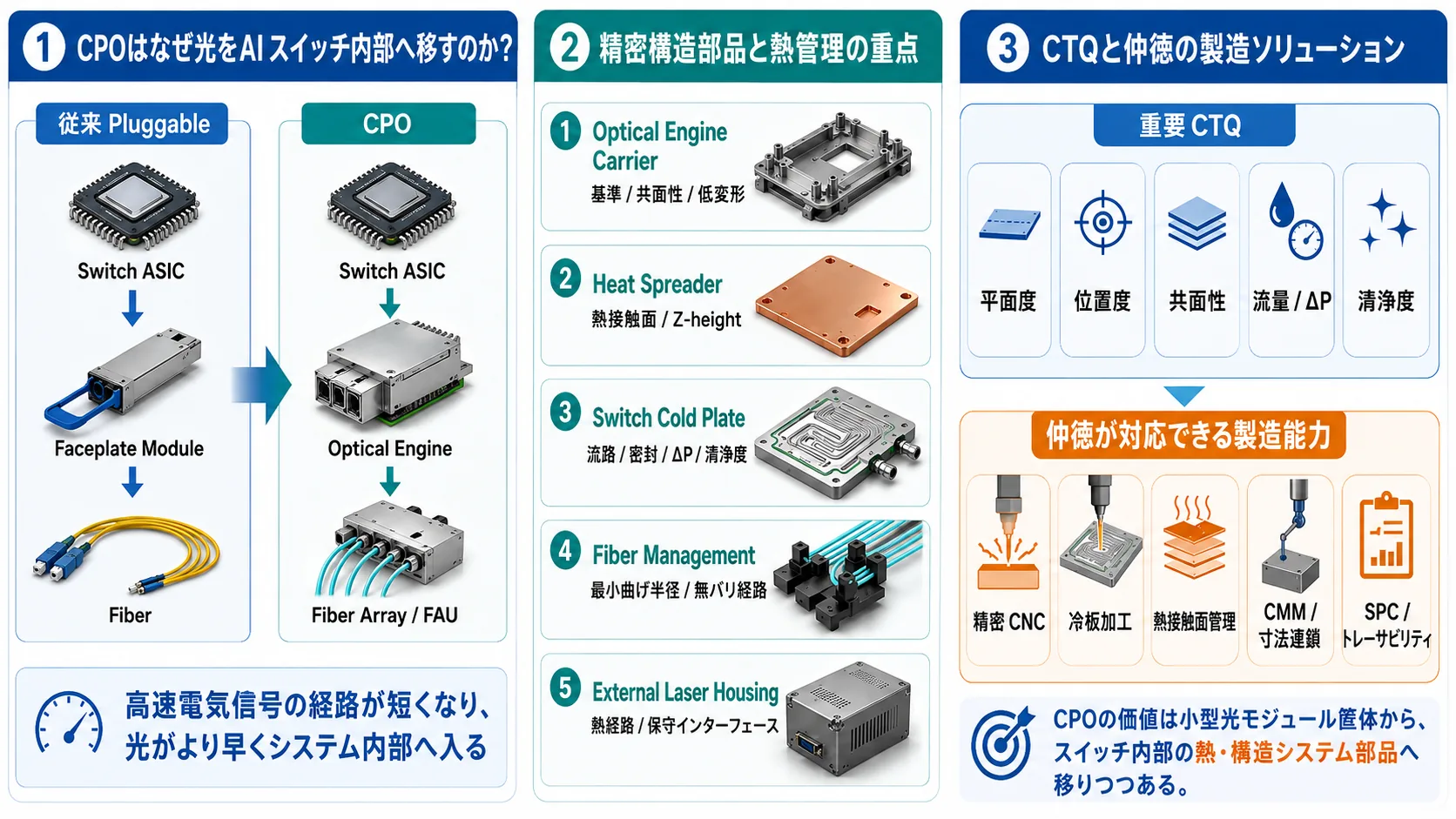
従来
Switch ASIC
  ↓ 長い高速電気経路
Faceplate
  ↓
Pluggable Optical Module
  ↓
Fiber

CPO
Switch ASIC
  │
  ├─ Optical Engine
  │      ↓
  └──── Fiber Array / FAU
         ↓
      Front Panel / Backplane
Corningは2026年7月、NPO/CPOがFiberをFaceplateの内側へ移し、Siliconから数mmの位置まで近づけると説明しています。BroadcomはCPOを、OpticsとSwitch Siliconを共通Package Substrate上に異種集積する方式として説明しています。
したがって機械部品の価値も移ります。
独立した小型モジュールハウジング中心
→ Optical Engine Carrier、Heat Spreader、Cold Plate、Fiber Management、System Datum中心
本文は2026年8月までの英語、中国語、日本語、ドイツ語、フランス語の公開情報を横断し、Corning、Broadcom、NVIDIA、TrendForce、TE Connectivity、GlobalFoundries、Fraunhoferなどを重点確認しています。CPOはメーカーごとに光源、冷却、Fiber Attach、保守境界が異なります。特定企業の構造を業界共通仕様とは扱わず、仲徳と本文中企業の供給関係を示すものでもありません。
Corning: Why Scalable CPO Must Be Built as a System
1. なぜ光学をスイッチ内部へ移すのか
従来のプラガブル光モジュールは明確な機械境界を持ちます。
Switch ASIC
→ PCB高速配線
→ Front-panel Connector / Cage
→ Optical Module
→ Fiber
保守性、多ベンダー化、標準化では優れています。
しかしSerDesとSwitch Capacityが上がると、ASICからFaceplateまでのPCB、Via、Connector、Cage、Module InterfaceでLossとReflectionが増え、DSP/RetimerのPowerも増えます。
CPOはOptical EngineをASICと同じPackage Substrateまたは極近傍へ置き、
高速電気経路を早く終わらせ、長距離を光に任せる
ことが狙いです。
Broadcomは51.2T、102.4TのCPO Switch Platformを公開し、Path Loss、Power、Bandwidth Densityを主要価値として示しています。
2. CPOは機械境界を描き直す
| 境界 | Pluggable | CPO |
|---|---|---|
| 光電変換 | Front-panel Module | ASIC近傍のOptical Engine |
| 熱管理 | Module単位 | ASIC + OE共同設計 |
| Fiber入口 | Moduleへ直接 | Fiber/FAUがChassis内部へ |
| Mechanical Datum | Module Envelope / Cage | Package / Carrier / Cold Plate / Chassis |
| Service | Module交換 | OE / Laser / Fiber / Systemを共同設計 |
| 精密金属部品 | Housing / Base / Heatsink | Carrier / Heat Spreader / Cold Plate / Supports |
つまり「ハウジングがなくなる」のではなく、
機械価値が小型独立Moduleから、より統合されたOptical–Thermal–Mechanical Systemへ移る
という変化です。
3. 五言語の調査で繰り返し現れる3つの量産課題
Fiber Alignment
TrendForceは2026年CPO量産の主要障壁としてFiber Alignment、Thermal Management、Testing Costを挙げています。
FraunhoferもPIC PackagingでPIC–Fiber、Laser–PICのAlignmentとThermal Sensitivityを重要課題としています。
重要なのは:
最終光結合精度とMetal CarrierのCNC精度は同じではない
ことです。
微細光学AlignmentはPhotonics Packagingが担い、Metal Carrierはそれを保つ一次機械Datumを提供します。
Thermal Management
CPOでは:
High-Power Switch ASIC
        ↓
Shared Package
        ↓
PIC / EIC / Optical Engine
となるため、Module単体冷却から
ASIC + OE + Package + Heat Spreader / Cold Plate
の共同熱設計へ移ります。
NVIDIAはLiquid-Cooled CPO Switchを公開し、Switch SiliconとOnboard Photonicsを同一の冷却アーキテクチャで冷却しています。
NVIDIA: Silicon Photonics Networking
Fiber Routing
CorningはCPOをFaceplate-to-SiliconのSystemとして設計すべきだと説明しています。TE ConnectivityのOFC 2026展示もCPO/NPO Socket、FAU、External Laser、Optical Backplane、Liquid Coolingを一体で扱っています。
Fiber Managementは曲げ半径、Strain、Service、Cold Plate/Tubing Clearance、Assembly Sequenceへ直接関係します。
4. 精密加工対象の優先順位
| Part | Function | CNC適合度 | 判断 |
|---|---|---|---|
| Optical Engine Carrier / Frame | 一次機械Datum | 高 | Coplanarity、Stiffness、Low Distortion |
| Heat Spreader / Thermal Lid | 熱をCold Plateへ伝達 | 高 | Contact SurfaceとZ-height |
| Switch Cold Plate | ASIC/OE周辺を冷却 | 高 | Channel、Flatness、Seal、ΔP、Cleanliness |
| Liquid Interface Block | Cold PlateとLoop接続 | 高 | Port、Seal、Internal Passage |
| External Laser Housing | CW Laser構造と熱経路 | 中高 | Thermal / Connector / Service |
| Fiber Management Metal Frame | Fiber Route保護 | 中 | Burr-Free、Stiffness、Service |
| FAU Fine Alignment | 最終光結合 | 低〜中 | Photonic Packaging主体 |
| Chassis / Faceplate | System Envelope | 中低 | Sheet Metal/Die Casting主体 |
狙うべきは「Nanometer Alignment加工」ではなく、
Photonics Packagingで作られたAlignmentを保持する機械・熱基準
です。
5. Optical Engine CarrierのCTQ
| CTQ | 意味 |
|---|---|
| Datum Flatness | OE姿勢と局部荷重 |
| Coplanarity | 複数OEのZ-height |
| Pocket / Step Height | Packageとの相対高さ |
| Hole Position | Assembly / Connector Path |
| Free-State Warpage | Fixtureによる見かけ合格を防止 |
| Final Dimension after Finish | Anodizing/Plating後の寸法 |
| Stiffness | Cold Plate荷重で変形しない |
| Cleanliness / Burr | Optical Zoneの保護 |
すべての公差を厳しくするのではなく、Functional Stackから真のCTQを決めるべきです。
6. Heat Spreader / Cold Plateが中心部品になる理由
熱設計には:
- ASICの大熱量を早く排出;
- Optical Engineの温度変動とGradientを管理
という二つの目的があります。
Heat Spreader CTQ
- Thermal Contact Flatness;
- Roughness;
- Local Step Height;
- Coplanarity;
- Thickness;
- Cu/Al Interface;
- Coating/TIM Compatibility;
- Load Distortion。
Switch Cold Plate CTQ
- ASIC Contact Flatness;
- OE周辺Z-height;
- Channel Geometry;
- Seal Groove;
- Port Position;
- Leak / Proof Pressure;
- Flow / Pressure Drop;
- Burr / Particle;
- Cleaning Residue;
- Coolant Compatibility。
NVIDIA Q3450-LDでは2本のParallel Loopが使われ、Flow、Pressure、ΔP、Filtration、Coolant条件が公開されています。
数値はその製品固有ですが、CPO Switch Cold Plateがすでに実量産部品であることを示しています。
NVIDIA Q3450-LD Liquid-Cooling System
7. Fiber ManagementのCTQ
- 顧客指定Minimum Bend Radius;
- FAU/Connector前の方向;
- Slack;
- Clamp Position;
- Strain Relief;
- Cold Plate/UQD/Tubing/PCB Clearance;
- Service Path;
- Burr-Free Radius;
- Connector Cleanliness Protection。
重要なのは単純な±0.01 mmではなく、
Fiberを傷めず、Service可能で、Cooling Systemと共存できるRoute
です。
8. CPOの「精度」は3階層で考える
Level 1: Photonic Alignment
- PIC ↔ FAU;
- Laser ↔ PIC;
- Waveguide Coupling;
- Active Alignment。
Level 2: Precision Mechanical Datum
- Carrier Datum;
- Cold Plate Datum;
- Heat Spreader Z-height;
- Chassis/Mid-Plate Position;
- Fiber Connector Support;
- External Laser Interface。
精密CNCが最も価値を出せる領域です。
Level 3: System Envelope
- Sheet Metal;
- Die Casting;
- Extrusion;
- Injection Molding;
- Structural Assembly。
CNCはFunctional Interfaceへ集中させます。
9. Failure–Cause–Countermeasure
| Failure | Cause | Countermeasure |
|---|---|---|
| OE姿勢変化 | Carrier Warpage / Stack-up | Free-State Inspection、CMM |
| Thermal Hotspot | Spread/Cold Plate Flatness不足 | Contact Zone管理 |
| Thermal Cycle後Link Drift | CTE差 / Gradient | 材料・構造Review、Cycle後検証 |
| Fiber Micro-Bend | Clamp過大 / Radius不足 | Route Gauge、Rounded Edge |
| Fiber Damage | Burr / Particle | Deburring、Cleanliness |
| Cold Plate ΔP異常 | Channel Variation / Contamination | Flow CTQ、Cleaning |
| Leak | Seal / Port / Join不良 | Leak / Proof、Traceability |
| Finish後干渉 | Coating未考慮 | Masking、Compensation、Final Inspection |
| Grounding不良 | AnodizingがContactを覆う | Conductive Zone定義 |
10. CPOによる量産構造の変化
従来:
1 Module
→ Small Housing
→ Heatsink
→ Front-Panel Replacement
CPO:
1 Switch Package
→ Multiple Optical Engines
→ Shared Carrier / Mid-Plate
→ Shared Heat Spreader / Cold Plate
→ Multiple FAU / Fiber Harnesses
→ External Laser
→ System Cooling / Service
部品数が単純に増えるわけではありません。
しかしCarrierやCold Plate一つが複数OE、ASIC、Fiber Route、System Reliabilityを同時に左右するため、一部品あたりの機能価値は高まります。
11. 仲徳が狙うべき製造領域
仲徳はPIC/EIC/FAU Photonic Packaging Factoryではなく、
CPO向け精密金属構造・Thermal Management Supplier
として位置付ける方が現実的です。
Optical Engine Carrier / Frame
- Aluminum Precision CNC;
- Multi-Datum Machining;
- Thin-Wall / Low-Distortion;
- Position / Coplanarity;
- Surface Treatment後Final Inspection;
- CMM Stack-up。
Heat Spreader / Thermal Base
- Thermal Contact Finish;
- Flatness / Roughness;
- Local Step;
- Cu/Al Structure;
- Masking;
- Free vs Assembly State。
Switch Cold Plate / Liquid Interface
Customer Drawingに基づき:
- CNC Channel;
- Base/Cover;
- Seal Groove;
- Interface Block;
- Deburring / Cleaning;
- Leak / Proof / Flow / ΔP CTQ;
- Liquid-Cooling Structural Assembly。
接合方法とTest条件はCustomer-approved Designに合わせます。
Fiber Management Metal Structure
- Metal Guide Frame;
- FAU/Connector Support;
- High-Stiffness Bracket;
- Cold Plate/Tubing Clearance;
- Burr-Free Radius;
- Assembly Gauge。
最終Active Optical Alignmentを一般CNC能力として表現すべきではありません。
12. 推奨Manufacturing Control Chain
Customer Optical / Thermal Architecture
↓
Functional Boundary
↓
CTQ + Datum Review
↓
DFM
↓
Prototype
↓
Free-State + Assembly-State Validation
↓
Surface Treatment
↓
Final Dimension / Flatness / Cleanliness
↓
Cold-Plate Functional Test if Applicable
↓
DVT / PVT
↓
SPC + Traceability| CTQ Layer | Control |
|---|---|
| Mechanical | Flatness、Position、Coplanarity、Z-height、Warpage |
| Thermal | Contact Surface、TIM、Channel、Flow/ΔP |
| Liquid | Seal、Leak、Proof、Cleanliness |
| Fiber-Safe | Route、Radius、Burr、Clamp、Connector Support |
| Surface | Coating、Masking、Conductive Zone |
| Production | Fixture、Tool Life、SPC、Traceability |
13. RFQで必要な入力
| Input | 内容 |
|---|---|
| Architecture | CPO/NPO Type、OE数量/位置 |
| Datum | Package/Carrier/Cold Plate/Chassis Datum |
| Optical Boundary | FAU/Fiber/Connector位置、Routing |
| Thermal | ASIC/OE Power、Hotspot、TIM |
| Cold Plate | Coolant、Flow、ΔP、Pressure、Leak、Cleanliness |
| Material | Al、Cu、SUS、Coating/Plating |
| Surface | Thermal Contact、Ground、Masking、Wetted Surface |
| State | Free State / Assembly State |
| Reliability | Thermal Cycle、Vibration、Fiber Service |
| Volume | Prototype、EVT/DVT/PVT、Annual Volume、SPC |
良いDFMは全寸法を高精度化することではなく、Optical、Thermal、Liquid、Assemblyを決める少数のCTQを特定することから始まります。
よくある質問
CPOはなぜ光エンジンをスイッチのフロントパネルからASIC近傍へ移すのですか?
主な目的は高速SerDesの電気経路を短くすることです。従来のプラガブル構成では、信号がSwitch ASICからPCB、コネクタ、フロントパネルを通って光モジュールへ入ります。Lane Rateが上がるほど挿入損失、等化、消費電力が大きな課題になります。CPOは光エンジンをASICと同じパッケージまたは極近傍に置き、電気信号をより早い段階で光へ変換します。
CPOが普及すると従来の光モジュールハウジングのCNC需要はなくなりますか?
すぐになくなるわけではありません。プラガブル、LPO、NPO、CPOは用途と保守方式に応じて長期間併存すると考えられます。ただし本格的なCPOスイッチでは、フロントパネルの小型ハウジングより、光エンジンCarrier、Heat Spreader、Cold Plate、Fiber Management、外部レーザー構造、システム取付インターフェースの価値が高まります。
CPOの光学アライメントでは金属CNC部品にナノメートル精度が必要ですか?
通常その理解は適切ではありません。PICとFAUの最終光結合は、フォトニクス封装、Active/Passive Alignment、専用装置、接着や接合工程が担うことが一般的です。金属CNC部品の重要な役割は、平面度、位置、剛性、熱安定性を持つ一次機械基準を提供し、後工程や熱サイクルで微細な光学アライメントを崩さないことです。
CPOでSwitch Cold Plateと液冷インターフェースが重要になるのはなぜですか?
光エンジンが高出力Switch ASICに近づくと、ASIC、光学素子、周辺電子部品が強く熱結合します。高性能空冷を使うCPOもありますが、NVIDIAはオンボードのシリコンフォトニクスを液冷するCPOスイッチを公開しています。そのためCold Plateの平面度、流路、圧力損失、シール、清浄度、材料適合性がシステムCTQになり得ます。
CPO精密構造部品の量産で起こりやすい故障は何ですか?
Carrierの反りによる光エンジン姿勢と熱接触の変化、Heat SpreaderやCold Plateの平面度不足によるTIM厚さの偏り、表面処理膜厚によるZ-height変化、Fiber Guideのバリによるマイクロベンドや損傷、ClampによるFiber応力、Cold Plate内部の粒子や残液による流量変化、異種材料の熱膨張差による相対変位などが代表例です。
仲徳へCPO関連構造部品を見積依頼する際に必要な資料は何ですか?
2D図面、3Dモデル、部品がSwitch ASIC—Optical Engine—Fiber経路のどこにあるか、機械基準、組立Z-height、熱源と熱流経路、TIM条件、冷却方式、Cold Plate流量と許容圧力損失、気密・耐圧、清浄度、Fiber Pathと最小曲げ半径、表面処理、導電/Masking領域、Free StateまたはAssembly Stateの検査条件、試作数量、年間予定数量、信頼性検証条件を提示することが推奨されます。